DAY 1
Every Stone Is Arguing for Something
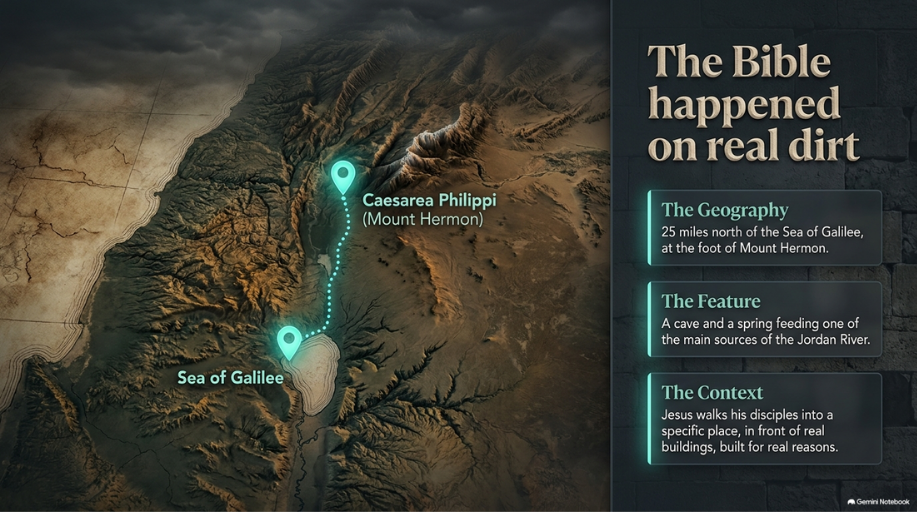
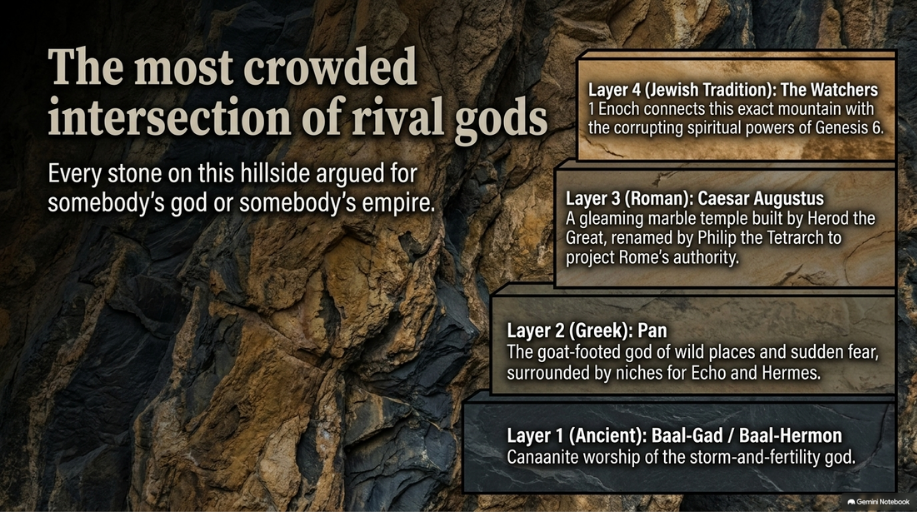
Caesarea Philippi was not a quiet place to ask a quiet question. Long before Jesus ever led his disciples there, the ground at the base of Mount Hermon had already been claimed a dozen times over: a cave and spring once dedicated to the Canaanite storm god Baal, later rededicated to Pan, and eventually crowned with a gleaming marble temple Herod built to honor Caesar Augustus. Old gods, new gods, an emperor’s temple, and a mountain with a dark reputation stretching back to Genesis, all crowded onto one small hillside. It was, quite literally, the most spiritually loaded intersection in the region.
And that is exactly where Jesus chose to ask his most important question. Not on a quiet mountaintop away from distraction. Not in the calm of the temple courts. He walked his disciples into the noisiest possible marketplace of rival claims and asked them, in front of every stone that was arguing for somebody else’s god, who they believed he was.
We still walk into our own Caesarea Philippi most weeks of our lives. Not a cave in northern Israel, but a noisy intersection of rival claims on our attention and our loyalty all the same. Money says it is the living god. Fear says it is. Certain politicians, certain platforms, certain versions of success say it, loudly, with their own temples built right out in the open where we cannot miss them. God does not wait for us to clear the noise away before he speaks. He asks his question right in the middle of it.
That is good news for anyone who has ever felt like their faith has to compete for airtime with everything else pulling at them this week. It does. It always has. The question was never whether the noise would be there. The question has always been whether we can still hear the true voice inside of it.
SCRIPTURE
Joshua 24:14-15. Now therefore fear Yahweh, and serve him in sincerity and in truth. Put away the gods which your fathers served beyond the River, and in Egypt, and serve Yahweh. If it seems evil to you to serve Yahweh, choose this day whom you will serve; but as for me and my house, we will serve Yahweh. (World English Bible)
FROM THE SERMON
| “Every stone around them is arguing for somebody’s god, or somebody’s empire, or both at once.”
— from the sermon “Do Not Go and Do Not Tell” |
REFLECTION
- What does it say about God that Jesus chose the most crowded intersection of rival gods in the region, rather than a quiet, sacred place, to ask his most important question?
- What are the “stones” in your own life right now, money, fear, comfort, the opinions of others, that are quietly arguing for your loyalty?
- Who in your life is standing at their own Caesarea Philippi this week, surrounded by competing voices, and needing someone to help them hear the true one?
PRAYER
Living God, you do not wait for quiet rooms or empty hillsides before you speak to us. You meet us in the noise, among the competing voices that ask for our worship every day. Quiet what does not deserve our loyalty, and steady what does. Help us hear your question clearly this week: who do we say that you are? We ask it together, and we wait for your answer to settle in us. Amen.
DAY 2
Revealed, Not Discovered
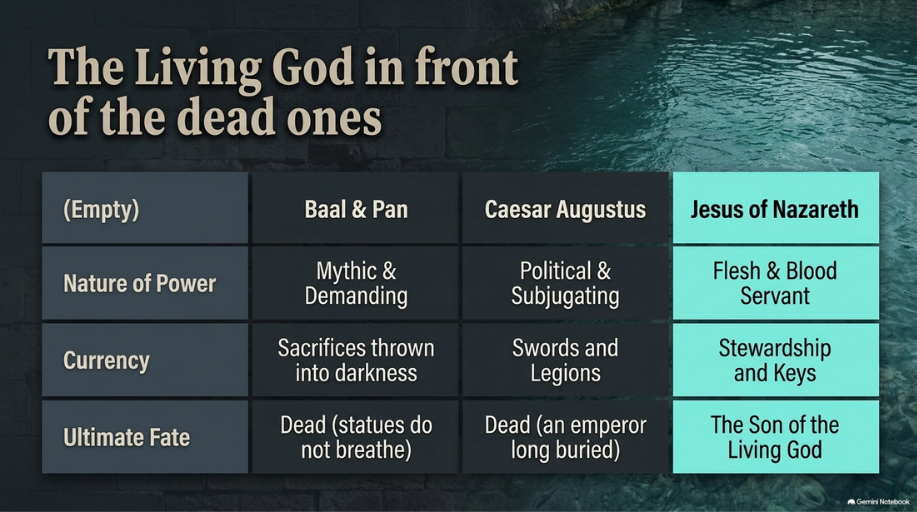
Picture where Peter is standing when he says it. Behind him, niches carved into a limestone cliff once held statues of gods who could not breathe. Across the valley stood a temple to an emperor who, however powerful in his lifetime, had already been dead for decades. Everywhere Peter looked, someone had built a monument to a god that could not actually live. And into all of that, Peter says the truest sentence in the chapter: “You are the Christ, the Son of the living God.” Not a story about God. Not a monument to God. The Son of the living God, standing in front of him in the shape of a Galilean carpenter’s son.
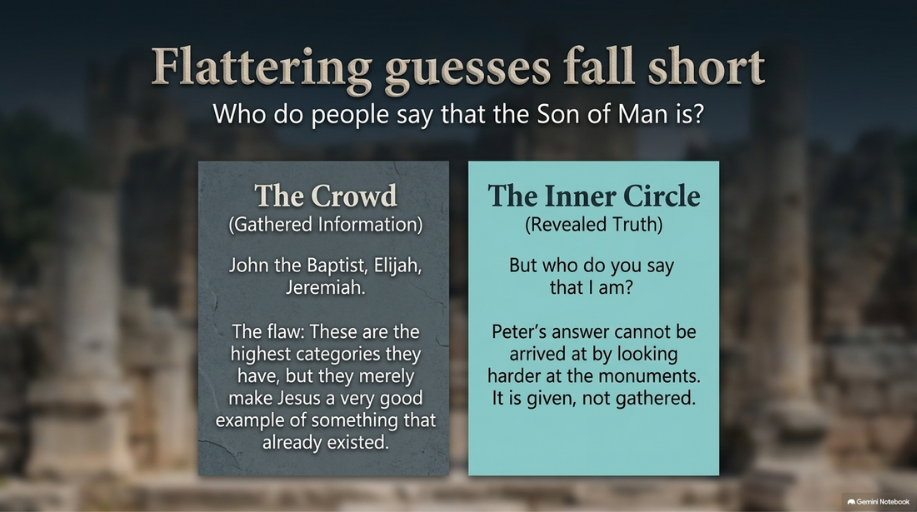
Jesus’s response to that confession matters just as much as the confession itself. “Flesh and blood has not revealed this to you, but my Father in heaven.” Peter did not out-argue anyone that day. He did not out-read the inscriptions on Herod’s temple or out-reason the priests of Pan. That kind of knowing was not available to him by looking harder at the evidence in front of him. It was given. Revealed. Only God can produce the truth Peter just spoke.
That should be a relief to every one of us who has ever felt responsible for arguing someone into faith. We can tell the truth. We can live it out loud. We can pray without ceasing. But we cannot manufacture revelation, because it was never ours to manufacture in the first place. The very ground the disciples were standing on, built stone by stone to make ultimate power visible and impressive, could not produce Peter’s confession. Only the Father could.
It should also humble us about our own faith. Whatever you believe about Jesus today, however settled or shaky that belief feels this week, it did not originate with your own cleverness. It was given to you. That is not a small thing to sit with.
SCRIPTURE
Matthew 16:16-17. Simon Peter answered, “You are the Christ, the Son of the living God.” Jesus answered him, “Blessed are you, Simon Bar Jonah, for flesh and blood has not revealed this to you, but my Father who is in heaven.” (World English Bible)
FROM THE SERMON
| “That kind of knowing is not information gathered. It is given. Revealed.”
— from the sermon “Do Not Go and Do Not Tell” |
REFLECTION
- If true knowledge of Jesus is revealed by God rather than reasoned out by us, what does that say about how faith actually works?
- Can you remember a moment when something about Jesus became suddenly, unmistakably true to you, in a way you could not have argued yourself into?
- Who do you know who is circling the truth about Jesus with good guesses, admiration, or curiosity, but has not yet received the deeper revelation? How might you pray for them this week rather than simply arguing with them?
PRAYER
Father in heaven, Peter’s confession was your gift before it was his achievement. We cannot reason our way to the truth about your Son; we can only receive what you choose to reveal. Open our eyes again this week to see Jesus clearly, not as one good example among many, but as the Son of the living God. And where someone we love is still circling that truth, do for them what only you can do. Amen.
DAY 3
The Gates That Cannot Hold
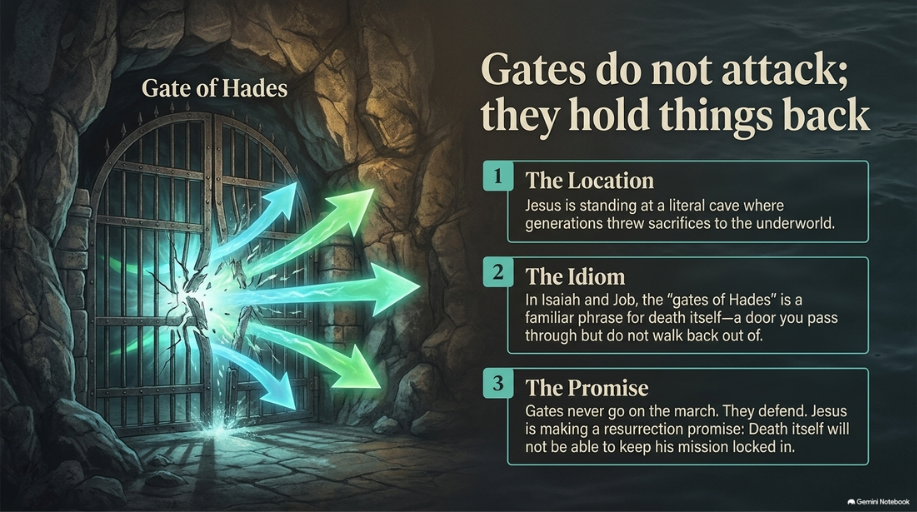
The cave behind Peter was not just a cave. Generations of people had called it the Gate of Hades, a doorway to the underworld where sacrifices were thrown into the darkness as offerings to whatever lived beneath the earth. It was, in every sense that mattered to the people standing there, a monument to the permanence of death. And it is precisely there, at that exact cave mouth, that Jesus says out loud that the gates of Hades will not prevail against what he is about to build.
Notice what gates actually do. They do not attack. Nobody has ever seen a gate go on the march. Gates defend. Gates hold something back. So when Jesus says the gates of Hades will not prevail against his mission, the picture is not the church storming hell’s front door, as much as we love that image in our hymns. The picture is closer to this: death itself, for all its ancient, cave-mouth, underworld menace, will not be able to hold the mission of Jesus back. Whatever door death has always been able to close, it will not be able to close on this.
That is a resurrection promise, spoken in front of the one landmark in the whole region built to memorialize that death is permanent. And it did not stay a promise spoken at a cave. Paul would later write to the church at Corinth that death itself would be swallowed up in victory, that the sting we fear so much would finally lose its power, because of what God accomplished through Christ.
Every one of us is carrying at least one door that feels permanently shut this week. Grief that has not lifted. A relationship that ended and did not get resolved. A diagnosis, a disappointment, a dream that quietly died somewhere along the way. This devotional is not asking you to pretend those doors do not exist. It is asking you to bring them, specifically, to the one whom even the Gate of Hades could not hold.
SCRIPTURE
1 Corinthians 15:54-57. But when this corruptible will have put on incorruption, and this mortal will have put on immortality, then what is written will happen: “Death is swallowed up in victory.” “Death, where is your sting? Hades, where is your victory?” The sting of death is sin, and the power of sin is the law. But thanks be to God, who gives us the victory through our Lord Jesus Christ. (World English Bible)
FROM THE SERMON
| “Whatever door death has always been able to close, it will not be able to close on this.”
— from the sermon “Do Not Go and Do Not Tell” |
REFLECTION
- How does understanding “gates” as defensive rather than as weapons change the way you picture the church’s mission in the world?
- What door in your own life feels permanently shut right now, and what would it look like to bring that specific closed door to Jesus this week?
- Who around you is living as though some door in their life is closed for good? How might you become a small sign to them that the gates of Hades do not get the last word?
PRAYER
Lord Jesus, you stood at the mouth of death itself and promised that no gate would hold back what you were building. We bring you the doors in our lives that feel permanently shut: grief, disappointment, endings we did not choose. Remind us this week that death could not hold you, and it cannot hold what you are doing in us. We wait in hope. Amen.
DAY 4
Keys, Not Conquest
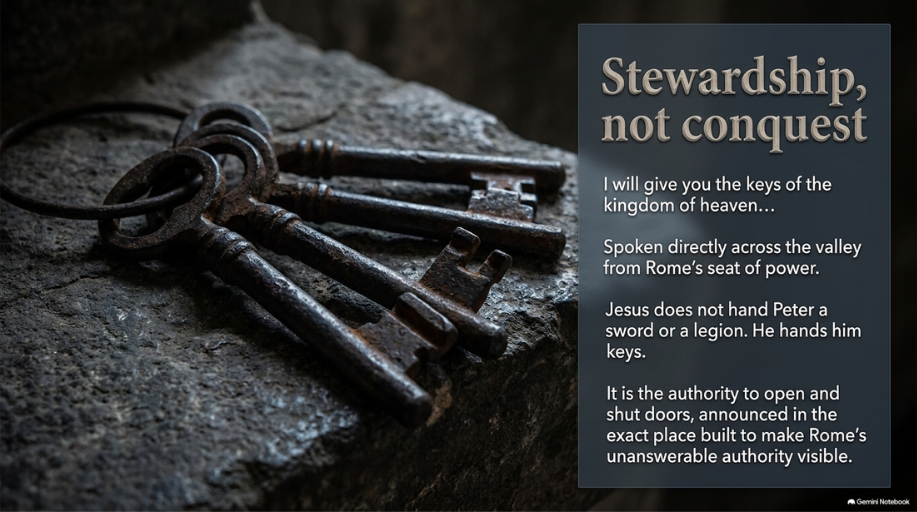
Remember where they are standing. This is Philip the Tetrarch’s capital, a town built to project Rome’s authority into the far edge of Jewish territory. Keys, binding, loosing, this is the vocabulary of who gets to open doors and who gets to shut them, spoken directly across the valley from the people who genuinely believed they held that authority over the land.
And in the middle of all that imperial machinery, Jesus does something almost startling in its restraint. He does not hand Peter a sword or a legion. He hands him keys. Stewardship, not conquest. A completely different kind of authority than every other kind on display that day, announced in the one place built to make Rome’s version of authority look unanswerable.
Jesus makes the same point again later, more plainly, when James and John’s mother comes asking for places of honor for her sons. “It shall not be so among you,” he tells the disciples. Whoever wants to become great must become a servant. Whoever wants to be first must become a slave to the rest. Because the Son of Man himself did not come to be served, but to serve, and to give his life as a ransom for many. Kingdom authority looks like a towel and a basin before it ever looks like a throne.
Most of us will never be handed a legion. But every one of us has been handed some kind of key: a position, an influence, a relationship, a platform, a gift. The question this passage puts to us is not whether we have authority. It is whether we are using it to open doors for other people, or to keep them closed.
SCRIPTURE
Matthew 20:26-28. It shall not be so among you, but whoever desires to become great among you shall be your servant. Whoever desires to be first among you shall be your bondservant, even as the Son of Man came not to be served, but to serve, and to give his life as a ransom for many. (World English Bible)
FROM THE SERMON
| “He is not handing Peter a sword or a legion. He is handing him keys. Stewardship, not conquest.”
— from the sermon “Do Not Go and Do Not Tell” |
REFLECTION
- Why do you think Jesus chose keys, the vocabulary of stewardship, rather than a sword, the vocabulary of conquest, to describe the authority he was giving his church?
- Where in your own life, at home, at work, or in this church, have you been tempted to use whatever authority you have to control rather than to serve?
- Whose door could you help open this week, a door of welcome, opportunity, forgiveness, or belonging, using whatever key God has placed in your hand?
PRAYER
God of the kingdom, you handed Peter keys, not a sword; you called us to serve, not to rule. Forgive us the times we have used what you gave us to control rather than to open doors for others. Make us stewards this week, not conquerors, quick to serve and slow to grasp for power. Amen.
DAY 5
Let Your Life Speak First
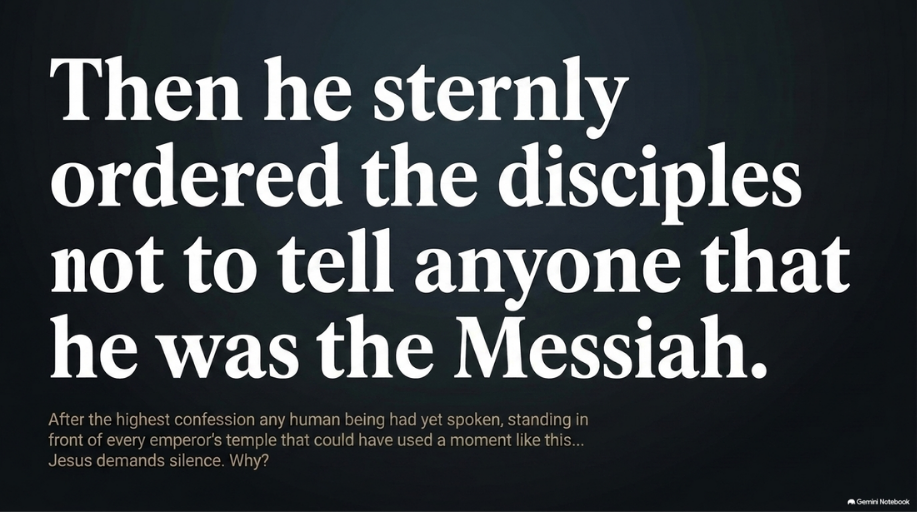
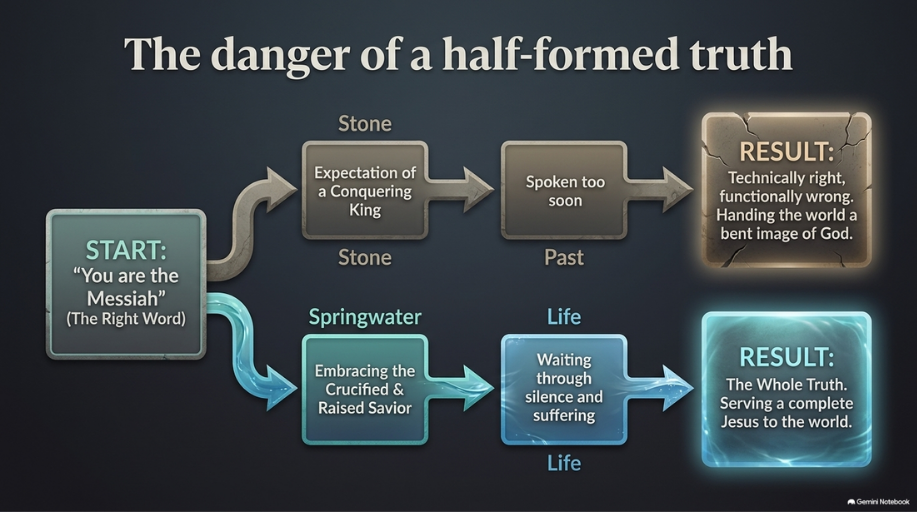
Right after the highest confession any human being had yet spoken about him, standing in front of every god and every emperor’s temple that could have used a moment like this one, Jesus tells his closest friends to keep quiet. Peter had the right word, Messiah, but not yet the full mission underneath it. Just a few verses later, when Jesus starts to teach that the Son of Man must suffer, be killed, and be raised, this same Peter pulls him aside and rebukes him for saying it. He still expected a conquering king, not a crucified savior.
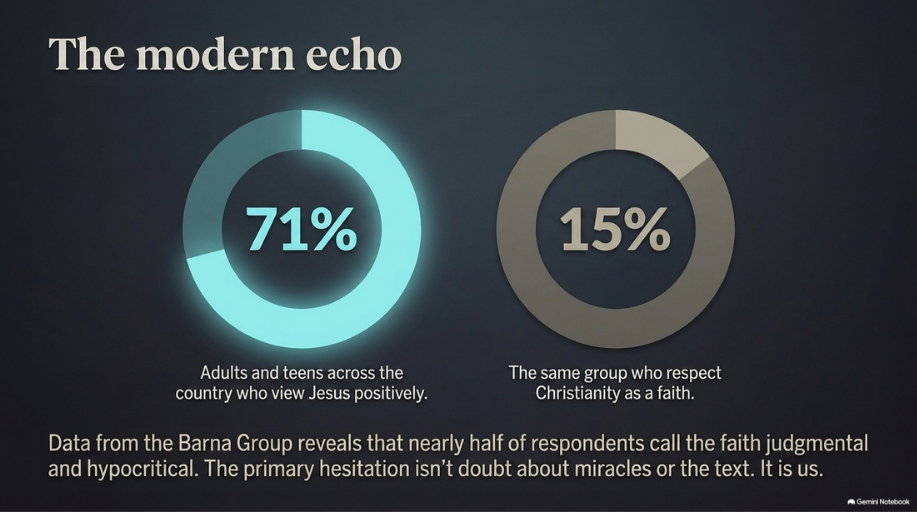
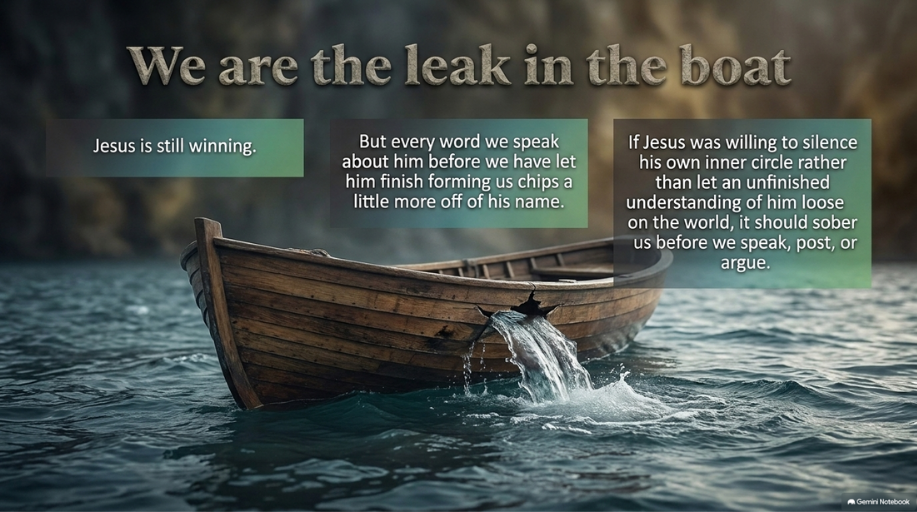
The Barna Group has put actual numbers on why that matters so much for us today. In a recent survey, seventy-one percent of adults and teens still view Jesus positively. But ask the same people about Christianity as a faith, the thing carried by people like us, and only fifteen percent say they respect it. Nearly half call it judgmental. Nearly half call it hypocritical. Jesus is still winning. We are the leak in the boat. Every one of us who says we follow him is telling somebody, every week, who he is, whether we mean to or not.
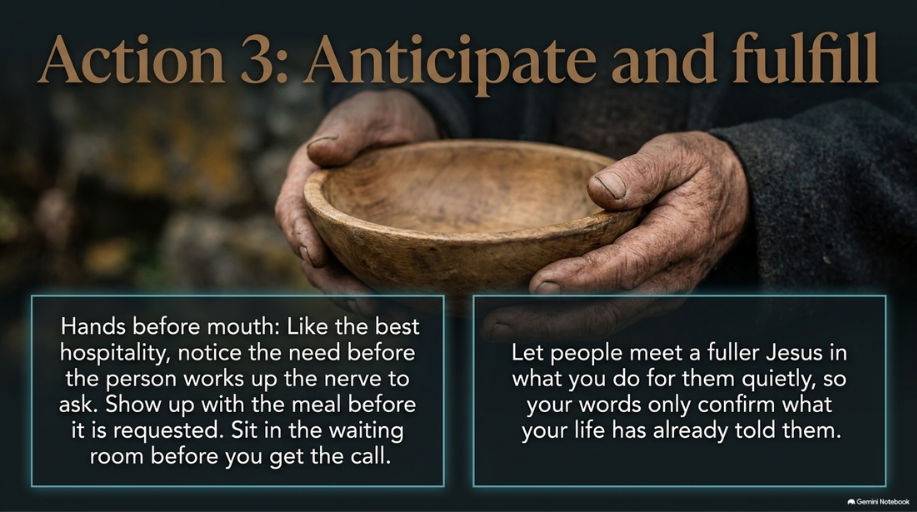
So what do we do with that? During years spent running hotels, staff were trained toward something called anticipate and fulfill: notice what a guest needs before they have worked up the nerve to ask for it, and be standing there with it already in hand. Nobody put that on a sign in the lobby. It just showed up, meal after meal, room after room, in a hundred small choices nobody announced. Peter, notice, eventually got to preach, and preach well. But first he had to learn to serve, to wash feet, to break bread, and to be broken himself, before his words could carry the whole truth about Jesus instead of just a piece of it.
That is the kind of witness worth practicing this week. Notice somebody before they ask. Show up with what is needed before it is requested. Let people meet a fuller Jesus in what you do for them quietly, and let your words, whenever they finally come, only confirm what your life has already told them.
SCRIPTURE
1 Peter 2:12. having good behavior among the nations, so in that of which they speak against you as evildoers, they may by your good works, which they see, glorify God in the day of visitation. (World English Bible)
FROM THE SERMON
| “Let your answer show up in your hands before it shows up in your mouth this week.”
— from the sermon “Do Not Go and Do Not Tell” |
REFLECTION
- Why might a half-formed understanding of Jesus, spoken too soon, do more damage than good news spoken later, once it has had time to become whole?
- Is there someone who may have met a smaller or more bent version of Jesus because of something you said or did before you were ready? What would one small step of repair look like?
- Who is one person this week you could notice before they ask, showing up with what they need before they have to request it, letting your actions say what your words have not yet earned the right to say?
PRAYER
Gracious God, before our lips ever mention your name, let our hands already be telling the truth about you. Show us the one person who needs to be noticed before they ask. Give us the patience to let our lives confirm what our words will one day get to say. And where we have handed someone a smaller Jesus than the real one, have mercy, and make it right. Amen.
PLEASANT VALLEY CHURCH OF THE BRETHREN
Who Do You Say That I Am?
Small Group Discussion Guide
Based on the sermon “Do Not Go and Do Not Tell” by Pastor Harry Jarrett · Matthew 16:13-20
SUMMARY
This week’s sermon takes us to Caesarea Philippi, a hillside crowded with rival claims to ultimate power: an old cave once dedicated to the Canaanite god Baal, later rededicated to Pan, and a marble temple Herod built to honor Caesar Augustus. Standing in the middle of all of it, Jesus asks his disciples, “Who do you say that I am?” Peter answers rightly: “You are the Christ, the Son of the living God,” a truth Jesus says was revealed to Peter by the Father, not discovered by Peter himself. Jesus then promises that the gates of Hades will not prevail against what he is building, and hands Peter keys rather than a sword, a picture of stewardship rather than conquest. Strikingly, Jesus then orders the disciples to tell no one, because a half-formed Messiah, announced too soon, does more damage than good news spoken once it has had time to become whole. The sermon closes with a challenge drawn from Barna Group research: most people still view Jesus positively, but view Christians and Christianity far more skeptically. The call this week is to let our answer to Jesus’s question show up in our hands, in quiet, faithful service, before it ever shows up in our mouths.
OPENING PRAYER
Living God, we gather tonight the way the disciples once stood at Caesarea Philippi: surrounded by competing claims on our attention and our loyalty. Quiet the noise in this room and in our hearts. Help us hear your question clearly: who do we say that you are? Give us honesty as we answer, patience as we listen to one another, and courage to let our lives, and not only our words, tell the truth about you this week. Amen.
ICE BREAKER
Think of a place that carries a lot of history or meaning for you, a hometown, a family homestead, a favorite trail, a room in a building you know well. Without over-explaining, describe that place in a sentence or two. What competing memories, associations, or claims does that place hold for you, good and hard alike?
KEY VERSES
Matthew 16:15-16. He said to them, “But who do you say that I am?” Simon Peter answered, “You are the Christ, the Son of the living God.”
Matthew 16:18. “I also tell you that you are Peter, and on this rock I will build my assembly, and the gates of Hades will not prevail against it.”
1 Peter 2:12. having good behavior among the nations, so in that of which they speak against you as evildoers, they may by your good works, which they see, glorify God in the day of visitation.
GROUP DISCUSSION QUESTIONS
- Pastor Harry described Caesarea Philippi as “the most crowded intersection of rival claims to ultimate power in the entire region.” What are the modern equivalents of that intersection in our own culture, or in your own life?
- Jesus asked the disciples what other people were saying about him before he asked what they themselves believed. Why might it matter that he asked it in that order?
- Peter’s confession, “You are the Christ, the Son of the living God,” is described as revealed rather than discovered. How does that change the way we think about helping someone else come to faith?
- The sermon reframes the “gates of Hades” as defensive rather than offensive: gates hold something back rather than attack. How does that shift change the way you picture the church’s mission in the world?
- Jesus gives Peter keys, not a sword, calling it stewardship rather than conquest. Where have you seen the church, or yourself, tempted to reach for conquest instead of stewardship?
- Why do you think Jesus ordered the disciples to keep silent about his identity immediately after Peter’s confession, especially given what happens just a few verses later when Peter rebukes Jesus?
- The Barna Group statistics cited in the sermon show that seventy-one percent of people still view Jesus positively, but only fifteen percent respect Christianity as practiced by believers. What is your honest reaction to that gap?
- Pastor Harry described “anticipate and fulfill” as a posture of noticing someone’s need before they ask. What would it look like for our group, or this church, to practice that this month?
LIFE APPLICATIONS
- Sit With the Question
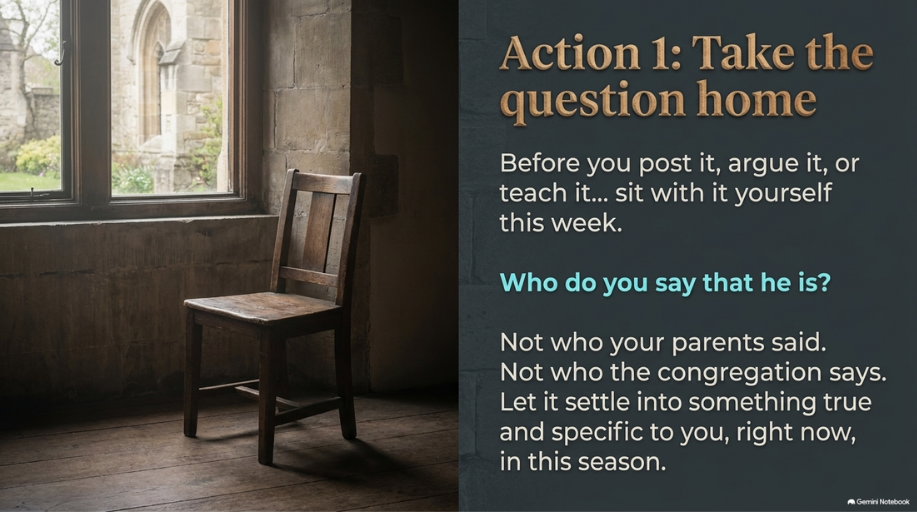
Before you post it, argue it, or hand it to someone else, take fifteen quiet minutes this week to write out your own honest answer to “Who do you say that I am?” Not who your parents said, not who this congregation has always said. Let it be specific to you, right now, in this season of your life.
| Check-In: Share one sentence from what you wrote, or one thing that surprised you about the process, at our next gathering. |
- One Small Step of Repair
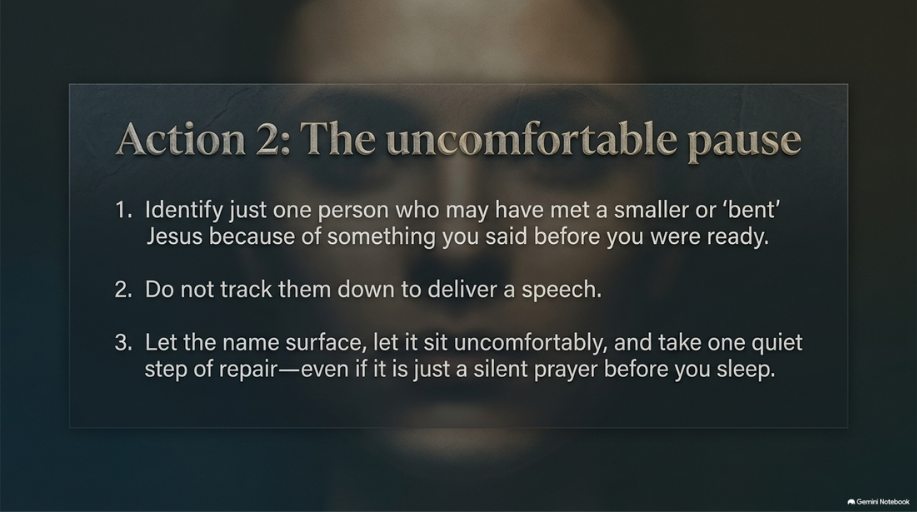
Let the name of one person surface, someone who may have met a smaller or more bent version of Jesus because of something you said or did before you were ready. You do not need to deliver a speech. Ask God to show you one small, humble step of repair, even if it is nothing more than praying for that person by name this week.
| Check-In: Without necessarily naming the person, share whether God brought someone to mind and what step, if any, you felt led to take. |
- Notice Before They Ask
Practice “anticipate and fulfill” this week. Choose one person, a neighbor, a coworker, a family member, and notice a need before they voice it. Show up with the meal before it is requested. Sit in the waiting room before you get the call. Let your actions say what your words have not yet earned the right to say.
| Check-In: Tell the group what need you noticed and what you did, or what got in the way of doing it. |
- Hand Someone a Key
Identify one door you have some ability to open for someone else this week, whether that is a welcome, an opportunity, a word of forgiveness, or simple belonging. Use whatever influence or position you have to open that door rather than to control it.
| Check-In: Report back on the door you tried to open and what happened when you did. |
KEY SERMON TAKEAWAYS
- God does not wait for quiet, uncontested spaces to speak to us; he asks his most important questions right in the middle of our noisiest competing loyalties.
- True knowledge of who Jesus is comes as revelation from God, not as a conclusion we argue our way into on our own.
- The gates of Hades are defensive, not offensive: death itself cannot hold back what Jesus is building, which is a resurrection promise, not a battle cry.
- Kingdom authority looks like keys and stewardship, not swords and conquest.
- A half-formed understanding of Jesus, spoken too soon, does more damage than good news spoken later, once it has had time to become whole.
- The biggest obstacle to faith today is often not unbelief in Jesus but disappointment in his followers; our lives preach a sermon every week whether we intend to or not.
CLOSING PRAYER
Gracious God, thank you for meeting us in the middle of our noise and asking us the question that matters most. Forgive us for the times our words have described you better than our lives have. Give each of us in this room the courage to sit with your question this week, the humility to repair what we can, and the patience to let our hands tell the truth about you before our mouths do. Build your church here, not with swords, but with keys, faithfully placed in ordinary hands. We ask this together, in the name of Jesus. Amen.
Share this entry
Interesting Links
Connect with Us
91 Valley Church Road
Weyers Cave, Virginia 24486
(540) 234-9921
office@pleasantvalleyalive.org
Our Office Hours
Office: Tuesday – Friday 8:30 AM – 12:30 PM
Pastor: Monday – Thursday 11:00 AM – 3:00 PM
Sunday Morning Schedule:
9:30 AM – Sunday School (September – May)
10:15 AM – Pre-Service Music
10:30 AM – Worship Service Begins