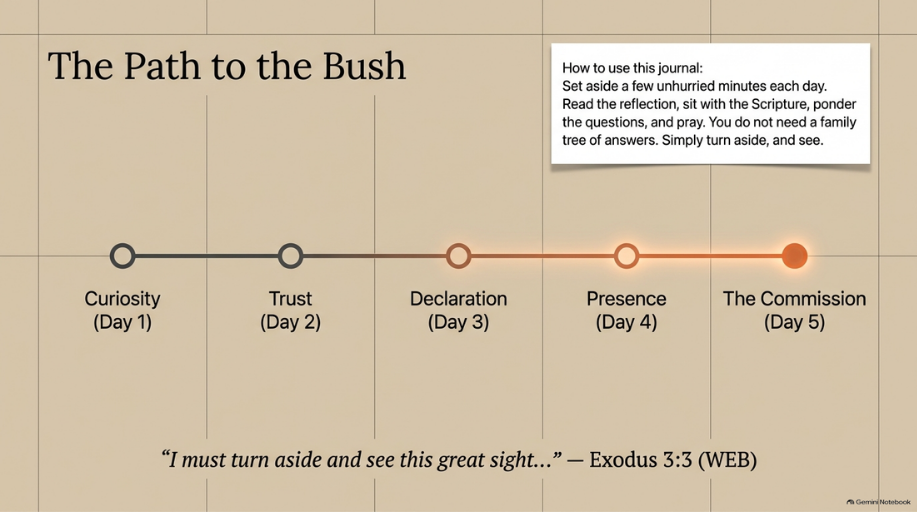
Day One
Curiosity Before Fear
Devotional
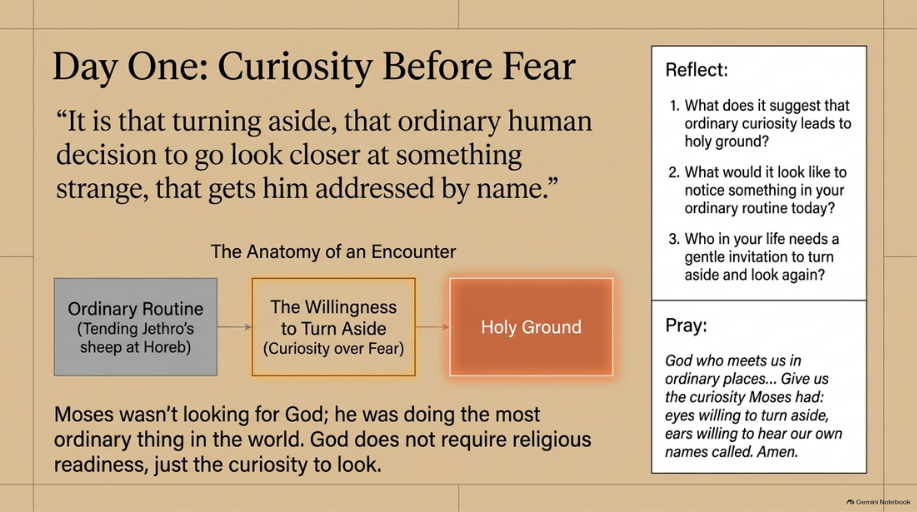
Moses is not looking for God the day the bush catches his eye. He is doing the most ordinary thing in the world, tending his father-in-law Jethro’s sheep, and the flock simply wanders out past the edge of the wilderness to a mountain called Horeb. Nothing about the morning suggests he is on the verge of meeting the living God. He is just working, the way he has worked a hundred mornings before.
And there, in a bush that has no business still being a bush, he sees fire that burns and burns and never once consumes what should be burning. What is remarkable is not first Moses’s fear, but his curiosity. He does not fall to his knees in terror. He simply decides, I must turn aside and see this great sight, why the bush is not burned up. Curiosity comes before fear. That is such a human, unremarkable decision: to go look closer at something strange.
And it is that ordinary decision, that small willingness to turn aside, that gets him addressed by name. Moses, Moses. The ground under his feet, ground he has walked a hundred times with these very sheep, is suddenly holy. Nothing about the geography changed. What changed was that Moses stopped, looked, and let himself be interrupted.
We are not usually handed burning bushes. But we are handed ordinary mornings, familiar routines, and moments strange enough to make us pause if we are willing to notice them. God does not require us to already be religious or ready. God simply asks that we be curious enough to turn aside and look. That is where holy ground so often begins.
Scripture
“I must turn aside and see this great sight, why the bush is not burnt.” (Exodus 3:3, WEB)
From the Sermon
| “It is that turning aside, that ordinary human decision to go look closer at something strange, that gets him addressed by name.” |
For Reflection
- Moses notices the bush before he is ever afraid of it; curiosity, not fear, opens the encounter. What does it suggest about God that ordinary curiosity, not religious readiness, is often what leads us toward holy ground?
- Think of the ordinary places you move through every day (your kitchen, your commute, your desk). What would it look like for you to actually notice something there today, the way Moses noticed the bush?
- Who in your life has stopped being curious about God, convinced they already know everything there is to know? How might you gently invite them to turn aside and look again?
Prayer
God who meets us in ordinary places, we confess how easily we walk past you, heads down, minds elsewhere, certain that nothing here is holy. Give us the curiosity Moses had: eyes willing to turn aside, ears willing to hear our own names called. Make the ground beneath us holy today, and give us the courage to notice it. In the name of Jesus, we pray. Amen.
Day Two
Called by Name, Standing on Holy Ground
Devotional
When the Lord sees that Moses has turned aside to look, God calls out to him, Moses, Moses. Not a title, not a general summons into the wilderness, but his own name, spoken twice. Before God gives Moses a single instruction, God gives him something more basic: recognition. He is not addressing a stranger. He is calling a man he already knows by name.
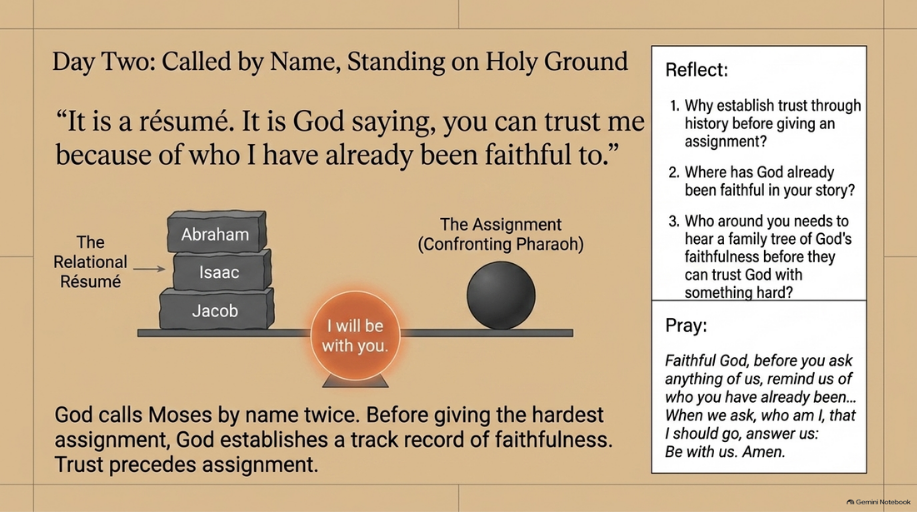
Then comes the command to remove his sandals, because the place has become holy ground, and then God does something worth slowing down for. God introduces himself, and the introduction is a family tree. I am the God of your father, the God of Abraham, the God of Isaac, and the God of Jacob. Three generations, named out loud. This is not a title, and it is not really a name either. It is a résumé. It is God saying, you can trust me because of who I have already been faithful to, because of the relationship I have already kept.
For a while, that is enough for Moses. It is enough right up until God tells him to go stand in front of Pharaoh and lead a couple hundred thousand enslaved people out of the most powerful empire on earth. That is when Moses starts asking the harder question: Who am I, that I should go? And God’s answer to that one is not a résumé either. It is a promise, spoken plainly: I will be with you.
There is a pattern worth carrying with us. God builds trust before God gives assignment. Before Moses is asked to do the hardest thing he has ever done, he is reminded of a long history of faithfulness that came before him and does not depend on him. Our own callings, however large or small, rest on the same kind of ground: not on our confidence, but on God’s track record of showing up.
Scripture
“Moreover he said, I am the God of your father, the God of Abraham, the God of Isaac, and the God of Jacob. Moses hid his face, for he was afraid to look at God.” (Exodus 3:6, WEB)
From the Sermon
| “It is a résumé. It is God saying, you can trust me because of who I have already been faithful to, because of the relationship I have already kept.” |
For Reflection
- God’s first move is not a demand but an introduction: I am the God of your father, the God of Abraham, the God of Isaac, and the God of Jacob. Why do you think God chooses to establish trust through a history of faithfulness before giving Moses an assignment?
- Where in your own story has God already been faithful, in ways you might be tempted to forget when a new, harder calling shows up?
- Who around you needs to hear the family tree of God’s faithfulness, a testimony, a memory, a story, before they will be ready to trust God with something harder?
Prayer
Faithful God, before you ask anything of us, remind us of who you have already been. Bring to mind the Abrahams and Isaacs and Jacobs of our own lives: the people, the seasons, the answered prayers that prove your track record. When we ask, who am I, that I should go, answer us the way you answered Moses. Be with us. In the name of Jesus, we pray. Amen.
Day Three
What Is Your Name?
Devotional
Moses asks a follow-up question, and it is worth noticing that he asks it at all. Suppose I go to the Israelites and say, the God of your ancestors has sent me to you, and they say to me, what is his name? What shall I say to them? Here is the question worth sitting with: why isn’t the God of your father, the God of Abraham, the God of Isaac, and the God of Jacob a good enough answer? It is true. It is impressive. Why does Moses need more?
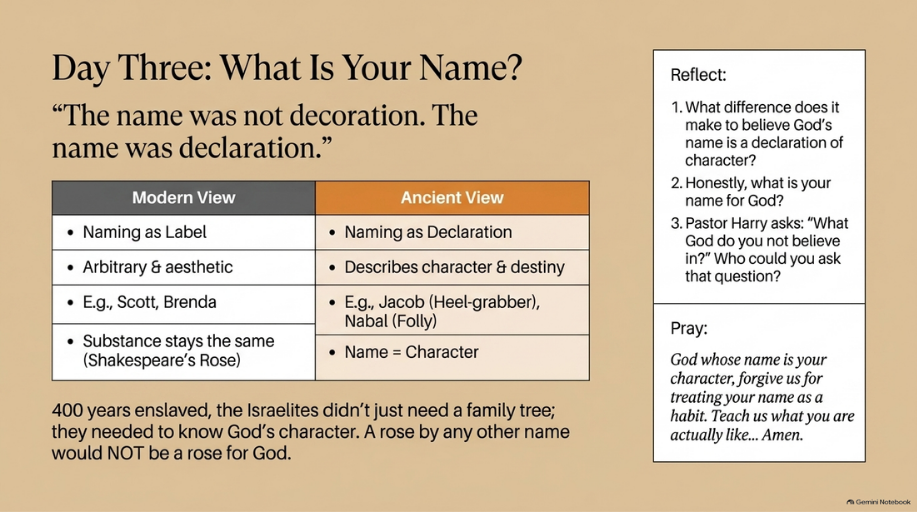
Because in the world Moses lived in, a name was not a label. It was a description of character. Jacob’s own name means something like heel-grabber, the one who takes another’s place, because he came out of the womb holding his twin brother’s heel, and it turned out to describe exactly the kind of man he would become. Later in the story, a man named Nabal refuses to help David and his men, and his wife says it flat out: as his name is, so is he. Nabal is his name, and folly is with him. The name was not decoration. The name was declaration.
That is not how naming works for most of us now. We pick a name for a baby because we like the sound of it, or it runs in the family, and Scott does not mean anything, and Brenda does not mean anything. You could swap them and nothing about the person changes. That is Shakespeare’s whole point when Juliet says a rose by any other name would smell just as sweet: the label is arbitrary, the substance stays the same no matter what you call it.
But that is why a rose, by any other name, would NOT be a rose, not for God. If God’s name doesn’t actually describe God’s character, then it is worthless, no matter how many patriarchs are attached to it. Moses’s people, four hundred years enslaved, did not need a family tree. They needed to know what God was actually going to be like when it counted, and so do we.
Scripture
“Moses said to God, Behold, when I come to the children of Israel, and tell them, ‘The God of your fathers has sent me to you,’ and they ask me, ‘What is his name?’ what should I tell them?” (Exodus 3:13, WEB)
From the Sermon
| “The name was not decoration. The name was declaration.” |
For Reflection
- In the ancient world, a name described character, not just identity. What difference does it make to believe that God’s name is a declaration of who God actually is, and not just a label we use out of habit?
- If someone asked you, honestly, what is your name for God, and what does that name actually mean to you, what would you say, and would your life back it up?
- For years, when someone has told Pastor Harry they do not believe in God, he has asked, ok, what God do you not believe in? Who in your life might you ask that same question, and what conversation could it open?
Prayer
God whose name is your character, forgive us for the times we have treated your name as a habit rather than a declaration. Teach us what you are actually like: faithful, present, near. Give us the honesty to ask what God we do and do not believe in, and the humility to let your true character reshape our assumptions. In the name of Jesus, we pray. Amen.
Day Four
I Am Present
Devotional
So God answers Moses. I AM WHO I AM. And then, say this to the Israelites: I AM has sent me to you. And then a third time, using the name that gets translated in our Bibles as the LORD: the LORD, the God of your fathers, this is my name forever. Preachers have spent centuries turning that phrase into a philosophy lecture: I am self-existent, I depend on nothing and no one. There is something true in that, but if you only hear the philosophy, you miss what Moses’s actual audience needed to hear.
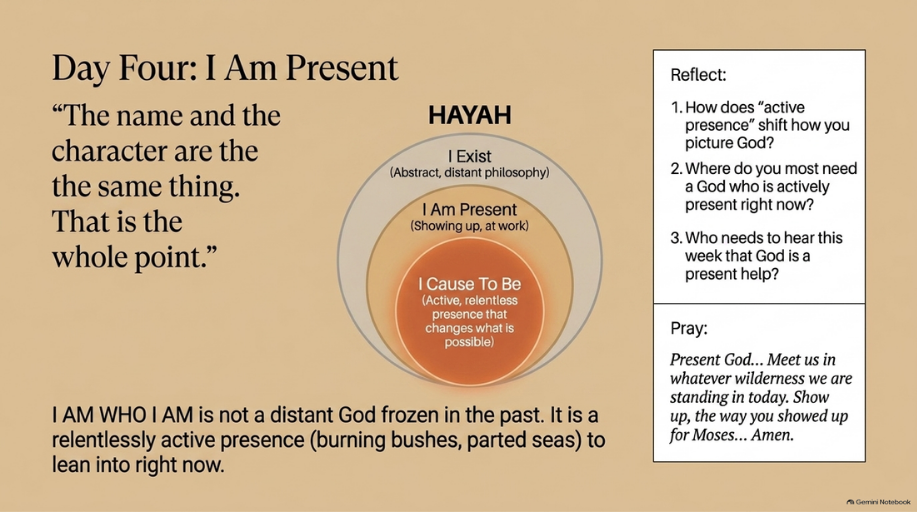
The Hebrew verb underneath I AM is hayah, to be, and scholars who have spent their careers with this word point out that in Hebrew, to be rarely means simple existence the way it does in English. It means active presence. Not I exist, in the abstract, but I am here, I am showing up, I am at work. One Old Testament scholar puts it this way: the closest paraphrase might not be I Am Who I Am so much as I Am Present. Some have even proposed a causative sense underneath it too, not just he is, but he causes to be: the God who brings things into being simply by showing up.
Hold both of those readings together for a second. He is. He causes to be. Either way you land, you are nowhere near a distant God frozen in the past. You are looking at a God who is relentlessly, actively present, and whose presence changes what is possible. This God does not just exist somewhere out past the stars, or just in the past. This God is about to show up: in a burning bush, in ten plagues, in a parted sea, in a pillar of fire that leads a people through the desert by night.
The name and the character are the same thing. That is the whole point. Whatever wilderness you are standing in this week, the same God who was about to show up for Moses is not a memory to look back on, but a presence to lean into right now.
Scripture
“God said to Moses, I AM WHO I AM, and he said, You shall tell the children of Israel this: ‘I AM has sent me to you.’” (Exodus 3:14, WEB)
From the Sermon
| “The name and the character are the same thing. That is the whole point.” |
For Reflection
- The Hebrew behind I AM suggests active presence, not simple existence: not I exist, but I am here, I am showing up, I am at work. How does that shift the way you picture God when you pray?
- Where in your life right now do you most need a God who is actively present, rather than distantly aware? Name it honestly, even if only to yourself.
- Who around you needs to hear, this week, that God is not a distant idea but a present help? What would it look like for you to be evidence of that presence in their life?
Prayer
Present God, we confess how often we treat you as a memory of what you once did rather than a presence at work right now. Meet us in whatever wilderness we are standing in today. Show up, the way you showed up for Moses, and make us people who carry that same presence to others. In the name of Jesus, we pray. Amen.
Day Five
The Name We Carry
Devotional
Most of us do not get names like the one God gave Moses to carry. Our own names do not describe our character, and neither do most of ours. If you had a baby this year, you probably picked their name because you loved how it sounded, not because you were making a theological claim about who they would become. That is not a failure. That is just how naming works for us now.
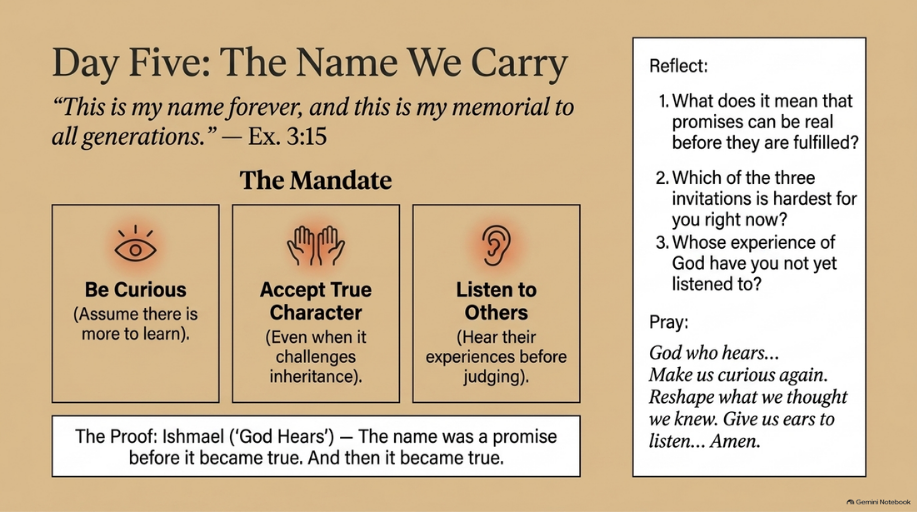
But the name of God we offer to others is very important to think about, because it is more than just a name. It holds a history, it describes a character, and it proclaims a presence that is either distant or near. It is no longer enough in our world to simply say God, or even Jesus. We have to say more about the character and presence for people to know who we are really talking about. So here are three things worth carrying into this week: become curious again, because if we believe we already know everything about God, we are mistaken. Accept who God actually says God is, even when it challenges what we’ve inherited. And ask others how they have experienced a present God, and listen before we judge.
Remember the boy named Ishmael, cast out into the wilderness with his mother, dying of thirst under a bush. His name meant God hears. And God heard him, right where he was, not where he should have been. The name was a promise before it ever became true. And then it became true.
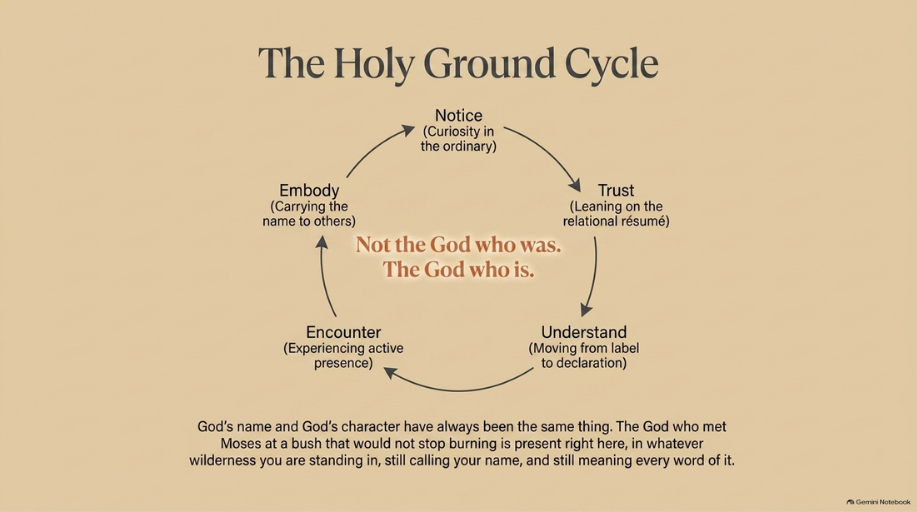
That is what we carry out of this week. Our own names are mostly just sounds we like. But the God who met Moses at a bush that would not stop burning does not have that problem. God’s name and God’s character have always been the same thing, and they still are. Not the God who was. The God who is: present, right here, in whatever wilderness you are standing in, still calling your name, and still meaning every word of it.
Scripture
“God said moreover to Moses, You shall tell the children of Israel this: ‘The LORD, the God of your fathers, the God of Abraham, the God of Isaac, and the God of Jacob, has sent me to you.’ This is my name forever, and this is my memorial to all generations.” (Exodus 3:15, WEB)
From the Sermon
| “The name was a promise before it ever became true. And then it became true.” |
For Reflection
- Ishmael’s name meant God hears, and it was a promise before it ever became true, and then it became true. What does it mean that God’s promises can be real before we are able to see them fulfilled?
- Of this week’s three invitations (become curious, accept who God says God is, listen to others before you judge), which is hardest for you right now, and why?
- Whose experience of God have you not yet taken the time to really listen to? What would it look like to ask them, and to listen without judging, before this week is over?
Prayer
God who hears, thank you for meeting us this week the way you met Moses: not as the God who was, but the God who is. Make us curious again. Reshape what we thought we knew about your character. Give us ears to listen to how others have experienced you before we judge. And wherever we are standing right now, in whatever wilderness, let us hear you calling our names, and know that you mean every word of it. In the name of Jesus, we pray. Amen.
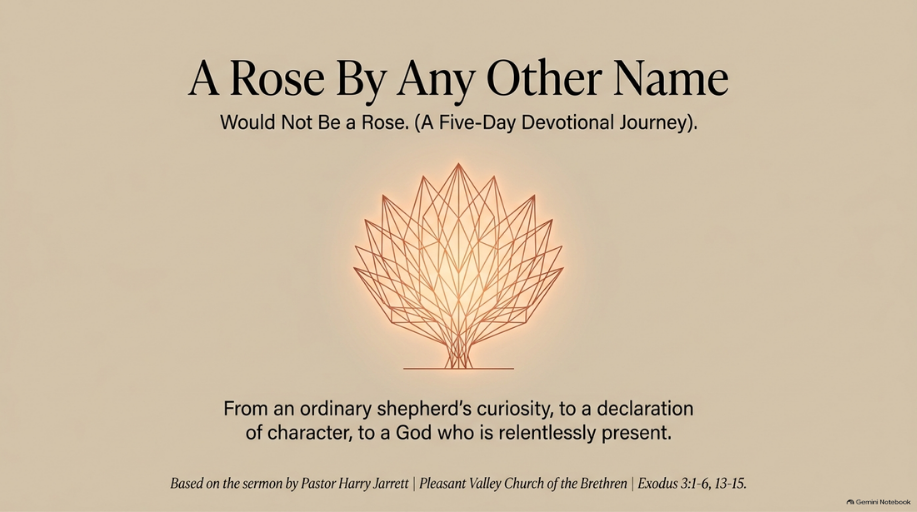
A Rose By Any Other Name Would Not Be a Rose
Small Group Discussion Guide
Based on the sermon by Pastor Harry Jarrett | Exodus 3:1-6, 13-15
Pleasant Valley Church of the Brethren · Weyers Cave, Virginia
Summary
This week Pastor Harry preached from Exodus 3:1-6 and 13-15, the story of Moses and the burning bush, under the title “A Rose By Any Other Name Would Not Be a Rose.” Moses wasn’t looking for God; he was tending sheep when ordinary curiosity led him to turn aside and notice a bush that burned without being consumed, and the ground beneath his familiar path suddenly became holy. God’s first words to Moses were an introduction built on history: “the God of Abraham, the God of Isaac, and the God of Jacob.” But when Moses asked for God’s actual name, so he would have something more than a family tree to carry back to an enslaved people, God answered, “I AM WHO I AM,” a name whose Hebrew root suggests not just existence but active, ongoing presence. Pastor Harry reminded us that in the ancient world names were declarations of character, not arbitrary labels the way they often are for us today, which is exactly why “the God of Abraham, Isaac, and Jacob” wasn’t enough on its own. Israel needed to know not just who God had been faithful to, but what God was actually going to be like when it counted. He closed by inviting us to three things: become curious about God again, accept who God says God is even when it challenges what we’ve inherited, and listen to how others have experienced a present God before we judge them, remembering that even a name like Ishmael’s, “God hears,” was a promise before it ever became true.
Opening Prayer
(Read aloud together, or led by one person.)
Present God, we turn aside from our ordinary week to gather here in your name. Meet us on this ground and make it holy. Teach us, as you taught Moses, that you are not the God who was, but the God who is: near, attentive, and at work among us. Open our hearts to hear you call our names. In the name of Jesus, we pray. Amen.
Ice Breaker
Share your name, and if you know it, what it means or why your parents chose it. Then answer: has anyone ever needed to learn your character before your name carried any weight with them, the way Pastor Harry described being known for years simply as “Beth’s husband” until people came to know him?
Key Verses
“I must turn aside now, and see this great sight, why the bush is not burnt.” (Exodus 3:3, WEB)
“Don’t come close. Take your sandals off of your feet, for the place you are standing on is holy ground.” (Exodus 3:5, WEB)
“I am the God of your father, the God of Abraham, the God of Isaac, and the God of Jacob.” (Exodus 3:6, WEB)
“God said to Moses, I AM WHO I AM.” (Exodus 3:14, WEB)
“This is my name forever, and this is my memorial to all generations.” (Exodus 3:15, WEB)
Group Discussion Questions
- Moses is doing the most ordinary thing in the world, tending sheep, when he notices a burning bush and it becomes holy ground. What does this tell us about the kind of moments God tends to use to get our attention?
- God’s first words to Moses are an introduction built on a family history: I am the God of your father, the God of Abraham, the God of Isaac, and the God of Jacob. Why might God choose to build trust through a history of faithfulness before ever giving an assignment?
- Pastor Harry said, the name was not decoration, the name was declaration. In the ancient world, a name described character. What is lost when we start treating God as a label instead of a description of who God actually is?
- The Hebrew behind I AM WHO I AM carries a sense of active presence: not just I exist, but I am here, I am showing up, I am at work. How does that change the way you picture God showing up in your own life?
- Pastor Harry shared how his own name carried real weight in one church and almost none in another, until people came to know his character rather than just his history. When has your own sense of identity or worth depended on whether people truly knew you, and not just your name?
- Where in your life right now do you most need to know that God is not a distant idea, but is actively present and at work?
- Pastor Harry described asking people who say they do not believe in God, ok, what God do you not believe in, and often finding common ground. How might curiosity, rather than defensiveness, change a hard conversation you have been avoiding?
- The sermon closes with the story of Ishmael, whose name meant God hears, a promise that came true. Who in your circle needs to hear that God has heard them, right where they are, and how could this group help carry that message this week?
Life Applications
| 1. Turn aside on purpose.
Choose one ordinary place or moment this week (a commute, a chore, a walk) and deliberately slow down to notice God there, the way Moses turned aside to look at the bush. Check-in: Come ready to name one ordinary moment that became, even briefly, holy ground. |
| 2. Trace your own family tree of faithfulness.
Write down three specific times God has been faithful to you or your family, the way God recited Abraham, Isaac, and Jacob to Moses. Check-in: Share one of your three moments with the group, and how remembering it might strengthen you for something hard ahead. |
| 3. Ask the honest question.
This week, ask someone (a friend, a coworker, a family member) what they actually believe about God, or what God they don’t believe in, and listen without correcting them first. Check-in: Report back on the conversation: what did you learn, and how did listening first change it? |
| 4. Practice presence.
Choose one person who is struggling and be present with them this week (a visit, a call, a meal, simply showing up) as a living reminder that God is not distant but near. Check-in: Tell the group who you visited and what it was like to be a small sign of “I Am Present” in their life. |
Key Sermon Takeaways
- Moses was not looking for God; he was doing ordinary work when curiosity, not fear, led him to turn aside and notice the burning bush.
- God’s first move with Moses was an introduction built on a history of faithfulness: the God of Abraham, the God of Isaac, and the God of Jacob.
- In the ancient world, names described character; a name was not decoration but declaration, the way Jacob’s name (heel-grabber) and Nabal’s name (folly) both matched the men who carried them.
- When Moses asks for God’s actual name, God answers, I AM WHO I AM, a name whose Hebrew root suggests active, ongoing presence, not simply I exist but I am here, I am showing up, I am at work.
- God’s name and God’s character are the same thing; this God shows up, in a burning bush, in plagues, in a parted sea, in a pillar of fire.
- Our own names rarely describe our character the way God’s name describes God’s, but the name of God we offer to others matters immensely; it carries history, describes character, and proclaims a presence that is either distant or near.
- Three invitations for this week: become curious about God again, accept who God actually says God is even when it challenges what we’ve inherited, and listen to how others have experienced a present God before judging them.
- Ishmael’s name meant God hears, and it was a promise before it ever became true; the same God who heard him in the wilderness is present, calling our names, in whatever wilderness we are standing in.
Closing Prayer
(Read aloud together, or led by one person.)
God who hears, thank you for meeting us in this time together, the way you met Moses at a bush that would not stop burning. Send us out carrying not just your name, but your character: your faithfulness, your presence, your nearness to whoever is struggling in this room and beyond it. Give us curiosity where we have grown certain, and ears to listen before we judge. We trust that you are not far off but present, right here, still calling us by name. Amen.