Day One
The Suitcase by the Door
Devotional
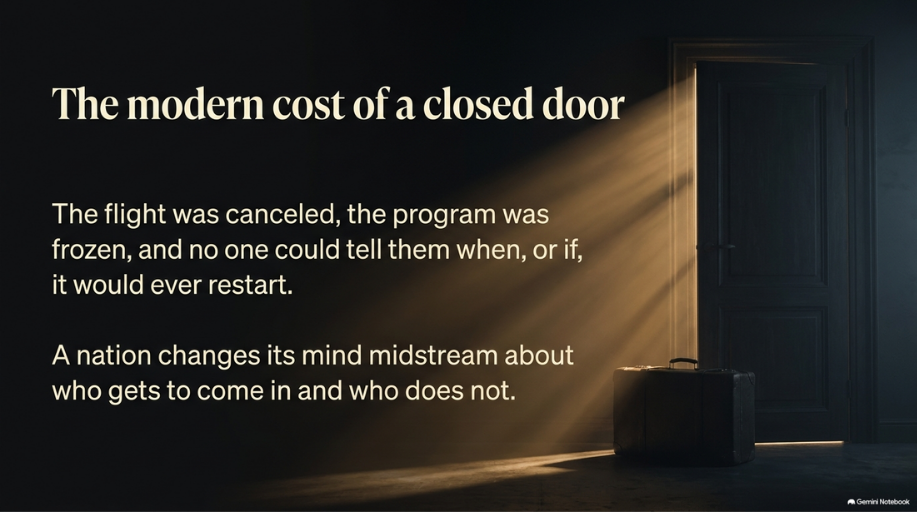
Somewhere this spring, a family finished the last of their paperwork. They had sold what they owned, given notice on their apartment, and said the goodbyes you say when you do not expect to come back. The flight was booked. Then came the call: the flight was canceled, the program was frozen, and no one could say when, or if, it would restart. Pastor Harry did not meet that family himself. He only heard a relief worker’s account of what happens when a nation changes its mind midstream about who gets to come in and who does not. But he has not been able to stop thinking about the suitcase already packed by the door.
Neither, perhaps, can we. Stories like this reach us now with startling regularity, and they tend to produce two reactions at once. The first is honest: outrage and deep sadness on the family’s behalf. The second is less noble, and we do not always say it out loud: relief that the decision was not ours to make. It is a strange kind of comfort, being appalled by someone else’s closed door while never having to open one ourselves.
Isaiah 56 opens with a command that refuses us that comfort. “Maintain justice and do what is right,” the prophet says, “for my salvation is near.” Not someday. Near. The command is active, not observational. God does not ask Israel to feel bad about injustice from a safe distance. God asks them to do something about it, because salvation, God’s own righteousness breaking into the world, is already on its way and will not wait for everyone to feel ready.
This is where our week begins: not with the far-off crisis in Isaiah’s Jerusalem, and not even with the headlines, but with our own two reactions, side by side. We are allowed to feel both the outrage and the relief. What we are not allowed to do, if we take this verse seriously, is stop at the relief. God’s righteousness is near, and it is asking something of us before it asks anything else: maintain justice, do what is right, right where you are.
Scripture
“Maintain justice and do what is right, for my salvation is near and my righteousness will soon be revealed.” (Isaiah 56:1, WEB)
From the Sermon
| “It is easier to be appalled by someone else’s closed door than to actually try and do something about changing the situation.” |
For Reflection
- Isaiah 56:1 pairs “maintain justice” with the nearness of God’s own righteousness. Why do you think God ties the doing of justice so closely to God’s own character, rather than treating it as a separate moral obligation?
- When you hear a story like the one of the family with their bags packed, which reaction comes first for you: outrage, relief, or something else, and what do you do with it after it passes?
- Where has “someone else’s closed door” become an easier target for your compassion than a door you actually have some say over?
Prayer
God of justice and mercy, we confess that it is easier to be moved by someone else’s closed door than to open one ourselves. Forgive the relief we feel when a hard decision is not ours to make. Your salvation is near, and your righteousness will not wait. Give us courage to maintain justice and do what is right, starting today, starting here. In the name of Christ, our advocate, we pray. Amen.
Day Two
An Argument as Old as the Rubble
Devotional
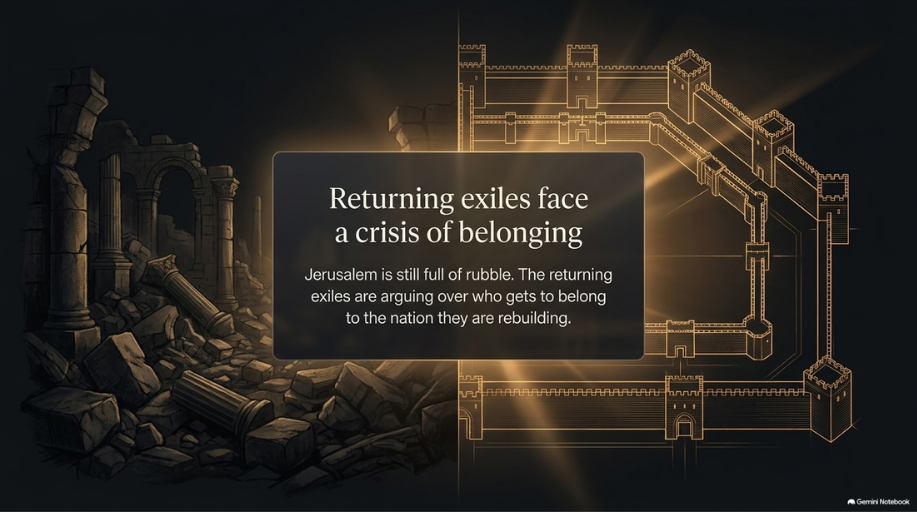
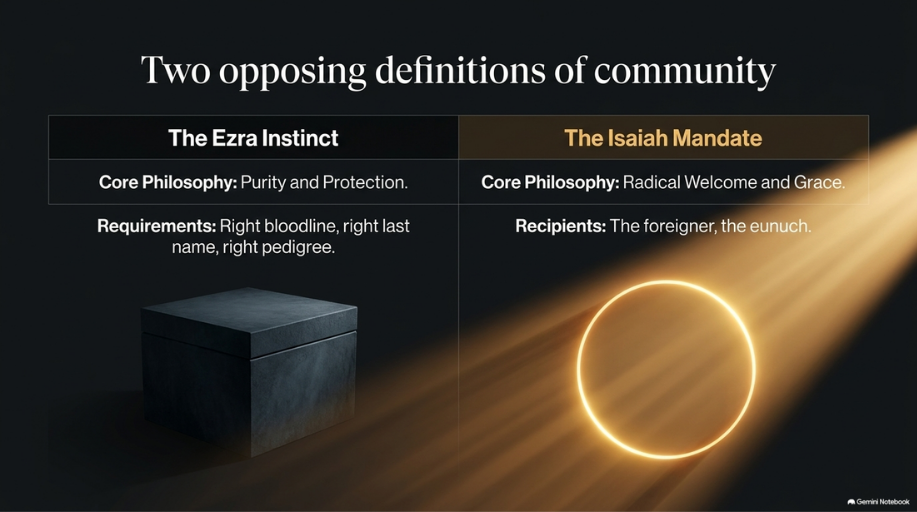
Isaiah 56 was written for a community facing exactly this kind of situation, though the details were different. The prophet we call Third Isaiah spoke to exiles newly returned from Babylon, standing in a Jerusalem still full of rubble, arguing over who got to belong to the nation they were rebuilding. Some of the returning exiles wanted tight borders: people with the right bloodline, the right last name, the right pedigree. You can read that argument in the book of Ezra, where foreign wives and their children are sent away in the name of purity. Isaiah 56 looks at the very same crisis and answers it in exactly the opposite direction.
It is worth pausing on how ordinary this argument was. These were not villains scheming in the dark. They were survivors, people who had lost everything once already, trying to rebuild something that would hold. Tight borders can feel, in a moment like that, like wisdom rather than fear. Isaiah does not mock that impulse. He simply refuses to let it have the final word. Blessed, he says, is not the one who guards the gate most carefully, but the one who holds fast to what God actually asks: justice, Sabbath faithfulness, a hand kept from evil. The blessing belongs to character, not to pedigree.
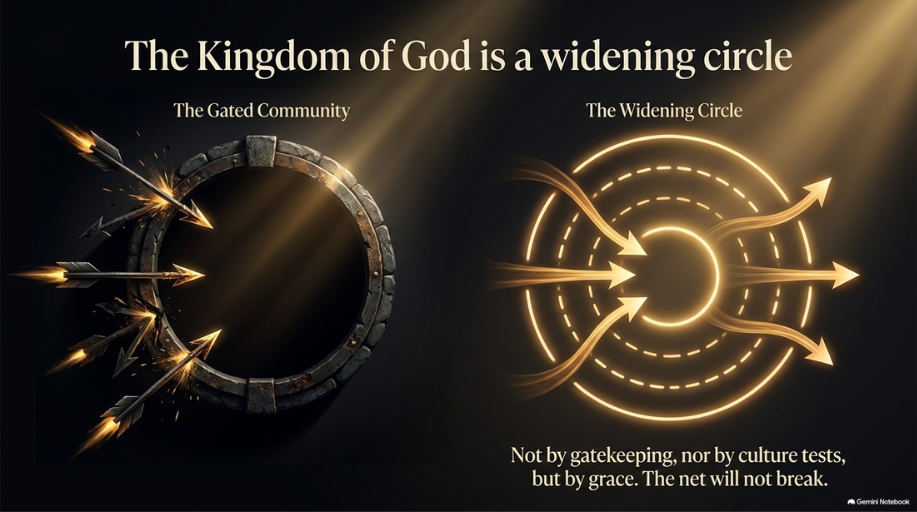
Every rebuilding project, whether it is a nation, a congregation, or a family, eventually faces this same fork. Do we protect what we have by narrowing who gets in, or do we protect it by living so faithfully that the circle can afford to widen? Isaiah’s answer, given to a people who had every reason to be defensive, was to widen it. That is not naivety. It is a different, harder kind of faithfulness, one that trusts God to hold what we build rather than trusting our own careful gatekeeping to hold it.
Scripture
“Blessed is the man who does this, and the son of man who holds it fast; who keeps the Sabbath without profaning it and keeps his hand from doing any evil.” (Isaiah 56:2, WEB)
From the Sermon
| “Some of the returning exiles wanted tight borders around it: with people who had the right bloodline, the right last name, and the right pedigree… Isaiah 56 looks at the same crisis and answers it in exactly the opposite direction.” |
For Reflection
- Isaiah answers the exiles’ anxiety about belonging not with looser rules but with a different definition of blessing altogether, holding fast to justice and Sabbath rather than bloodline. What does that tell us about what God actually values in a community?
- When have you, or a group you belong to, faced that same fork between guarding carefully and widening faithfully? Which did you choose, and how did it turn out?
- Where in our own congregation’s life right now might we be tempted toward tight borders instead of Isaiah’s harder faithfulness?
Prayer
God who rebuilds what rubble has broken, we confess how tempting it is to protect what we love by narrowing who belongs. Teach us Isaiah’s harder faithfulness: to hold fast to justice and mercy rather than pedigree, and to trust you to hold what we build. Make us a people blessed by character, not guarded by fear. In Jesus’ name we pray. Amen.
Day Three
You Will Not Be Cut Off
Devotional
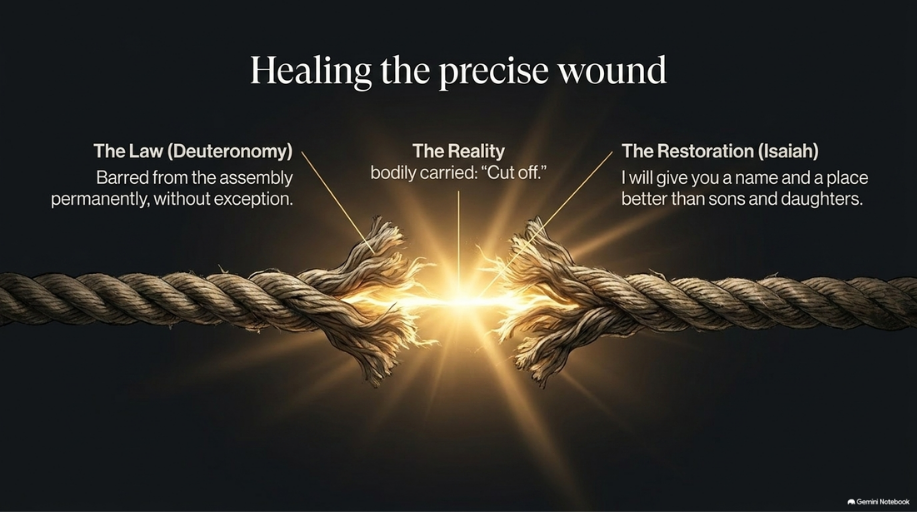
Notice who Isaiah names first in this passage: the foreigner, and the eunuch, someone the law in Deuteronomy would have barred permanently from the assembly, without exception. Here God says the reverse. Hold fast my covenant, and I will give you a name and a place better than sons and daughters. You will not be cut off. That phrase is not incidental. Cut off is the precise wound a eunuch carried bodily his whole life, the one word that named exactly what he had lost and exactly what the law said he could never have back. God does not offer vague comfort here. God speaks healing straight into the exact place the hurt happened.
We all carry some version of that wound: a specific word, a specific label, a specific way we have been told we do not fully count. Sometimes it was said to us outright. Sometimes we absorbed it quietly, from a family, a church, a culture that decided, without ever quite saying so, that people like us belonged somewhere near the edge. Isaiah 56 is not interested in speaking around that wound with generalities. It goes straight at it. Whatever your cut off has been, God says, it will not be the last word.
This is what makes Isaiah 56 more than a policy about immigration or inclusion. It is, underneath everything else, a promise about identity. The eunuch is not told to become someone else in order to belong. He is told that the very thing that marked him as excluded will become, in God’s house, a name and a memorial better than sons and daughters. God does not erase the wound. God builds a monument over it and calls it beloved.
Scripture
“Let no foreigner who has joined himself to Yahweh speak, saying, ‘Yahweh will surely separate me from his people.’ Do not let the eunuch say, ‘Behold, I am a dry tree.’ For Yahweh says… I will give them in my house and within my walls a memorial and a name better than of sons and of daughters. I will give them an everlasting name that will not be cut off.” (Isaiah 56:3-5, WEB)
From the Sermon
| “God does not offer vague comfort here. God speaks healing straight into the exact place the hurt happened.” |
For Reflection
- Why do you think God chooses to speak so specifically into the eunuch’s particular wound, “cut off,” rather than offering a general promise of belonging?
- What is the word or label that has made you feel cut off, and have you ever let God speak healing directly into that specific place?
- Who do you know who carries a “cut off” of their own, and what would it look like this week to speak Isaiah’s promise over them by name?
Prayer
God who names our wounds before we can name them ourselves, thank you that you do not offer vague comfort but speak healing straight into the place we hurt most. For all of us who have felt cut off, in ways large or small, spoken or silent: hold fast your covenant with us. Give us a name and a place in your house that no one can take away. In the name of Jesus, who was himself once cast out and then raised up, we pray. Amen.
Day Four
The Only Entrance Exam
Devotional
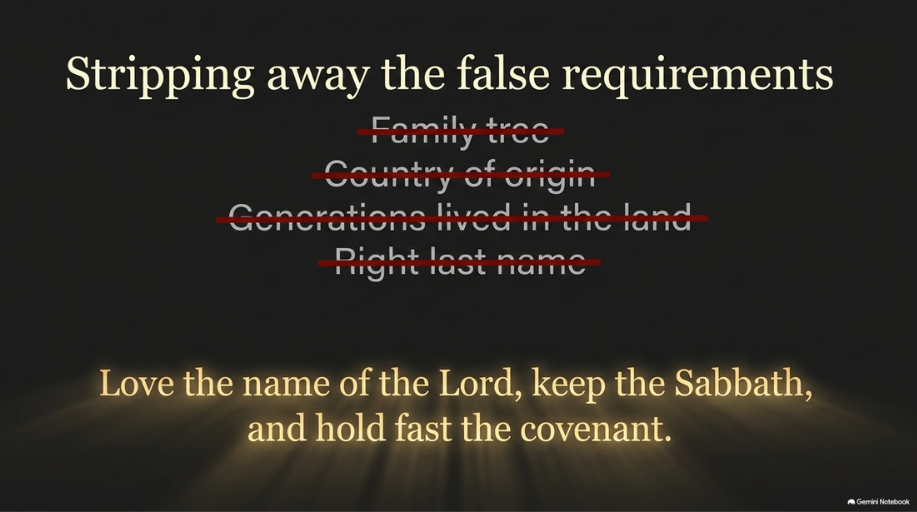
Then God speaks to the foreigners. Everyone who joins themselves to the Lord, who ministers to him, who loves his name. Isaiah does not mention their family tree, their country of origin, or how many generations their people have lived in the land. He gives one requirement, ethical rather than ethnic: love the Lord, keep the Sabbath, hold fast the covenant. That is the only entrance exam. There is no second question. And God’s own words are unmistakable: these I will bring to my holy mountain, and make them joyful in my house of prayer, for my house shall be called a house of prayer for all peoples.
It is worth sitting with how radical that single requirement actually is. Nearly every human system of belonging, ancient or modern, stacks up multiple entrance exams: where you were born, what you believe about a dozen secondary questions, whether you look and sound like the people already inside. Isaiah 56 strips all of that away and leaves one thing: do you love the name of the Lord? If the answer is yes, the door is open, and there is no follow-up question waiting behind it.
That kind of welcome is harder to live than it is to admire. We are practiced at adding entrance exams of our own, usually without noticing we are doing it. We ask, underneath our welcome, whether someone believed the right things growing up, or votes the way we do, or has been part of the church long enough to have earned a say. Isaiah 56 will not let us keep any of those questions. Love the name of the Lord, and even that is more invitation than exam, because God moves toward you long before you decide whether you love God back.
Scripture
“Also the foreigners who join themselves to Yahweh to serve him, and to love Yahweh’s name… I will bring these to my holy mountain, and make them joyful in my house of prayer… for my house will be called a house of prayer for all peoples.” (Isaiah 56:6-7, WEB)
From the Sermon
| “That is the only entrance exam. There is no second question.” |
For Reflection
- Isaiah reduces belonging to a single, ethical requirement rather than an ethnic or cultural one. What difference does it make that the entrance exam is about love and covenant faithfulness rather than pedigree or belief tests?
- What extra “entrance exams” have you, even unconsciously, added onto Isaiah’s one requirement, for yourself or for others?
- Who in your life is currently outside a door you have some power to open, and what would it look like to ask them only Isaiah’s one question?
Prayer
God whose house is called a house of prayer for all peoples, forgive us for the entrance exams we add to your one requirement. Strip away our extra questions. Teach us to ask only what you ask: do you love the name of the Lord? And give us the grace to remember that you moved toward us first, long before we knew how to answer. In Jesus’ name we pray. Amen.
Day Five
Fling the Doors Open
Devotional
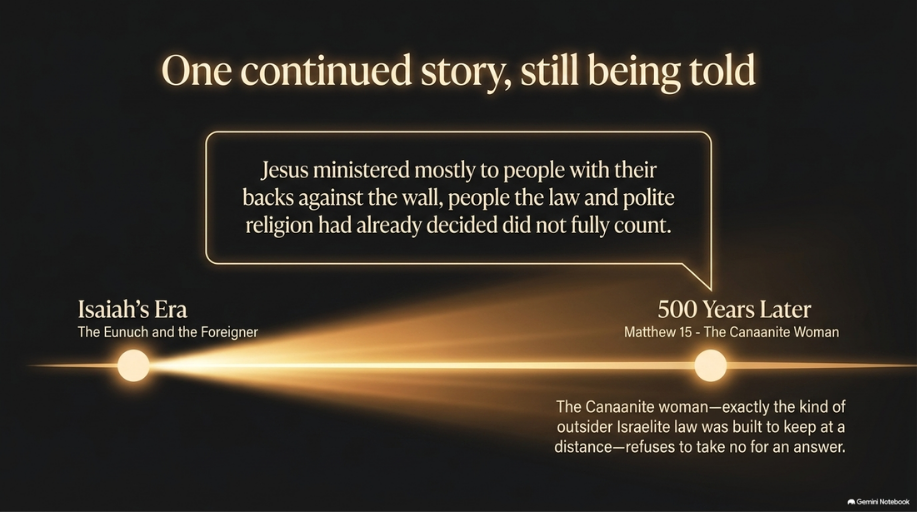
Howard Thurman, writing out of his own experience on the underside of American exclusion, said Jesus ministered mostly to people with their backs against the wall, people the law and polite religion had already decided did not fully count. Isaiah’s foreigner and eunuch are that same crowd, five centuries earlier than the events Matthew 15 describes. Matthew tells the story of a Canaanite woman, exactly the kind of outsider Israelite law was built to keep at a distance, refusing to take no for an answer from Jesus. Jesus, at first, ignores her. Then he seems to refuse her. But she persists. And finally he tells her that her faith is great, and he makes her daughter whole again. Isaiah’s promise and Jesus’ welcome are not two stories separated by five hundred years. They are one continuing story, still being told. Even Jesus, it seems, needed to learn this.
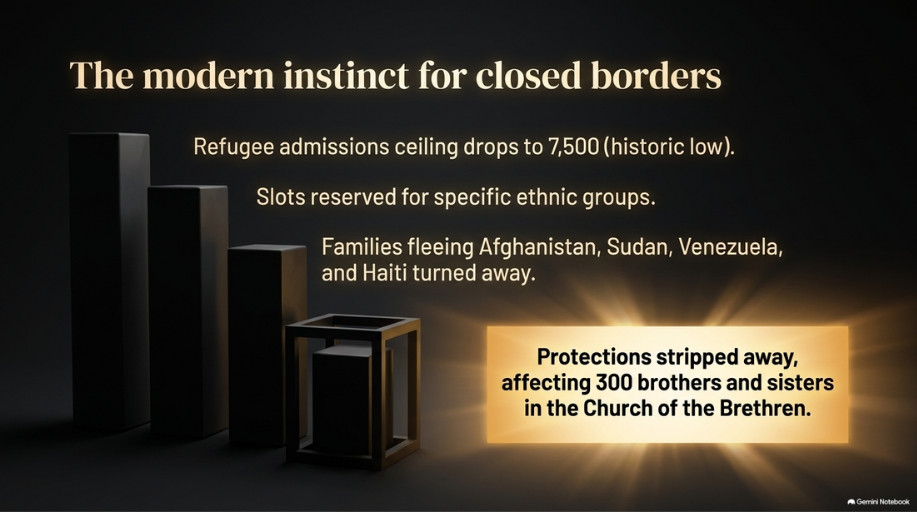
That argument was not resolved in the first century, and it is not resolved now. This past year our federal government set the refugee admissions ceiling at 7,500 people, the lowest in the history of the program, and turned away families fleeing war and persecution, including 300 of our own siblings in the Church of the Brethren. Isaiah 56 was never a policy memo for a nation-state. It was written for a worshiping community deciding who gets a seat at God’s table. So are we, this morning, in this room.
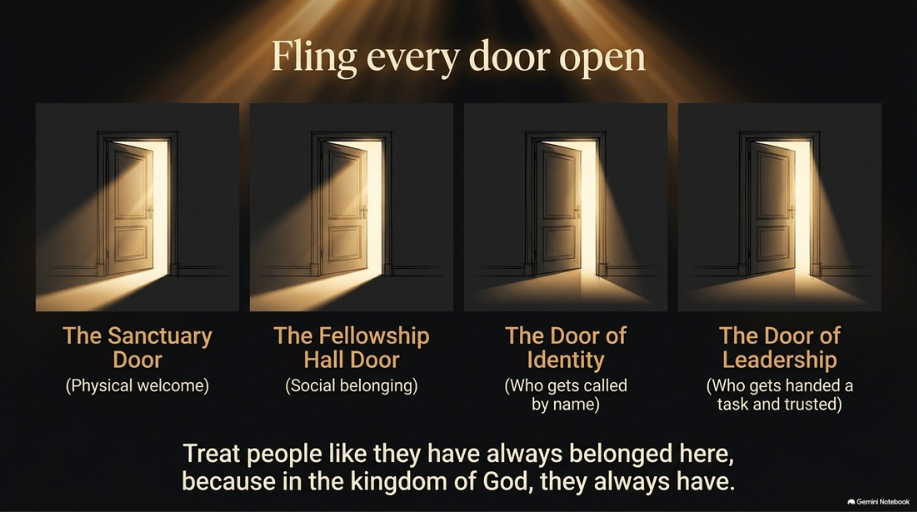
Here is what this text asks of us: that we fling the doors open. Every door. The sanctuary door, the fellowship hall door, the door of who gets called by name, who gets handed a task and trusted with it, who gets treated like they have always belonged here, because in the kingdom of God they always have. Not because we have solved welcoming, but because God has, and we are only being asked to catch up.
Scripture
“But she said, ‘Yes, Lord, but even the dogs eat the crumbs which fall from their masters’ table.’ Then Jesus answered her, ‘Woman, great is your faith! Be it done to you even as you desire.’ And her daughter was healed from that hour.” (Matthew 15:27-28, WEB)
From the Sermon
| “Here is what I believe this text is asking of Pleasant Valley: that we fling the doors open. Every door.” |
For Reflection
- Even Jesus, in Matthew’s account, seems to grow in his understanding of who his welcome includes. What does it mean for us that the widening of the circle was, in some sense, a lesson even Jesus had to learn?
- Where is God currently asking you to “catch up” to a welcome God has already extended, whether to a person, a group, or a whole category of people?
- What is one door, literal or otherwise, that Pleasant Valley could fling open this week, and what is your part in opening it?
Prayer
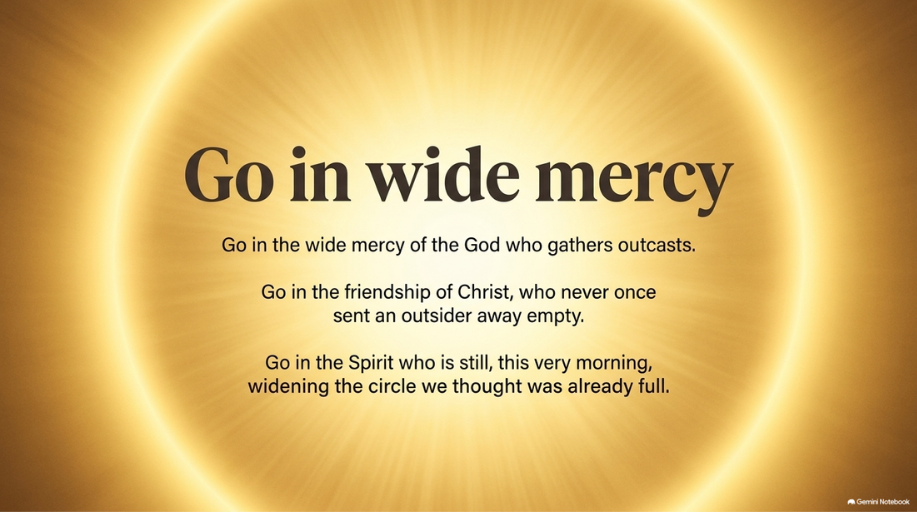
God who gathers outcasts and widens circles we thought were already full, send us out this week in the wide mercy that welcomed the Canaanite woman and the foreigner at Isaiah’s gate alike. Give us courage to fling open the doors you have already opened: the sanctuary door, the fellowship door, the door of whose name we call and whose gifts we trust. We go in the friendship of Christ, who never once sent an outsider away empty. Amen.
A House of Prayer for All Peoples
Small Group Discussion Guide
Based on the sermon by Pastor Harry Jarrett | Isaiah 56:1, 6-8
Pleasant Valley Church of the Brethren, Weyers Cave, Virginia
Summary
This week Pastor Harry preached from Isaiah 56:1, 6-8, the prophet’s stunning promise that God’s house “shall be called a house of prayer for all peoples.” He opened with the story of a family, never met, whose plans to resettle overnight collapsed when a program was suddenly frozen, and named two reactions such stories produce in us: honest outrage, and a quieter relief that the decision was not ours to make. Isaiah 56 was written for a community facing its own version of that argument: exiles newly returned from Babylon, rebuilding Jerusalem out of rubble, disagreeing over who belonged in the nation they were remaking. Some wanted tight borders of bloodline and pedigree, an argument you can read in the book of Ezra. Isaiah answers in exactly the opposite direction, naming the foreigner and the eunuch first and promising each of them a name that “will not be cut off.” The only entrance requirement Isaiah gives is ethical, not ethnic: love the name of the Lord. Pastor Harry connected this ancient promise to Matthew 15’s Canaanite woman, whose persistence seems to teach even Jesus something about the width of his own welcome, and to this year’s sharply lowered refugee admissions, including the loss of legal status for hundreds of Haitians, some of them our own siblings in the Church of the Brethren. His charge to Pleasant Valley: fling the doors open, every one of them, because God has already done the hard work of welcome, and we are only being asked to catch up.
Opening Prayer
(Read aloud together, or led by one person.)
God of the open door, we come to this circle carrying our own stories of welcome and exclusion, and we ask you to meet us honestly in both. Quiet whatever defensiveness we brought with us. Open our ears to your word and to each other, and show us, together, what it looks like to fling a door open in your name. In the name of Jesus, who never once sent an outsider away empty, we pray. Amen.
Ice Breaker
Describe a time someone made you feel unmistakably welcome: a new job, a new town, a new church, or a new group of any kind. What specifically did they do or say that made the welcome feel real rather than merely polite?
Key Verses
“Maintain justice and do what is right, for my salvation is near and my righteousness will soon be revealed.” (Isaiah 56:1, WEB)
“I will give them in my house and within my walls a memorial and a name better than of sons and of daughters. I will give them an everlasting name that will not be cut off.” (Isaiah 56:5, WEB)
“I will bring these to my holy mountain, and make them joyful in my house of prayer… for my house will be called a house of prayer for all peoples.” (Isaiah 56:7, WEB)
“Then Jesus answered her, ‘Woman, great is your faith! Be it done to you even as you desire.’” (Matthew 15:28, WEB)
Group Discussion Questions
- Isaiah 56 answers the exiles’ anxiety about belonging with one ethical requirement, love the name of the Lord, rather than a test of bloodline or pedigree. What does it reveal about God’s character that this is the only entrance exam God gives?
- Pastor Harry pointed out that “cut off” was the precise wound a eunuch carried his whole life, and that God speaks healing straight into that exact place rather than offering vague comfort. Why might it matter that God addresses our specific wounds by name instead of in generalities?
- In Matthew 15, Jesus at first ignores and then seems to refuse the Canaanite woman before her persistence changes the outcome. What do you make of the idea, as Pastor Harry suggested, that even Jesus needed to learn something about the width of his own welcome?
- Pastor Harry named two reactions we often have to stories of exclusion: honest outrage, and a quieter relief that the decision was not ours to make. Which of those reactions comes more naturally to you, and why?
- Whose “cut off,” a specific wound, label, or exclusion, have you carried, or watched someone else carry, and has anyone ever spoken healing directly into that place the way Isaiah 56 does?
- Isaiah 56 was written for a worshiping community deciding who gets a seat at God’s table, not as a policy memo for a nation-state. How should that distinction shape the way we as a congregation talk about the same questions when they show up in the news?
- Pastor Harry referenced this year’s lowered refugee ceiling and the loss of legal status for hundreds of Haitians, including siblings in our own denomination. What is our responsibility, as a specific congregation in Weyers Cave, when a global or national policy touches people who are literally part of our church family?
- Pastor Harry’s charge was to “fling the doors open, every door.” What is one specific door at Pleasant Valley, the sanctuary, the fellowship hall, a ministry team, a task, that this group could help open wider this year?
Life Applications
Speak the promise. Identify one person in your life who carries a “cut off,” a wound, label, or exclusion, and tell them directly, in your own words, that they are not cut off from God or from you.
Check-in: Come ready to share (without naming the person if it is sensitive) what you said and how it was received.
Widen one door. Choose one specific door at Pleasant Valley, a ministry team, a task, a welcome, and take one concrete step this week to open it to someone who has not been asked in before.
Check-in: Report back on the step you took and what happened next.
Learn one story. Read or watch one true account this week of a refugee or immigrant family’s experience (a news story, a denominational report, a personal conversation), and let it move you past outrage into one specific action.
Check-in: Share what you learned and the action you took, even if it was small.
Pray by name. Each day this week, pray by name for the Church of the Brethren siblings affected by the loss of Haitian legal status, and for one person in your own circle who may feel like an outsider.
Check-in: Share who you prayed for and anything you noticed in yourself over the week.
Key Sermon Takeaways
- Isaiah 56 was written for exiles newly returned from Babylon, arguing over who belonged in the nation they were rebuilding; some wanted tight, bloodline borders, an argument found in the book of Ezra.
- Isaiah answers in the opposite direction, naming the foreigner and the eunuch first and promising each an everlasting name that “will not be cut off.”
- The only entrance requirement Isaiah gives is ethical, not ethnic: love the name of the Lord, keep the Sabbath, hold fast the covenant.
- God’s house is called “a house of prayer for all peoples,” a promise Jesus enacts five centuries later in his encounter with the Canaanite woman in Matthew 15.
- Even Jesus, in that story, seems to grow in his understanding of the width of his own welcome.
- Isaiah 56 was never a policy memo for a nation-state; it was written for a worshiping community deciding who gets a seat at God’s table, exactly the question facing us this morning.
- Pastor Harry’s charge to Pleasant Valley: fling every door open, not because we have solved welcoming, but because God has, and we are only catching up.
Closing Prayer
(Read aloud together, or led by one person.)
God who gathers outcasts, thank you for the honesty and the welcome of this circle. Send us from here to fling open the doors you have already opened: the sanctuary door, the fellowship door, the door of whose name we call and whose gifts we trust. Where we have added entrance exams of our own, forgive us and strip them away. We go in the wide mercy of the God who gathers, in the friendship of Christ who never sent an outsider away empty, and in the Spirit who is still widening the circle we thought was already full. Amen.