Day 1 The Spirit That Overflows
DEVOTIONAL
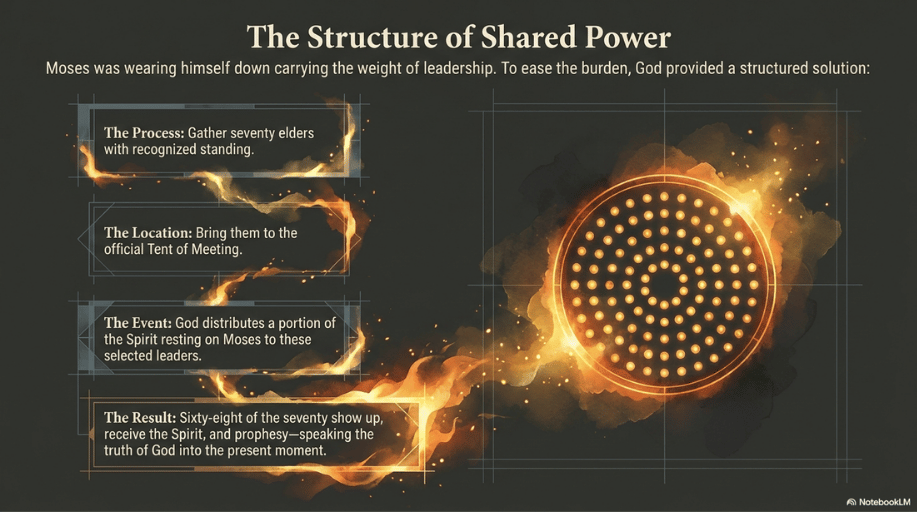
There is a moment in the wilderness that does not get nearly enough attention. Not the parting of the sea. Not the thunder of Sinai. This moment is quieter than all of those, and in some ways more radical. Moses is burning out. He has been trying to carry an entire nation on his shoulders, a nation that is hungry and ungrateful and very, very loud about both. God’s response is not to make Moses stronger. God’s response is to share the Spirit.
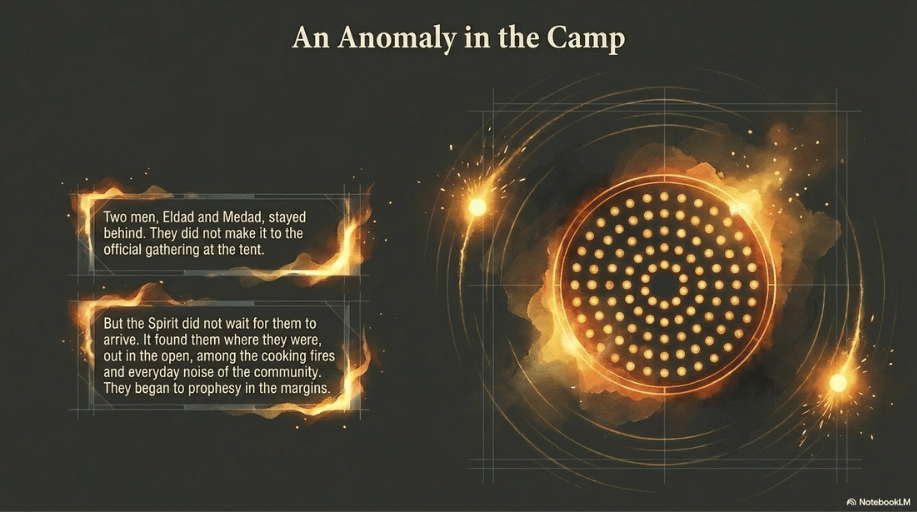
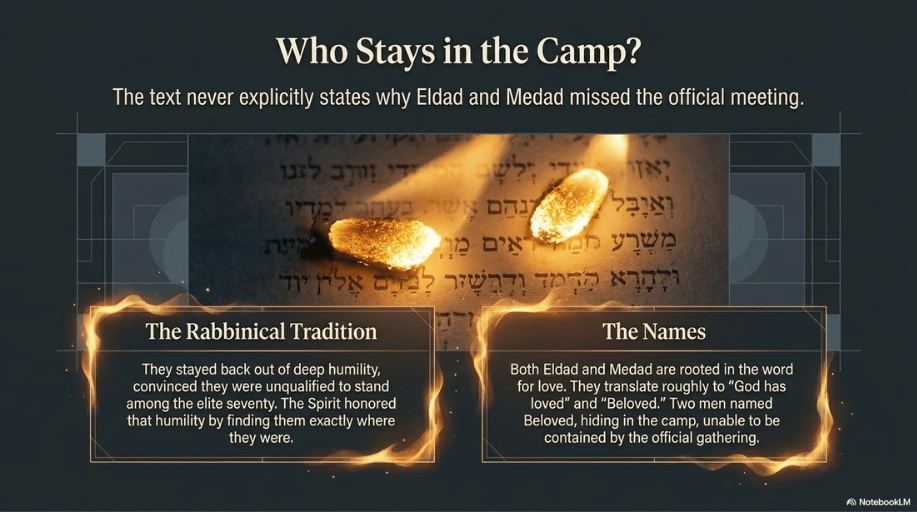
Seventy elders are called to the tent of meeting. The plan is orderly, recognized, institutional. God will take a portion of the Spirit resting on Moses and distribute it among the seventy. Sixty-eight show up. Two, Eldad and Medad, remain in the camp. We do not know why. The text doesn’t say, and perhaps that is the point. The Spirit does not wait for an explanation.
Out in the camp, among the cooking fires and the children and the everyday noise of community life, Eldad and Medad begin to prophesy. They didn’t earn it through presence at the tent. They didn’t go through the proper channel. And yet something is clearly alive and moving in them. The Spirit has overflowed the container.
This is the first thing these texts want us to know: the Spirit of God has never been successfully contained. Not by a tent, not by a process, not by a properly convened gathering of authorized leaders. God is generous beyond our categories. The beloved will be found where they are.
SCRIPTURE
Numbers 11:29 (NRSV)
“Are you jealous for my sake? Would that all the Lord’s people were prophets, and that the Lord would put his spirit on them!”
FROM THE SERMON
“The Spirit found them where they were.”
REFLECTION QUESTION
What does this story reveal about how God chooses to work, and why might that be unsettling? Where in your own life have you experienced the Spirit showing up somewhere unexpected? Is there someone around you right now in whom you sense something alive and moving, someone who might be an Eldad or a Medad? What would it look like to welcome, rather than question, what the Spirit is doing in them?
PRAYER
Lord God, we confess that we are often more comfortable with boundaries than you are. We build our tents and assume you will stay inside them. Open our eyes today to see where your Spirit is already at work beyond the places we expected. Teach us to receive that overflow with wonder rather than worry. Amen.
Day 2 Two Kinds of Leaders
DEVOTIONAL
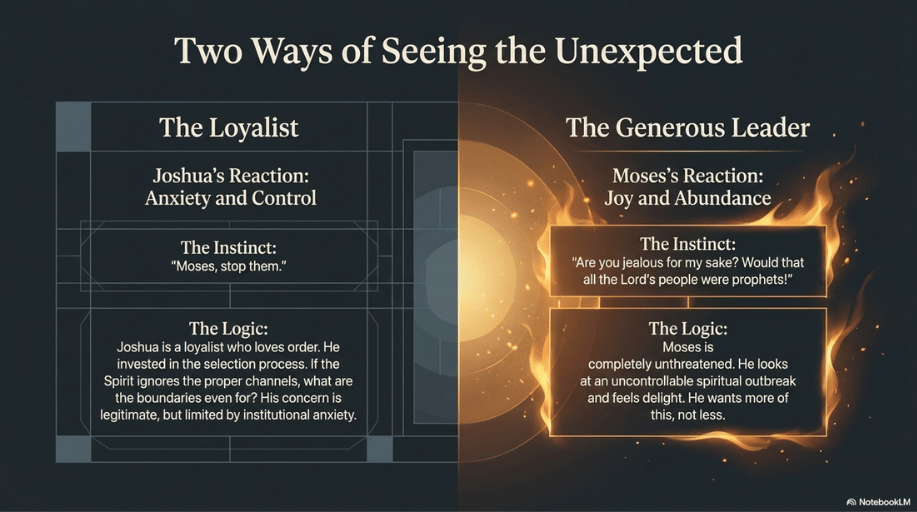
When word reaches Joshua that Eldad and Medad are prophesying in the camp, his response is immediate and instinctive: “Moses, stop them.” It is worth pausing here before we judge Joshua too quickly. He is not a villain. He is a loyalist, a man who has given his life to following Moses, investing in the structures Moses built, honoring the process God prescribed. He understands, perhaps better than anyone, that healthy communities depend on people respecting the boundaries that hold them together.
Joshua’s fear is legitimate. If anyone can receive the Spirit without showing up, without being in the right place at the right time, without going through proper channels, then what is the process for? What does it mean to be chosen? The question underneath his alarm is one that every institution eventually asks: if we don’t manage this carefully, will the whole thing come undone?
Moses’s response cuts through all of that anxiety like a knife through tent cloth. “Are you jealous for my sake?” There is almost a smile in it. Moses is not threatened. He does not feel diminished by what is happening in the camp. He looks at two unauthorized prophets and his first feeling is not alarm. It is delight. He wants more of this, not less. Would that all the Lord’s people were prophets.
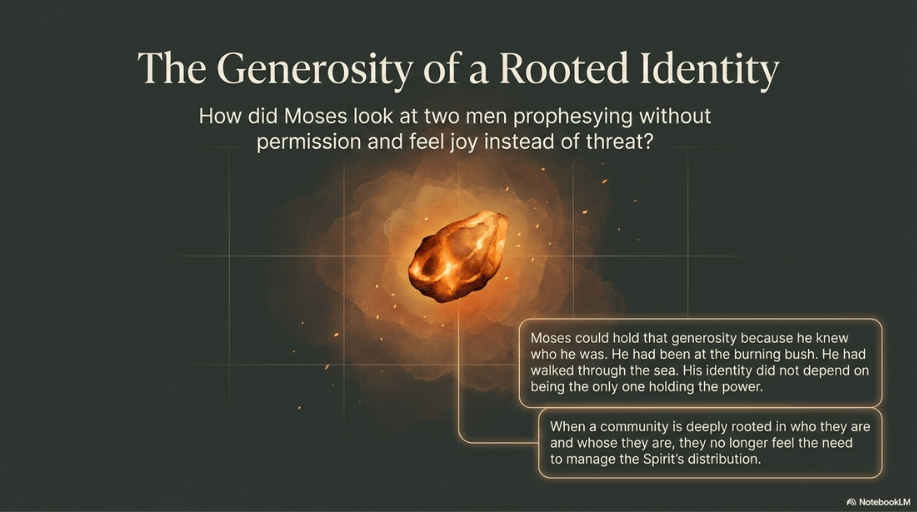
What makes the difference between these two responses is not intelligence or even faithfulness. It is identity. Moses had been at the burning bush. He had walked through the sea on dry ground. He knew who God was and he knew who he was in relation to God. That security did not depend on being the only one. And because his identity was rooted so deeply, he could hold power with an open hand. Joshua was not there yet. Most of us are not there yet either.
SCRIPTURE
Numbers 11:28-29 (NRSV)
“Joshua son of Nun, the assistant of Moses, one of his chosen men, said, ‘My lord Moses, stop them!’ But Moses said to him, ‘Are you jealous for my sake?'”
FROM THE SERMON
“Moses is not threatened. He is not worried about his position or his authority or the integrity of the system he built.”
REFLECTION QUESTION
What makes the Joshua response so understandable, and even reasonable? Where in your life, your work, your faith community, do you notice yourself reaching for the Joshua response: protecting structures, questioning credentials, managing who gets access? What kind of security would it take to hold Moses’s posture instead? How do you find that kind of security?
PRAYER
Father, we are honest with you: we are often more Joshua than Moses. We love our structures because they give us a sense of control. Loosen our grip today. Give us the security that comes from knowing who we are in you, so that we can hold our systems and processes lightly and welcome what the Spirit is doing, wherever it appears. Amen.
Day 3 Pentecost: Moses’s Wish at Scale
DEVOTIONAL
Several hundred years pass between the camp in the wilderness and an upper room in Jerusalem. But something of Moses’s wish has been traveling through all that time, carried in the words of Joel, whispered in the prayers of the faithful, waiting for the moment when God would answer it at a scale no one could have imagined.
The disciples are gathered, waiting as Jesus told them to wait, for something they could not fully picture. And then it arrives. Wind, like the breath of God moving over the deep. Fire, settling on each person in the room, not just the recognized leaders, not just the men, not just the elders. Everyone. And they begin to speak in languages they never studied, in the mother tongues of people from every corner of the known world.
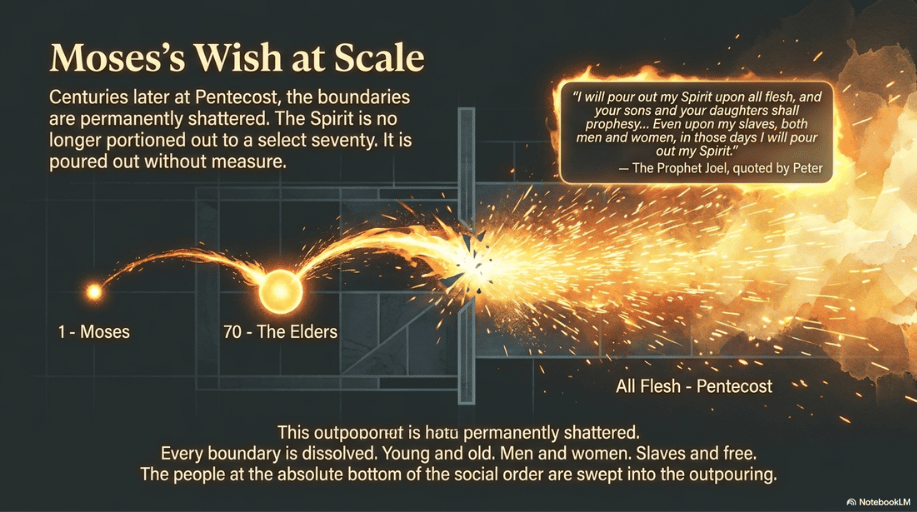
Peter steps into the bewildered crowd and gives them the only framework large enough to hold what is happening. He reaches back to Joel: in the last days, God declares, I will pour out my Spirit on all flesh. Sons and daughters. Old men and young men. Slaves, both men and women. Notice who is on that list. Not just the powerful. Not just the educated. Not just the people who had access to the official religious structures of their day. The people at the very bottom of the social order, people who owned nothing and controlled nothing, are included in the outpouring.
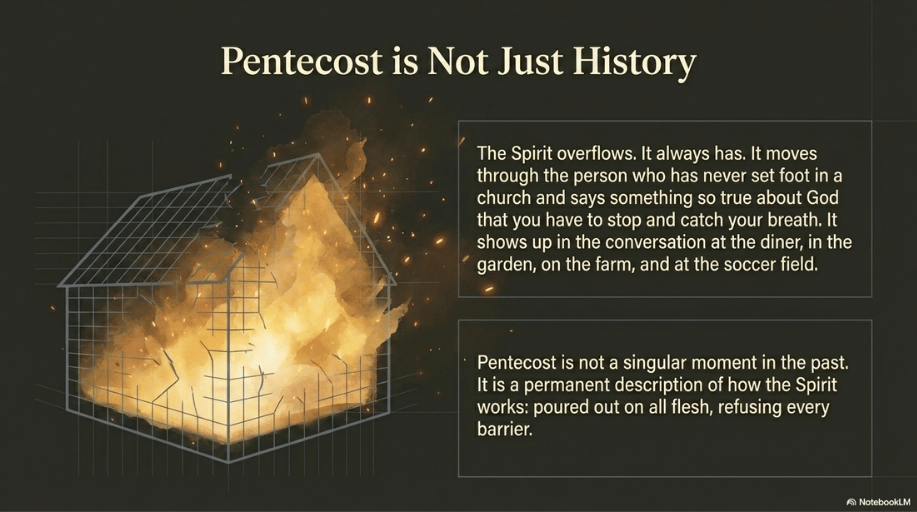
Moses wished it for all the Lord’s people. God poured it out on all flesh. The circle has been drawn wider than any institution could have drawn it, and Pentecost is not a one-time event. It is a description of how the Spirit works. The outpouring has not stopped.
SCRIPTURE
Acts 2:17-18 (NRSV)
“In the last days it will be, God declares, that I will pour out my Spirit upon all flesh, and your sons and your daughters shall prophesy, and your young men shall see visions, and your old men shall dream dreams. Even upon my slaves, both men and women, in those days I will pour out my Spirit; and they shall prophesy.”
FROM THE SERMON
“Every boundary the Spirit used to respect has been dissolved.”
REFLECTION QUESTION
What is significant about the specific groups Joel names: daughters, young people, old people, slaves? What does it tell us about the direction of God’s generosity? Where do you see the Spirit being poured out today on people who are outside the boundaries of what we typically recognize as religious or official? What barriers might your faith community be maintaining that this passage challenges?
PRAYER
Holy Spirit, you were poured out on all flesh at Pentecost, and you have not stopped. Forgive us for the moments we have treated your work as the property of the institution. Remind us today that you move where you will, that you have always included the ones we overlooked, and that your generosity is the shape of your love. Make us willing to be surprised by you. Amen.
Day 4 The Mess After the Fire
DEVOTIONAL
Pentecost is glorious. What comes after Pentecost is complicated. The community at Corinth is one of the most gift-rich communities in the early church, and also one of the most fractured. The Spirit has been extraordinarily generous with them: wisdom, knowledge, faith, healing, miracles, prophecy, discernment, tongues, interpretation. It is an embarrassment of spiritual riches. And they have turned it into a competition.
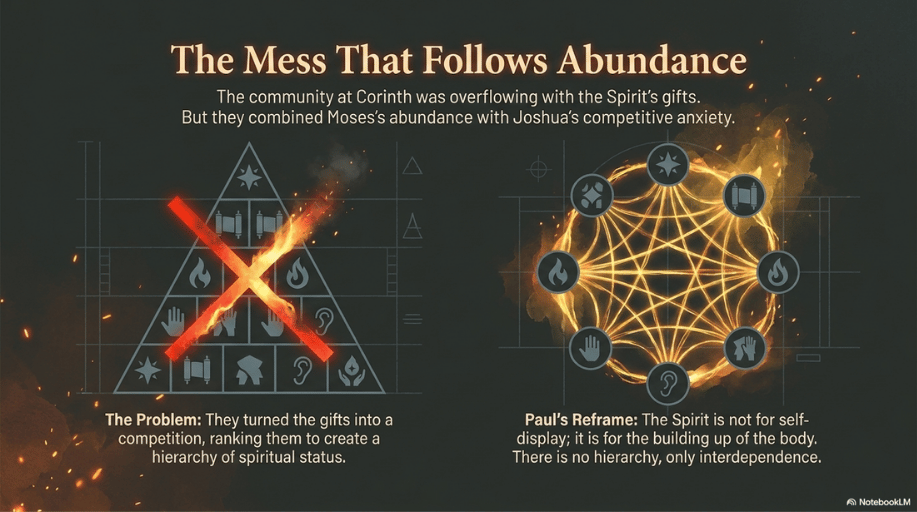
The Corinthians are ranking the gifts. The flashier ones, the more dramatic public manifestations, have become markers of spiritual status. The people who speak in tongues look down at the people who serve quietly. The ones with the dramatic gifts treat the ones with the ordinary gifts as lesser members of the body. The very thing that was supposed to build the community up is tearing it apart.
Paul does not respond by taking the gifts away or casting doubt on whether they are real. He responds by reframing the entire enterprise from the ground up. One Spirit gives all of them. Every gift is given for the common good, not for self-display. And then he reaches for the image that will define Christian community for centuries: you are a body. A body needs all of its parts. The eye cannot look at the hand and say, I have no need of you. There is no hierarchy here, only radical, beautiful, necessary interdependence.
The Corinthians had Moses’s abundance and Joshua’s competitive anxiety at the same time. They had received the gifts of Pentecost and were using them to sort themselves into winners and losers. Paul is writing to give them Moses’s eyes: to help them see that abundance was never meant to produce rankings, but community.
SCRIPTURE
1 Corinthians 12:7 (NRSV)
“To each is given the manifestation of the Spirit for the common good.”
FROM THE SERMON
“The Corinthians had Moses’s abundance and Joshua’s competitive anxiety at the same time.”
REFLECTION QUESTION
Why do communities so often turn gifts into status markers, even in the church? Can you think of ways that happens in your own experience of faith community? What does it mean to use a gift for the common good rather than for self-display? What would change in your community if every expression of the Spirit were evaluated by the question: is this building the body up?
PRAYER
Lord, you are generous beyond what we deserve, and we confess that we have sometimes used your generosity to make ourselves feel more important than others. Reorient us today. Let every gift we have, every moment of clarity, every ability, every word we speak, be offered in service of the whole. Remind us that we are members of one body, not competitors in a performance. Amen.
Day 5 Becoming a Moses People
DEVOTIONAL
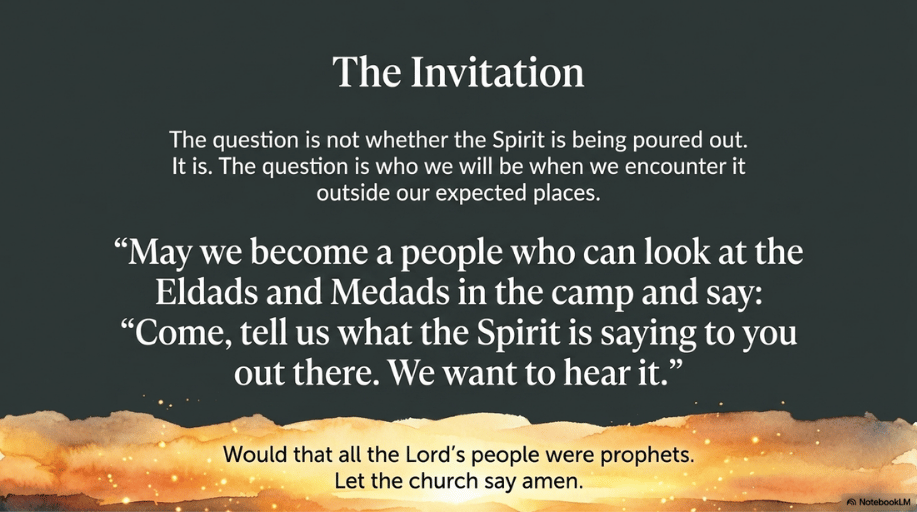
At the end of all three of these texts, the community has to decide what kind of people they are going to be. The Spirit has moved. The gifts have come. The outpouring is real. The question is not whether it is happening. The question is what kind of community we are going to be when it happens outside our expected places.
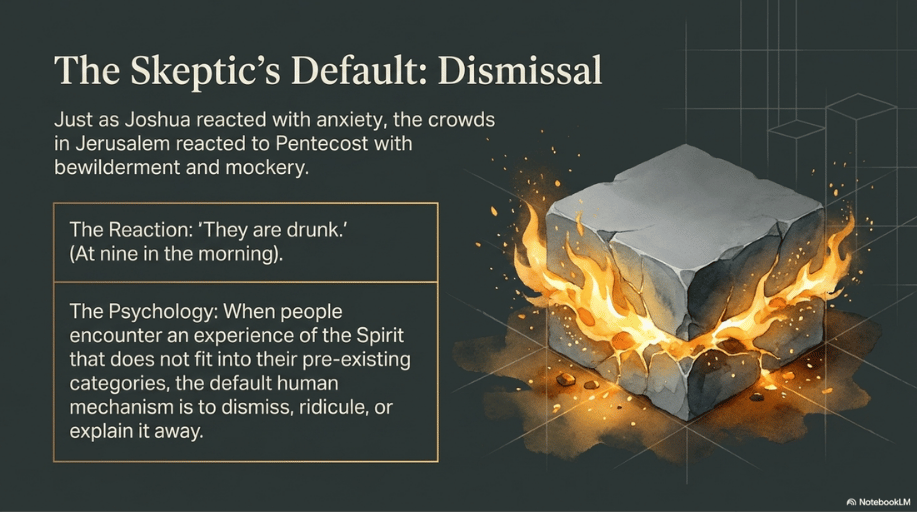
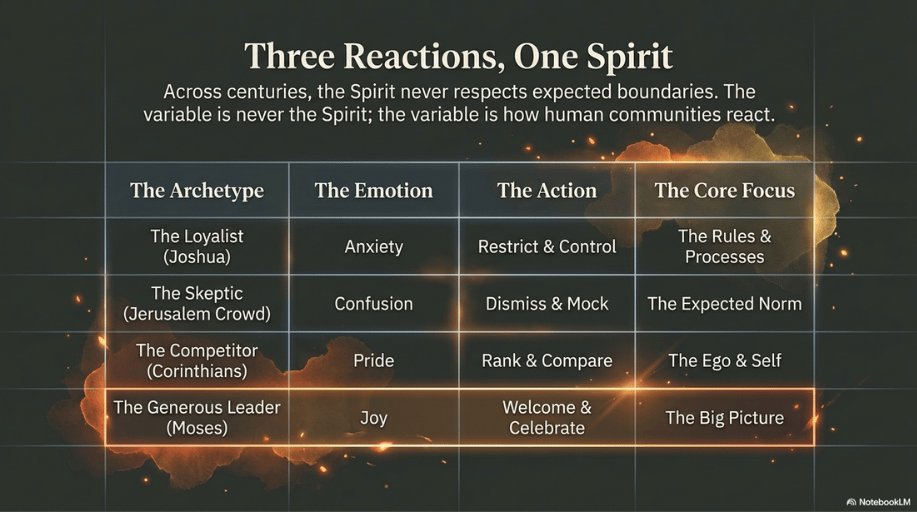
We have seen the options laid out across the week. There is the Joshua response: make them stop, they didn’t earn it, they didn’t follow the process, the Spirit should respect our structures. There is the crowd’s response: bewilderment and dismissal, they must be drunk, this doesn’t fit our categories. There is the Corinthian response: pride and competition, my gift matters more than yours, watch what I can do. And then there is the Moses response: Would that all the Lord’s people were prophets. More of this. Everywhere. In everyone.
Moses could hold that extraordinary generosity because his identity did not depend on being the only one. He had been at the burning bush. He had walked through the parted sea. He knew who God was, and he knew who he was in relation to God, and that knowing was a kind of bedrock that no threat to his position could shake. His security made him capable of a generosity that Joshua, for all his loyalty, could not yet manage.
This is the invitation extended to us, to Pleasant Valley Church of the Brethren, in Weyers Cave, in this particular moment. To become so rooted in who we are and whose we are that we have no need to manage the Spirit’s distribution. To become a people who can look at the Eldads and Medads prophesying in the camp and say not “make them stop” but “come, tell us what the Spirit is saying to you out there.” Pentecost says the Spirit is being poured out on all flesh. That is not a threat to the community of faith. It is the fulfillment of the oldest wish of the most burdened and most generous leader the people of God ever had.
SCRIPTURE
Numbers 11:29 (NRSV)
“Would that all the Lord’s people were prophets, and that the Lord would put his spirit on them!”
FROM THE SERMON
“The invitation of these texts is to that kind of security. To become a community so rooted in who we are and whose we are that we don’t need to manage the Spirit’s distribution.”
REFLECTION QUESTION
What would it mean for your congregation to truly be a Moses people? What practices, postures, or habits would need to change? Who are the Eldads and Medads around you, the ones prophesying in the camp, and how might you invite their voices into the community? What is one specific step you can take this week to welcome the Spirit’s work somewhere you might normally overlook it?
PRAYER
God of Pentecost, you have been pouring out your Spirit since the beginning. You poured it on Moses and the seventy, on Eldad and Medad in the camp, on fishermen and slaves and daughters in Jerusalem, and on us. Make us a people worthy of that outpouring. Root us so deeply in your love and your call that we have no need to guard the borders of your work. Teach us to say, with Moses: more of this, everywhere, in everyone. Would that all your people were prophets. Amen.
Small Group Discussion Guide
Would That All Were Prophets Numbers 11:24-30 | Acts 2:1-21 | 1 Corinthians 12:3b-13
Pleasant Valley Church of the Brethren | Weyers Cave, Virginia
Summary
Moses is burning out in the wilderness, and God’s answer is not to make him stronger. It is to share the Spirit. Seventy elders are called to the tent of meeting, but two, Eldad and Medad, stay behind in the camp. The Spirit finds them there anyway, overflowing every official boundary. When Joshua demands Moses shut it down, Moses responds with one of the most stunning lines in the Torah: “Would that all the Lord’s people were prophets.” Centuries later, that wish explodes at Pentecost, where the Spirit is poured out without measure on sons and daughters, old and young, even slaves. And in Corinth, the community that received those gifts promptly turned them into a competition. Paul writes to restore their vision: one Spirit, one body, every gift for the common good. Across all three texts, the pattern is the same. The Spirit overflows. The community has to decide what kind of people they will be when it does.
Opening Prayer
Lord God, we come together grateful for your Word and for each other. As we open these texts today, quiet the noise we carried in with us. Make us willing to hear something that surprises us, something that challenges us, something that calls us further than we planned to go. Where the Spirit overflows our expectations, give us Moses’s eyes to see it as gift rather than threat. We ask this together, in the name of Jesus. Amen.
Ice Breaker
Think of a time when something good happened to you in an unexpected place or through an unexpected person. It doesn’t have to be spiritual. Maybe it was a conversation you didn’t plan, or help that came from somewhere you weren’t looking. Share it with the group in two or three sentences.
Key Verses
Numbers 11:29 (NRSV) “Are you jealous for my sake? Would that all the Lord’s people were prophets, and that the Lord would put his spirit on them!”
Acts 2:17-18 (NRSV) “In the last days it will be, God declares, that I will pour out my Spirit upon all flesh, and your sons and your daughters shall prophesy, and your young men shall see visions, and your old men shall dream dreams. Even upon my slaves, both men and women, in those days I will pour out my Spirit; and they shall prophesy.”
1 Corinthians 12:7 (NRSV) “To each is given the manifestation of the Spirit for the common good.”
Group Discussion Questions
1. The text tells us Eldad and Medad stayed in the camp, but it never tells us why. Commentators across the centuries have offered different reasons: unworthiness, humility, duty to others, or simply missing the message. Why do you think the narrator leaves it open? What does that ambiguity do for the story?
2. Joshua’s response to the news about Eldad and Medad is immediate: “Moses, stop them.” What is the most charitable reading of Joshua’s concern? Where is his instinct coming from, and why is it not entirely wrong?
3. Moses responds with what the sermon called “one of the most stunning things anyone says in the entire Torah.” What does Moses’s response reveal about his relationship with his own identity and authority? What does it take to become a person who can genuinely mean those words?
4. The sermon notes that Eldad means “beloved of God” and Medad carries a similar root. Two men named Beloved, not at the tent, and the Spirit cannot be contained. How does that detail shape the way you read this story? What does it suggest about who God is looking for?
5. At Pentecost, Peter quotes Joel’s list: sons and daughters, old and young, slaves. Take a moment to think about who would be on that list in your own community or context today. Who are the people the Spirit might be moving in that the institution has not yet made room for?
6. The sermon describes four responses to the Spirit moving in unexpected places: Joshua’s anxiety, the crowd’s bewilderment, the Corinthians’ pride, and Moses’s delight. Which of those four responses feels most natural to you, and why? Which one do you think Pleasant Valley, as a congregation, tends toward?
7. Paul tells the Corinthians that every gift is given “for the common good,” not for self-display. How do you tell the difference in practice? What does a gift being used for the common good actually look like in a small congregation like this one?
8. The sermon ends with an invitation to become “a community so rooted in who we are and whose we are that we don’t need to manage the Spirit’s distribution.” What would that actually require of this congregation? What would we need to let go of, and what would we need to hold more tightly?
Life Applications
Seek an Eldad or Medad. This week, identify one person in your life who is outside your usual faith circles, someone you might not expect the Spirit to be speaking through, and have a real conversation with them. Listen more than you talk. At your next gathering, share one thing you heard that surprised you.
Audit your gift. Reflect on one ability, habit, or role you carry in this community. Ask yourself honestly: am I using this for the common good, or for something else? Write down one concrete way to redirect it toward building up the body. Check in with a trusted friend or group member in the coming week about what you discovered.
Practice Moses’s words. When you encounter someone this week doing something good in a way that differs from how you would do it, resist the Joshua impulse. Say, silently or aloud: “Would that all the Lord’s people were prophets.” Notice what that prayer does in you.
Key Sermon Takeaways
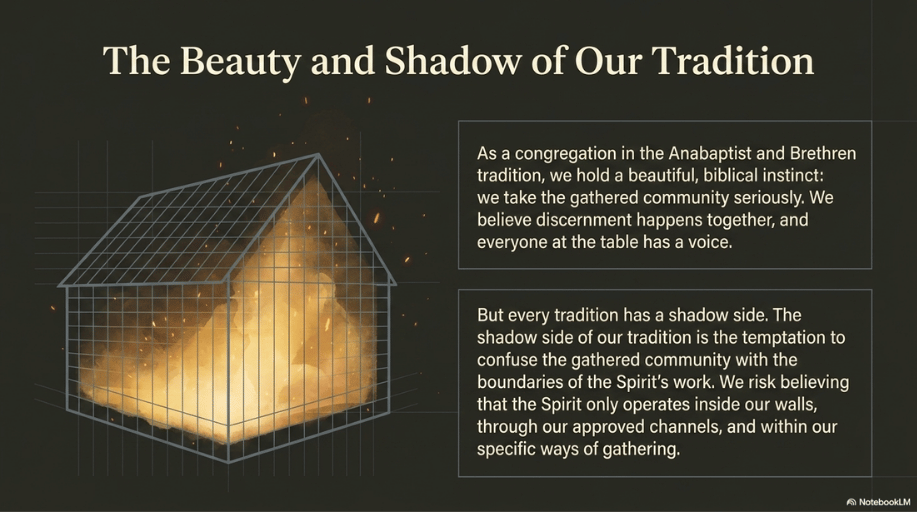
The Spirit has never been successfully contained by official structures, proper processes, or approved gatherings. It overflowed the tent of meeting in the wilderness and it overflows our institutions today.
Moses’s generosity was rooted in his security. He could welcome the Spirit in others because he knew who he was in relation to God. That security is available to us.
Pentecost is not a past event. It is a description of how the Spirit works: poured out on all flesh, no barrier held.
The gifts of the Spirit are given for the common good, not for self-display or status. A community that turns gifts into rankings has lost the plot.
The question before us is not whether the Spirit is being poured out. It is what kind of people we will be when we encounter it somewhere we did not expect.
Closing Prayer
God, we have sat with your Word today and we are grateful. We confess that we are more often Joshua than Moses, more often the bewildered crowd than the ones bold enough to speak. Grow us into people of deeper security, people who do not need to manage your generosity because we trust it. Send us back into our week with eyes open for the Eldads and Medads around us. And when we find them, give us the courage to say: come, tell us what the Spirit is saying to you out there. We want to hear it. Amen.
Pleasant Valley Church of the Brethren | Weyers Cave, Virginia