The Presence That Lights the Way
Devotional
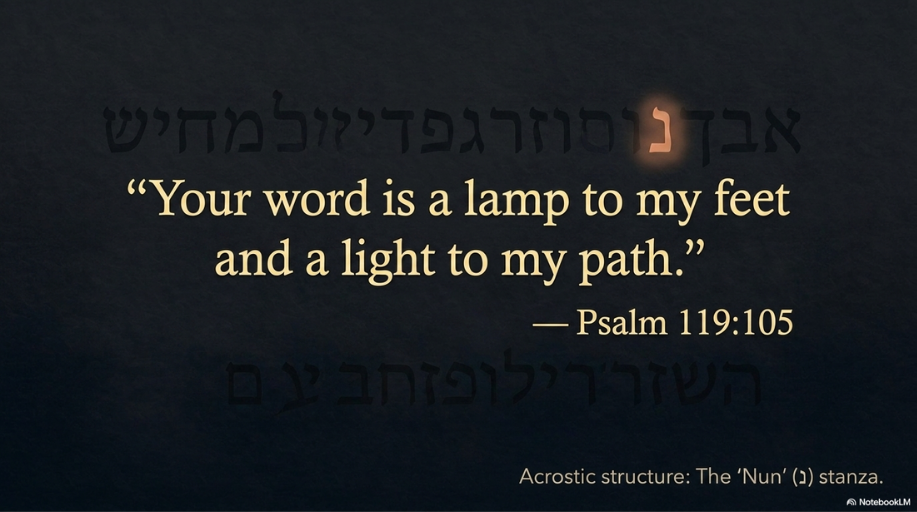
Psalm 119 is the longest chapter in the Bible, one hundred seventy-six verses, an acrostic built on the twenty-two letters of the Hebrew alphabet, eight verses for each letter. Our week begins in the nun section, right in the middle. It is easy to be impressed by the psalm’s sheer size and miss its heart. At its center sits a single, tender confession: God’s word is a lamp to my feet and a light for my path. Everything else in these many verses circles that one small flame.
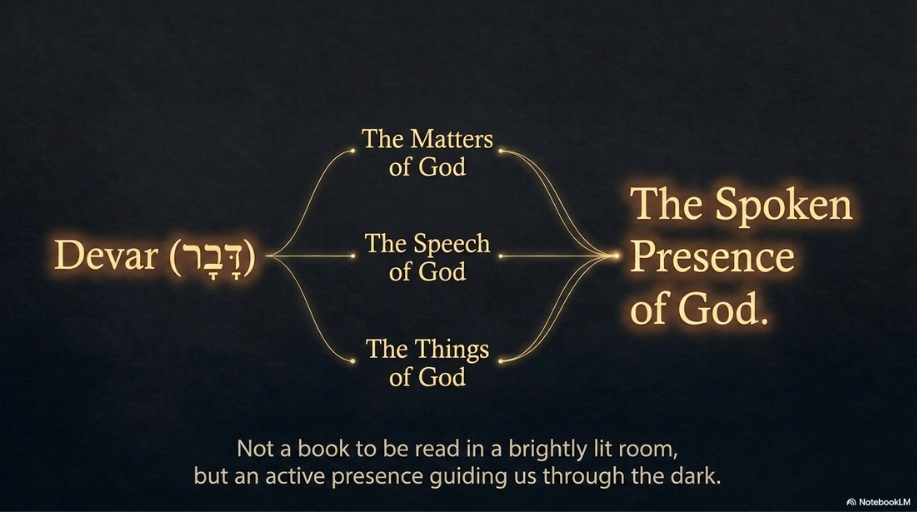
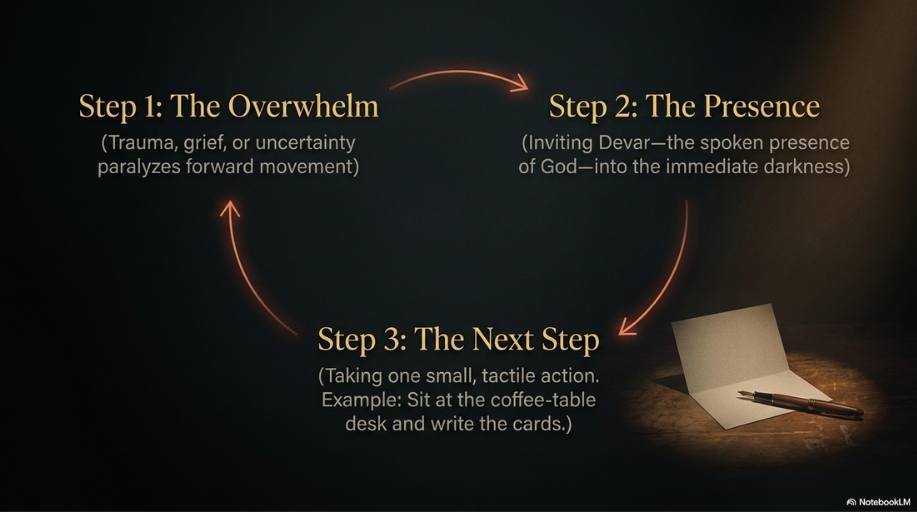
The Hebrew word we translate as word is devar, and it carries more than we usually hear. It is not only the sentences of Scripture but the matters of God, the things of God, the spoken presence of God in a person’s life. When the psalmist says that God’s word lights the path, he is not describing a rulebook held up to the dark. He is describing Someone. The light is the nearness of God, God’s voice and God’s care, moving with us step by step.
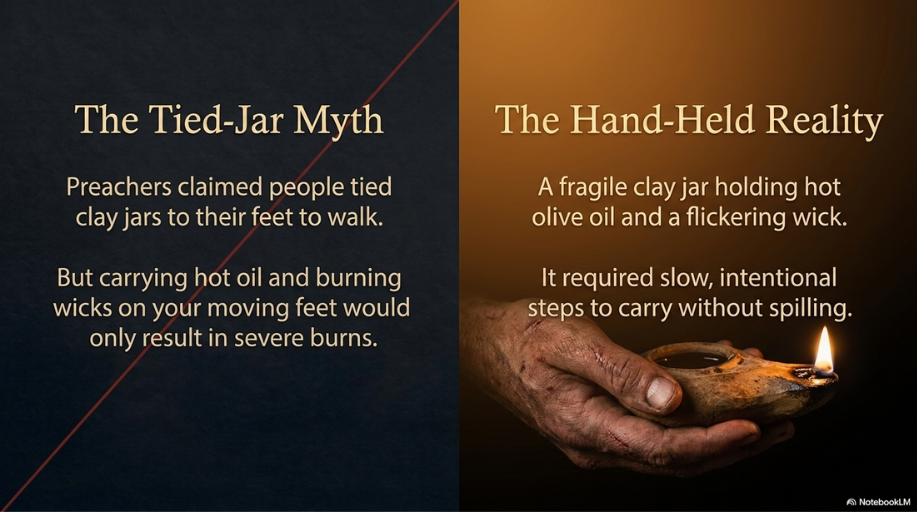
The lamp itself was humble. Not the bright fixtures overhead in our sanctuaries, and not the floodlights we imagine when we think of being guided. It was a small clay jar of olive oil with a wick, a lamp for the feet, throwing just enough glow onto the ground to show where to place the next step. That is worth sitting with. The God of all creation chose to come near, not as a blazing searchlight, but as a small, steady, faithful flame, close to the ground where we actually walk.
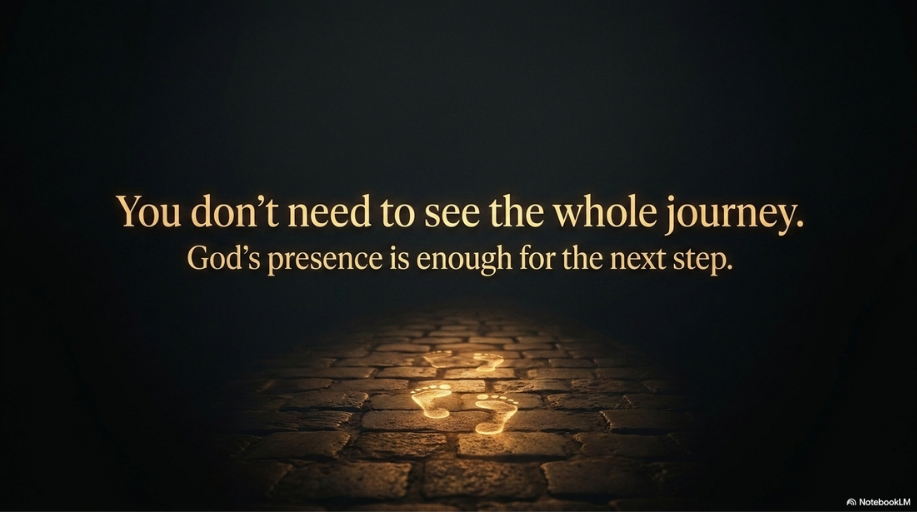
Before we ask this psalm for direction, we might let it reintroduce us to the One who gives it. The invitation this week is not first to figure out our path but to notice the Presence already on it with us. God has not handed us a map and stepped away. God has come close, near enough to light the ground beneath our feet. Begin here. Let the lamp be, before anything else, a sign that you are not walking alone.
Scripture
“Your word is a lamp to my feet, and a light for my path.” (Psalm 119:105, WEB)
From the Sermon
| “The matters of God, the things of God, the spoken presence of God in the psalmist’s life is like a lamp onto their feet and a light to the path.” |
For Reflection
- What does it change about Scripture to think of God’s word as the living presence of God with us, and not only as information about God?
- Where in your life right now do you most need to know that God is near, close enough to light the very ground you stand on?
- Who around you is walking in the dark this week, and how might your simple presence become a small lamp for them?
Prayer
Faithful God, before we ask you for direction, we thank you for your nearness. You did not leave us a map and walk away; you came close, near enough to light the ground beneath our feet. Open our eyes this week to your presence on the path with us. Teach us to trust the small, steady flame of your word, and to walk by it one step at a time. In the name of Jesus, our light, we pray. Amen.
Light for a Road of Snares and Stumbling Blocks
Devotional
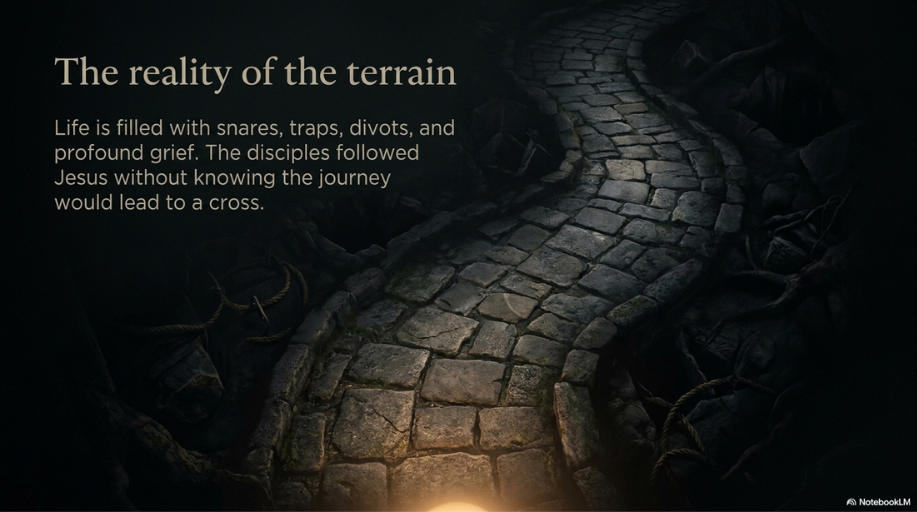
We sometimes imagine that the psalms were written from mountaintops of easy faith. This one was not. The psalmist speaks of a hard life: snares laid for him, traps set along his way, people who wanted to devour his very life. The image of the lamp was never decorative. It was born out of the felt experience of walking through genuine darkness, in the early morning or the late night, where a single misstep could mean real harm.
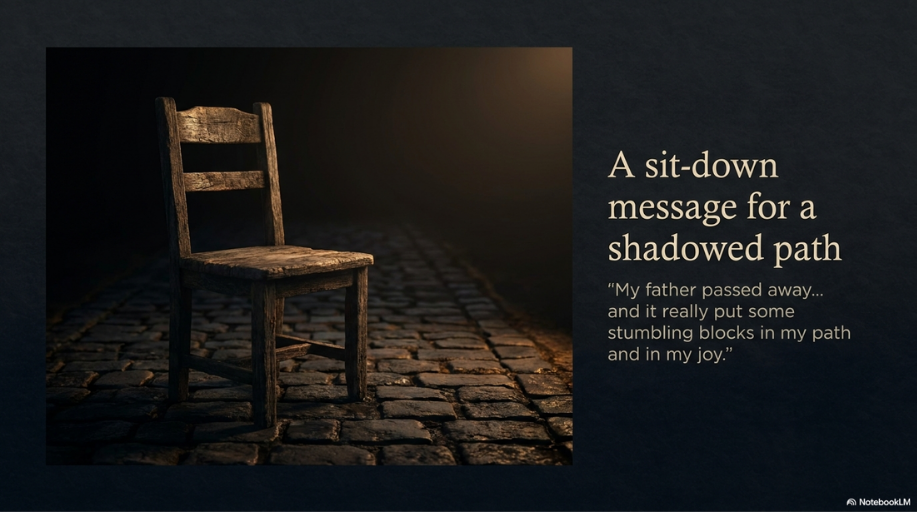
That is why this verse resists being read comfortably in a bright, warm room. It was written for people who knew what it was to need light because the way ahead was truly dark. Grief does this. Loss does this. The sudden shock of a phone call, a diagnosis, an empty chair at the table: these lay stumbling blocks across a path that seemed clear only yesterday. Our pastor named it plainly this week, out of his own recent loss, and many of us recognized the feeling in our own bodies.
Notice what the psalmist does not do. He does not pretend the snares are not there. He does not insist that faith has made his road smooth. He names the danger honestly and, in the same breath, holds on to God. The wicked have laid a snare for me, he says, yet I have not gone astray from your precepts. The lamp does not remove the traps. It shows him where not to step. That is a different, and more honest, kind of help than the one we often ask for.
If your path has stumbling blocks on it right now, this psalm is for you. It does not ask you to feel a light you do not feel, or to hurry past your grief. It offers something quieter and sturdier: enough light for this next step, even here, even now. God meets us, not in the life we wish we had, but in the one we are actually walking, snares and all, and God’s presence is enough for the ground in front of you.
Scripture
“The wicked have laid a snare for me, yet I haven’t gone astray from your precepts.” (Psalm 119:110, WEB)
From the Sermon
| “My father passed away, and wow, it really put some stumbling blocks in my path and in my life and in my joy and celebration.” |
For Reflection
- Why might God choose to give us light that reveals the snares rather than a life with no snares in it at all?
- What stumbling block is on your path right now, and what would it mean to name it honestly before God rather than stepping around it?
- Who in our congregation is walking a dark stretch of road, and what would it look like to walk beside them this week?
Prayer
God of the hard road, you do not ask us to pretend. You meet us in real darkness, among real snares, with real grief in our hands. We name before you now the stumbling blocks on our paths (pause). Do not let us go astray. Give us light enough for the next step, and give us one another to walk beside. We trust ourselves to your steady presence, through Jesus Christ. Amen.
Only Enough Light for the Next Step
Devotional
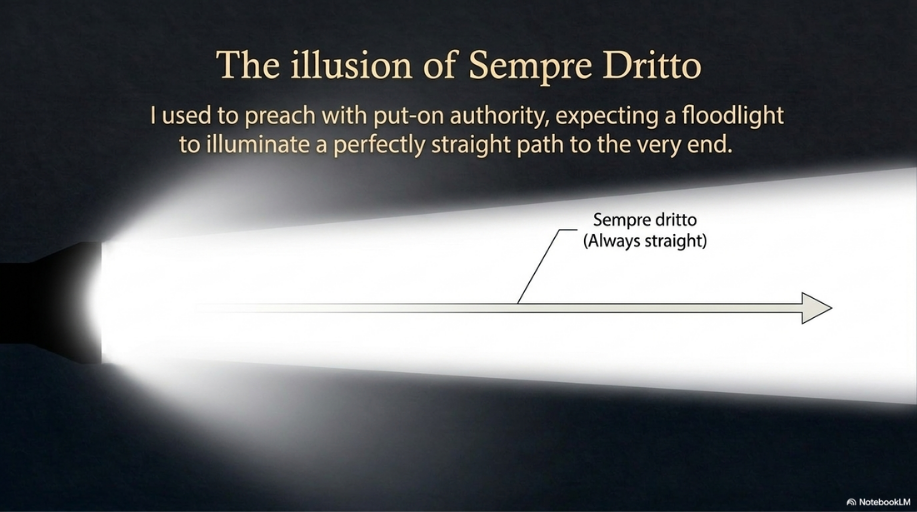
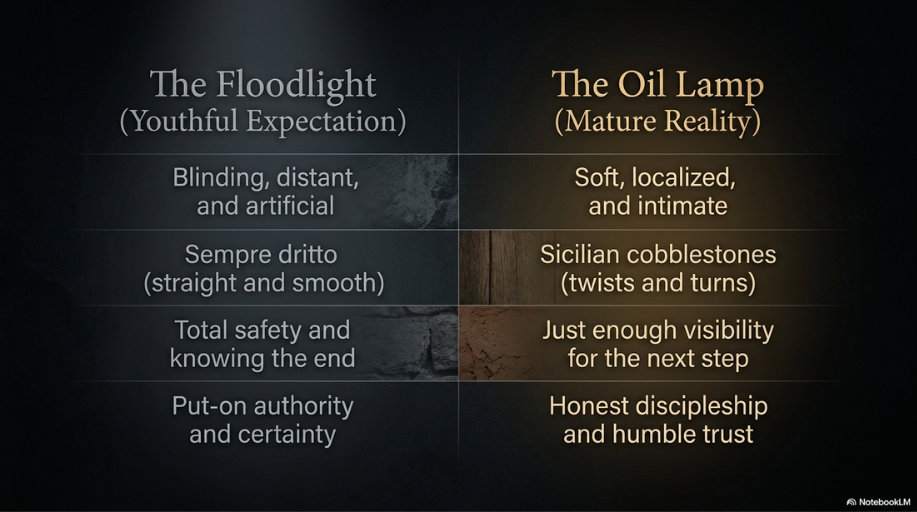
Here is the honest tension at the center of this week’s message. We want a floodlight. We want the kind of light that illuminates the entire path all the way to the end, so we can see every turn, avoid every divot, and know exactly how the story resolves. We want God’s guidance to work like a stadium light, and instead God hands us a small clay lamp that shows us only the ground immediately in front of us.
Our pastor described going back through nearly three decades of old sermons, letters, and blog posts, and noticing something about his younger self. He had often preached with a certain put-on authority and certainty, as though he carried a floodlight, as though the whole road ahead was clearly lit and guaranteed to be smooth. It is a temptation for all of us, not just preachers: to speak of faith as though it removes all mystery, as though a real Christian should always be able to see the end from the beginning.
But that is not the promise Scripture actually makes. The promise is smaller and, strangely, far more trustworthy. God’s presence will always be enough for the next step, and perhaps one more. The lamp is not broken because it fails to light the whole horizon. It is doing exactly what it was made to do. The problem is not the size of the light; it is the size of our demand. We keep asking a lamp to be a floodlight, and then we feel abandoned when it will not.
Maturity in faith often looks like laying that demand down. It means walking by faith and not by sight, trusting the One who holds the lamp rather than insisting on seeing the whole map ourselves. This is not resignation; it is a deeper kind of peace. When we stop despairing over the parts of the path we cannot see, we are freed to actually take the step we can see. Today, ask God not for a floodlight but for the grace to trust the lamp.
Scripture
“for we walk by faith, not by sight.” (2 Corinthians 5:7, WEB)
From the Sermon
| “We want a floodlight from the spirit of God that just shines all the way to the very end so that it’s just a straight path.” |
For Reflection
- What is the difference between a faith that removes all uncertainty and a faith that trusts God within uncertainty, and which one does Scripture actually promise?
- Where are you currently demanding a floodlight from God, straining to see the whole way when you have only been given light for the next step?
- How might your willingness to say, I do not know how this will turn out, but I trust God for the next step, become a gift to someone who is exhausted by pretending?
Prayer
Patient God, forgive us for demanding a floodlight when you have lovingly given us a lamp. We confess how often we despair over the road we cannot see and miss the step that is right in front of us. Teach us to walk by faith and not by sight. Give us peace in the not knowing, and trust in the One who holds the light. We will take the next step, because you are with us. Amen.
The Walk of Discipleship
Devotional
When Jesus called his first disciples, he did not hand them a plan. He said, simply, follow me. They did not know where he was going or what he would ask of them. They certainly did not imagine that the road would lead to a cross, that everything would seem, for a terrible moment, to come apart. And yet they went. Discipleship, from the very beginning, has meant walking with Jesus without being shown the whole itinerary in advance.
This is worth admitting, because we often quietly assume that following Jesus should come with more certainty than it does. Our pastor told of giving directions in Italy, where people would say sempre dritto, always go straight, as though the way were simple. But anyone who has walked a Sicilian town knows the truth: nothing is straight. The streets twist and turn over cobblestones, and just go straight turns out to be a small joke the old cities play on newcomers. Life with God is often more like those winding streets than the straight road we thought we were promised.
The temptation, when the path bends, is despair: to conclude that because we cannot see where this is going, God must not be leading. But the disciples’ story tells us otherwise. The turns did not mean Jesus had abandoned them. The darkness before the resurrection was not proof that the light had failed. It was, though they could not see it yet, the very road along which God was doing the deepest work. What looked like the path falling apart was the path all along.
To be a disciple is to keep taking the next step with Jesus even when the destination is hidden. It is to swear, with the psalmist, that we will follow God’s way, and then to actually do it, one bend in the road at a time. We do not need the whole map in order to be faithful. We need only to trust the Guide who carries the lamp, and to take the next step he makes visible. That is not a lesser faith. That is the walk itself.
Scripture
“Then Jesus said to his disciples, ‘If anyone desires to come after me, let him deny himself, take up his cross, and follow me.’” (Matthew 16:24, WEB)
From the Sermon
| “It’s supposed to be a walk of discipleship. Jesus said, come and follow me. And they didn’t know where Jesus was going or what Jesus was going to be doing.” |
For Reflection
- The disciples followed Jesus without knowing the destination, even toward a cross. What does their example teach us about what God actually asks of our faith?
- Where has your own path twisted in a way you did not expect, and how have you been tempted to read those turns as God’s absence?
- Who might God be calling you to walk alongside as a fellow disciple this week, not with all the answers, but simply taking the next step together?
Prayer
Lord Jesus, you called your first disciples with two words, follow me, and they went without knowing the way. Call us like that again. When our path twists and we cannot see the destination, keep us from despair. Remind us that the turns are not your absence, and the darkness is not the end of the story. We deny ourselves, take up our cross, and follow you, one step at a time. Amen.
Carry the Light to Others
Devotional
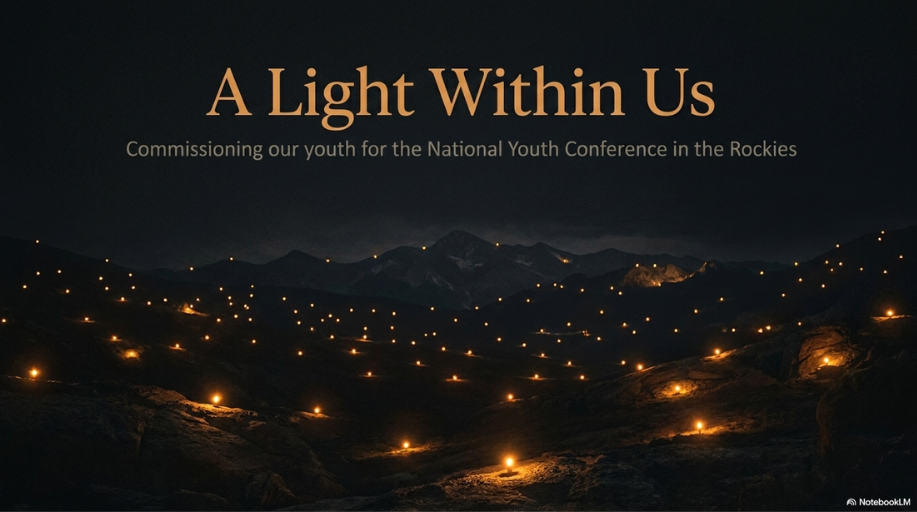
A lamp that only ever lit one person’s feet would be a small thing indeed. But the light God gives is meant to be carried. Having walked all week with the image of the lamp, we come now to the turn the sermon itself makes at the end: outward. The light within us is for the world. Our young people are gathering under the theme A Light Within Us, drawn from the words of Jesus in Matthew 5, and the same call belongs to every one of us, young and old alike.
Carrying the light rarely looks dramatic. Our pastor told of visiting Martha, who, taking her own next step of healing, had set herself up to write cards, delighted simply to be able to stand. Martha, what are you doing? I’m writing cards. Look, I can stand up. That is what carrying the light looks like on most days: not floodlit heroics, but the next small, faithful step, offered where we are, often in service of someone else. We take our step, and in doing so we help others take theirs.
It helps to remember how tender this is. When we carry our light to another person, our hopes and our dreams and our own hard-won experience of God, we are handing over something intimate. The world’s uncertainties press on people of every age. A recent Barna study of some fifteen hundred young people found them wrestling with real questions about the future, about what God is saying and doing. Those are our questions too. So we carry the light gently, honestly, without pretending we have the whole path figured out, offering only what we truly have.
And here is the promise to send us out with. As you go and carry your light, God goes with you, lighting your steps and your path through the whole of it. You may feel nervous about what to do or say. You may not know how it will turn out. But you can trust this: God will be with you the whole way, and one day, looking back, you will be able to say so. The lamp was never only for your feet. It was always meant to become, in you, a light the world could see.
Scripture
“You are the light of the world. A city located on a hill can’t be hidden. … Even so, let your light shine before men; that they may see your good works, and glorify your Father who is in heaven.” (Matthew 5:14, 16, WEB)
From the Sermon
| “As you carry your light and carry your hopes and carry your dreams and carry your experience of God, just remember that is an intimate, tender thing for most of us.” |
For Reflection
- Jesus calls us the light of the world and tells us to let that light shine. What does it mean that the light within us was always intended for others and not only for ourselves?
- What is one next step, small and specific like Martha’s cards, that you could take this week to carry your light to someone else?
- Our young people are carrying their light to the National Youth Conference, and there are people all around us carrying uncertain questions about the future. Whose light could you help tend and encourage in the days ahead?
Prayer
Shining God, you have called us the light of the world, and you have promised to walk with us as we carry that light to others. Send us out gently and honestly, ready to take the next small step of love. Go before us and beside us, lighting our path the whole way, so that when we look back we will say together: God was with us. Let our light shine, that others may see and give you glory. Amen.
A Light for All Our Paths
Small Group Discussion Guide
Based on the sermon by Pastor Harry Jarrett | Psalm 119:105-112 Pleasant Valley Church of the Brethren, Weyers Cave, Virginia
Summary
This week we looked at Psalm 119:105-112, the “nun” section of the Bible’s longest chapter, and its beloved image: “Your word is a lamp to my feet, and a light for my path.” Pastor Harry reminded us that the Hebrew word behind “word” (devar) means far more than sentences on a page; it points to the matters of God, the things of God, the very presence of God with us. The lamps of that day were small clay jars of oil that threw only enough light for the next step, never the whole road. And that, it turns out, is how God usually guides us. We long for a floodlight that shows the entire path, all the way to a smooth and certain end, but God gives us a lamp for the next step, and promises that it will be enough. Speaking honestly out of his own recent grief, and pointing to Martha taking her next small step of healing, Pastor Harry called us to a more honest faith: following Jesus one step at a time, even when we cannot see the destination, and carrying our light out to others, trusting that God is with us the whole way.
Opening Prayer
(Read aloud together, or led by one person.)
Gracious God, as we gather around your word, quiet our hearts. We do not come needing to see the whole road; we come asking you to light the step in front of us. Be present in our conversation, in our questions, and in the quiet between them, and lead us one step closer to you. In the name of Jesus, our light, we pray. Amen.
Ice Breaker
Think of a time you had to make your way somewhere in the dark (a power outage, a campsite, a late-night walk) with only a small light to guide you. What was that like? Or, if you prefer: when have you most wanted to see the whole road ahead of you, and had to settle for seeing only the next step?
Key Verses
“Your word is a lamp to my feet, and a light for my path.” (Psalm 119:105, WEB)
“The wicked have laid a snare for me, yet I haven’t gone astray from your precepts.” (Psalm 119:110, WEB)
“for we walk by faith, not by sight.” (2 Corinthians 5:7, WEB)
“You are the light of the world. A city located on a hill can’t be hidden. … Even so, let your light shine before men; that they may see your good works, and glorify your Father who is in heaven.” (Matthew 5:14, 16, WEB)
Group Discussion Questions
- The Hebrew word behind “word” in this psalm, devar, means more than sentences on a page; it points to the matters of God, the spoken presence of God with us. How does it change your reading of Psalm 119:105 to hear it as a promise of God’s presence, and not only of God’s instructions?
- The lamp of the psalmist’s day threw only enough light for the next step, never the whole road. Why do you think God so often chooses to guide us this way, one step at a time, rather than showing us the entire path at once?
- Pastor Harry admitted that as a younger preacher he spoke with a “put-on authority and certainty,” as if he carried a floodlight. What is the difference between a faith that claims to see the whole road and a faith that walks by the lamp, and what does “we walk by faith, not by sight” (2 Corinthians 5:7) add to that?
- Where in your life right now are you longing for a floodlight, straining to see how something will turn out, when God may only be offering light for the next step?
- The psalm was written by someone facing snares and real hardship, and Pastor Harry spoke openly about the stumbling blocks that grief laid on his own path. When has a hard season made this “next step at a time” kind of faith feel more real to you?
- Jesus said, “follow me,” and the disciples went without knowing where the road would lead, even toward a cross. What would it look like for you to take your next faithful step this week, even though you cannot see the destination?
- Pastor Harry described Martha, mid-recovery, delighting simply to be able to stand up and write cards, taking her next step by caring for others. Who around you is walking a dark stretch of road, and what small, next-step act of light could you offer them this week?
- Our young people are heading to the National Youth Conference under the theme “A Light Within Us” (Matthew 5). How can this group carry and share its light: with the youth, with the wider congregation, and with neighbors who are wrestling with uncertainty about the future?
Life Applications
- Name your next step. Identify one specific, doable “next step” that God seems to be lighting for you right now (a conversation, a task, a decision), and take it before the group meets again. Check-in: Come ready to tell the group what your one step was, and whether you took it.
- Walk with someone in the dark. Think of one person carrying grief or hard news, and do one small thing this week to walk beside them (a card, a call, a visit, a meal). Check-in: Text one group member once you have reached out, simply saying “done,” so you can encourage each other along the way.
- Lay down the floodlight. Choose one worry about the future that you keep trying to floodlight, and each day this week pray, “God, light my next step,” rather than demanding to see the whole road. Check-in: At week’s end, note whether that daily prayer changed how the worry felt, and share it next time you gather.
- Bless the light-carriers. Pray by name this week for the youth and leaders going to the National Youth Conference, and if you can, send one of them a short note of encouragement. Check-in: Bring the name of the person you prayed for or wrote to, and share one hope you have for them.
Key Sermon Takeaways
- Psalm 119 is the Bible’s longest chapter, an acrostic built on the Hebrew alphabet; our passage sits right in the middle, in the “nun” section.
- The “word” (devar) is more than text; it is the matters, the things, the spoken presence of God in our lives.
- The lamps of that day lit only the next step or two, never the whole path, and that is the picture of how God guides us.
- We tend to want a floodlight that reveals the entire road; God usually gives a lamp for the next step, and promises it will be enough.
- A “next step at a time” faith is more honest, more accessible, and truer to how life actually works, and it is a real comfort in grief and uncertainty.
- Discipleship means following Jesus without seeing the destination, then carrying our light out to others, trusting that God is with us the whole way.
Closing Prayer
(Read aloud together, or led by one person.)
Faithful God, thank you for walking with us in this time together, and for the light you give, always enough for the next step. As we go back to our homes and our weeks, teach us to trust the lamp instead of demanding the floodlight. Carry us through the twists and turns, comfort us in our grief, and make us light-bearers for one another and for a watching world. When we look back, let us be able to say together: God was with us the whole way. Amen.