The Questions We All Carry
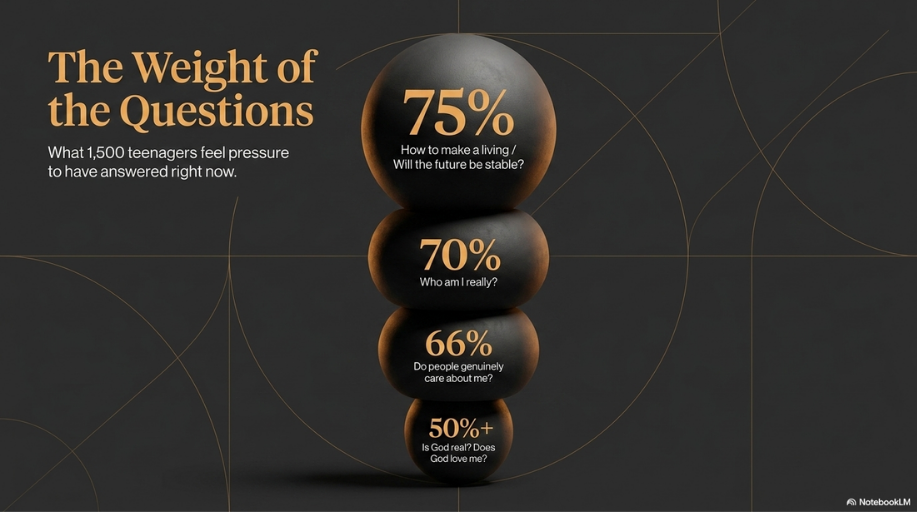
A recent Barna Group study asked 1,500 teenagers a striking question: not what they worry about, but what they feel pressure to figure out right now. Three out of four feel pressured to know how they will make a living. Three out of four feel pressured to know whether the future will even hold. Seven in ten carry the question of who they really are. Two-thirds wonder whether people genuinely care about them. And more than half, underneath everything else, are asking whether God is real and whether God really loves them.
If you are a teenager, none of that surprises you. You did not need research to tell you what you feel inside. But here is what the rest of us need to hear: when we read that list honestly, we do not think, “How sad for them.” We think, “I know every one of those questions personally.” Will the future hold? What is true? Who am I really? Does anyone see me? Is God real, and does God love me?
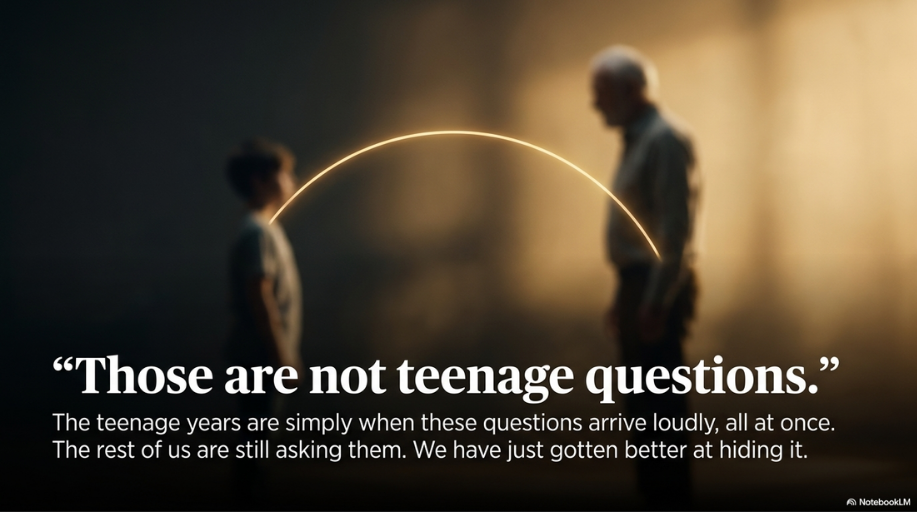
These are not teenage questions. They are human questions. The teenage years are simply when they all arrive at once, loudly, before anyone has explained that the adults nearby are still asking the same things. We have just gotten better at hiding it.
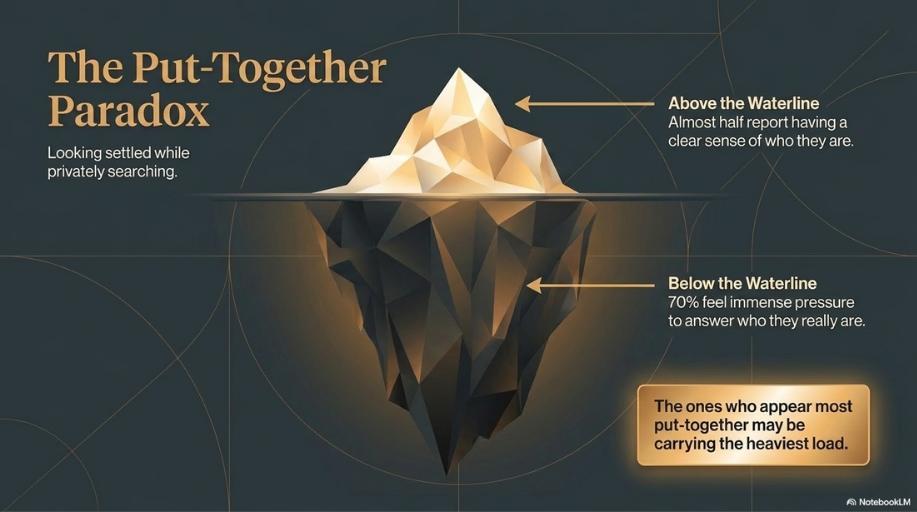
The study found one more thing worth sitting with. Almost half of teens say they have a clear sense of who they are, yet seventy percent feel pressure to answer who they really are. Put those together and you see people who have learned to look settled while privately searching. The ones who appear most put together may be carrying the heaviest loads. That is not a description of one generation. It is a description of every pew in every church, and probably of the person reading this page.
Scripture
“For I don’t know what I am doing. For I don’t practice what I desire to do; but what I hate, that I do.” (Romans 7:15, WEB)
From Sunday’s Sermon
| “Those are not just teenage questions. Those are human questions.” |
Reflection Questions
- What does it tell us about God that Scripture preserves the raw, unresolved questions of people like Paul rather than editing them out?
- Which of the five questions from the study (making a living, the future, identity, being cared for, God’s love) presses hardest on you right now?
- Who around you might be looking settled while privately searching, and what would it take to notice them this week?
Prayer
God of every generation, we confess that we carry questions we rarely say out loud. We ask about the future, about who we are, about whether you are real and whether you love us. Meet us in our honest asking. Remind us that our questions do not disqualify us from your presence. Through Jesus Christ our Lord, amen.
Honesty Is the Doorway
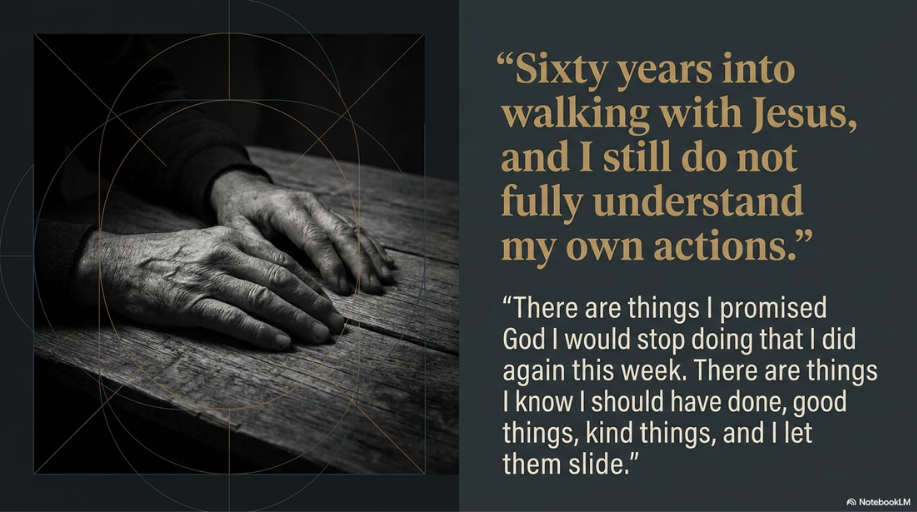
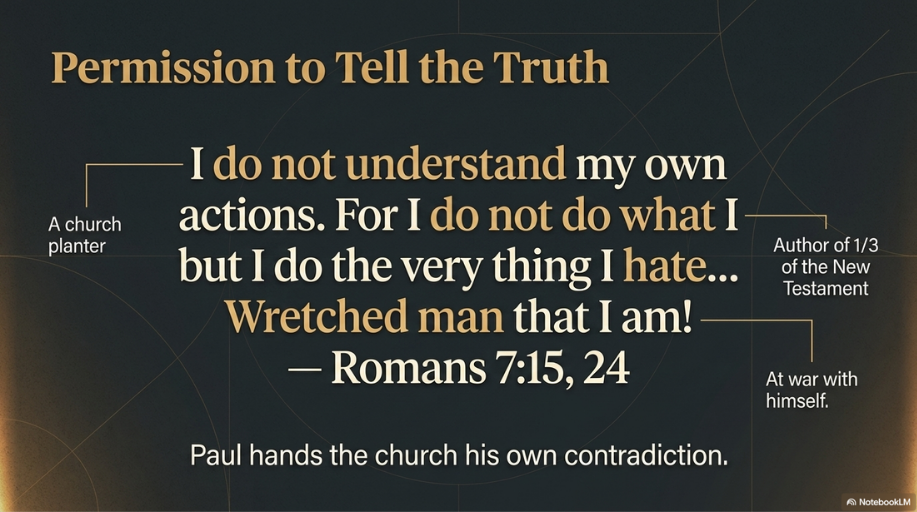
The Apostle Paul was a church planter, a missionary, and the author of two-thirds of the New Testament. Yet in a letter he knew would be read aloud in worship, he wrote: “I do not understand my own actions. For I do not do what I want, but I do the very thing I hate.” This is not a polished testimony with the rough edges sanded off. It is one of the giants of the faith saying, on the record, “I am divided. I am at war within myself. The thing I swore off, I did it again last Tuesday.”
Why would Paul hand the church a confession of his own contradictions? Because he understood something every one of us needs, whether we are fifteen or eighty-five: honesty about the struggle is not the opposite of faith. Honesty about the struggle is where real faith actually lives.
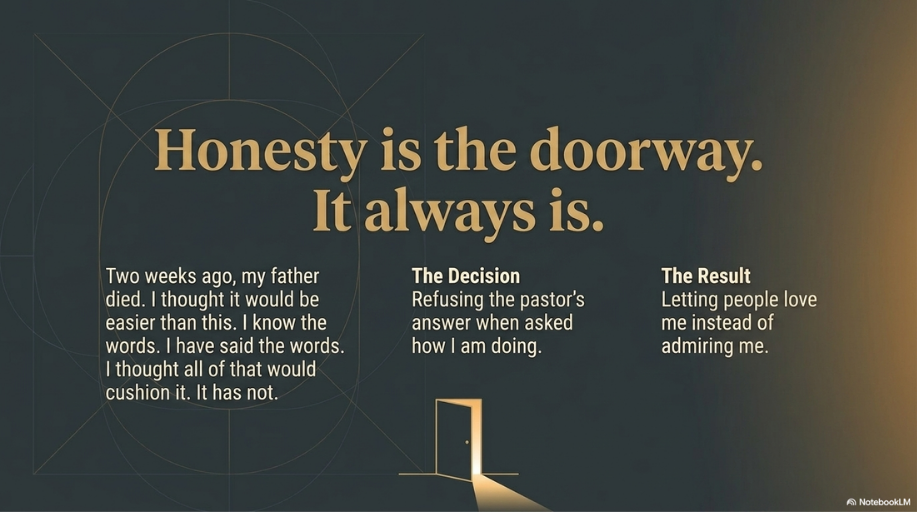
Pastor Harry offered his own confession this week: grieving the recent death of his father, he decided not to perform when people asked how he was doing. No pastor’s answer. Just the truth: not well, not well at all. That honesty has opened doors that a polished answer would have kept shut. It has let people love him instead of merely admiring him.
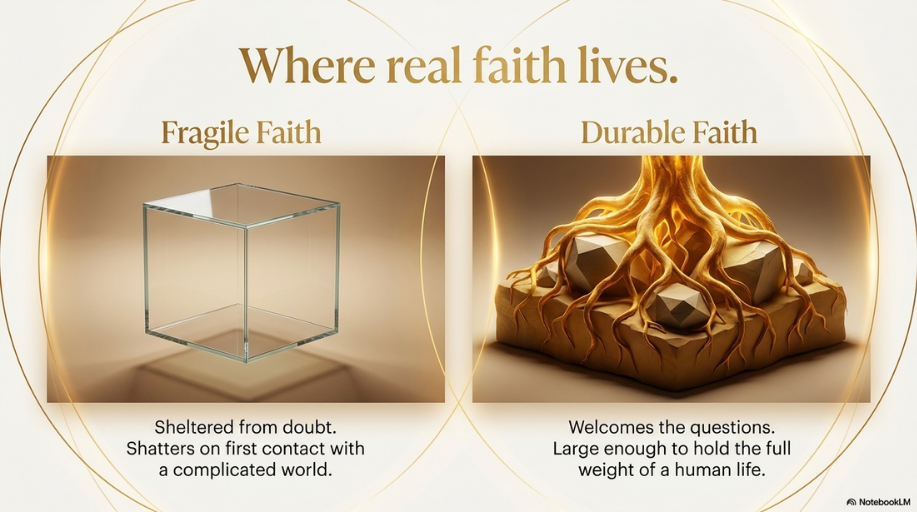
The research agrees with Paul. The strongest, most durable faith does not grow in people who have been sheltered from doubt and pain. It grows where doubt is welcomed, where questions are taken seriously, where faith is treated as something large enough to hold the full weight of human life. A faith protected from hard questions is not strong. It is fragile, waiting to crack on first contact with a complicated world.
Scripture
“What a wretched man I am! Who will deliver me out of the body of this death? I thank God through Jesus Christ, our Lord!” (Romans 7:24-25a, WEB)
From Sunday’s Sermon
| “Honesty about the struggle is not the opposite of faith. Honesty about the struggle is where real faith actually lives.” |
Reflection Questions
- If the Bible makes room for a man to say “I do not understand my own actions” and still calls him an apostle, what does that suggest about what God requires of us?
- Where in your life are you giving the polished answer instead of the true one, and what is that performance costing you?
- Whose love have you been keeping at arm’s length by being admirable instead of honest, and what one true sentence could you say to them this week?
Prayer
Lord Jesus, we are tired of performing. Like Paul, we do not fully understand our own actions, and like him, we bring our divided hearts to you. Teach us that honesty is the doorway. Give us courage to answer truthfully when someone asks how we are, and give us grace to receive love and not just admiration. Amen.
Living Next to the Loudspeaker
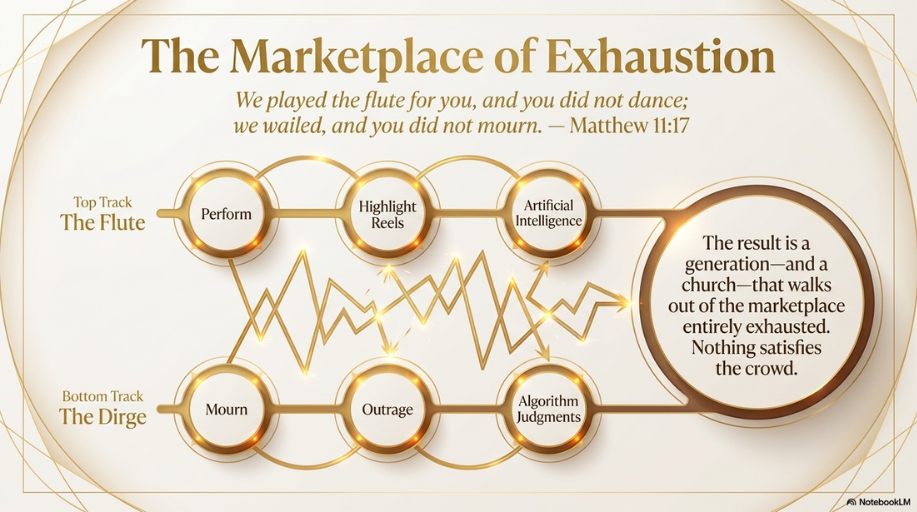
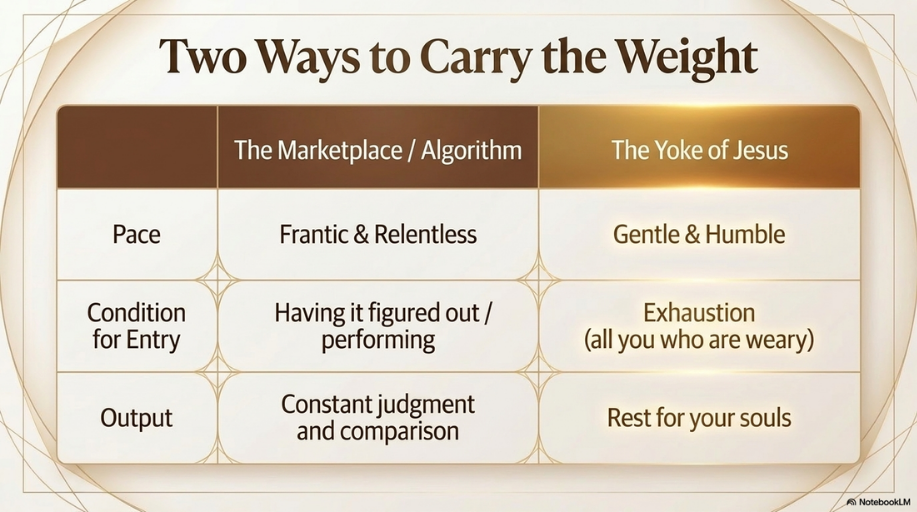
In Matthew 11, Jesus looks at his generation with real frustration, and there is something oddly comforting in that. He compares them to children sitting in the marketplace, calling out: “We played the flute for you, and you did not dance. We wailed, and you did not mourn.” Nothing satisfies. John came fasting, and they said he had a demon. Jesus came feasting, and they called him a glutton and a friend of sinners. Whatever song played, they refused to join in, and they judged everyone who did.
We all still live in that marketplace. But let us be honest about who lives closest to the loudspeaker. Every screen in our pockets is a chorus of voices insisting the flute is playing and we had better dance, the dirge is playing and we had better mourn, and whatever we do, someone will judge us within a minute or two.
Generation Alpha, today’s children and teenagers, are the first generation to grow up alongside artificial intelligence, and two-thirds of them are already asking whether they can trust it and what it means for being human. Those are good questions. But the rest of us are not exempt. Grown adults walk through the marketplace of social media exhausted, comparing our lives, our churches, our children, and our retirements to a highlight reel that never stops.
No wonder we are tired, all of us. The marketplace will hand you thousands of answers, and it will charge you your peace for every single one. Naming that clearly is the first step toward hearing a gentler voice.
Scripture
“But to what shall I compare this generation? It is like children sitting in the marketplaces, who call to their companions and say, ‘We played the flute for you, and you didn’t dance. We mourned for you, and you didn’t lament.'” (Matthew 11:16-17, WEB)
From Sunday’s Sermon
| “The marketplace will hand you thousands of answers and charge you your peace for every single one.” |
Reflection Questions
- What does Jesus’ frustration with his own generation reveal about how God regards the noise and judgment of every age, including ours?
- Where has the marketplace been charging you your peace lately: a feed, a comparison, a voice you keep listening to?
- What is one concrete way you could help someone younger step back from the loudspeaker this week, without a lecture?
Prayer
Father, we live next to the loudspeaker, and we are weary. Voices tell us when to dance and when to mourn, and they judge us either way. Quiet the marketplace in our hearts. Help us trade the endless scroll of comparison for the sound of your voice, which is gentler than any algorithm. Amen.
Revealed to Infants
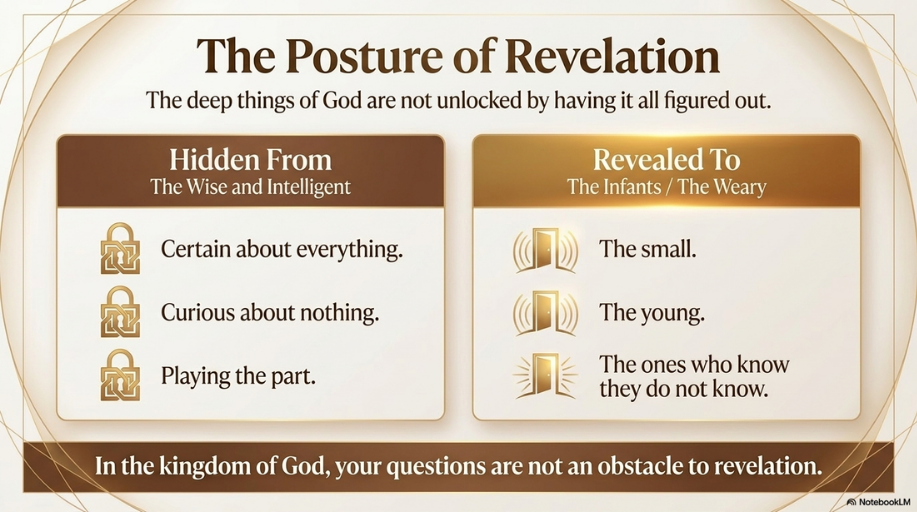
Right in the middle of his frustration with the marketplace, Jesus prays one of the loveliest prayers in the Bible: “I thank you, Father, Lord of heaven and earth, because you have hidden these things from the wise and the intelligent and have revealed them to infants.”
What is Jesus saying? The deep things of God are not unlocked by having it all figured out. They are revealed to the small, the young, the ones who know they do not know it all. In the Kingdom of God, questions are not an obstacle to revelation. They are the posture that revelation is looking for.
For those of us with more mileage, this is a strong warning. The moment we start playing the wise and intelligent, certain about everything and curious about nothing, we become the ones the deep things get hidden from. Certainty can become a locked door; humble curiosity keeps it open.
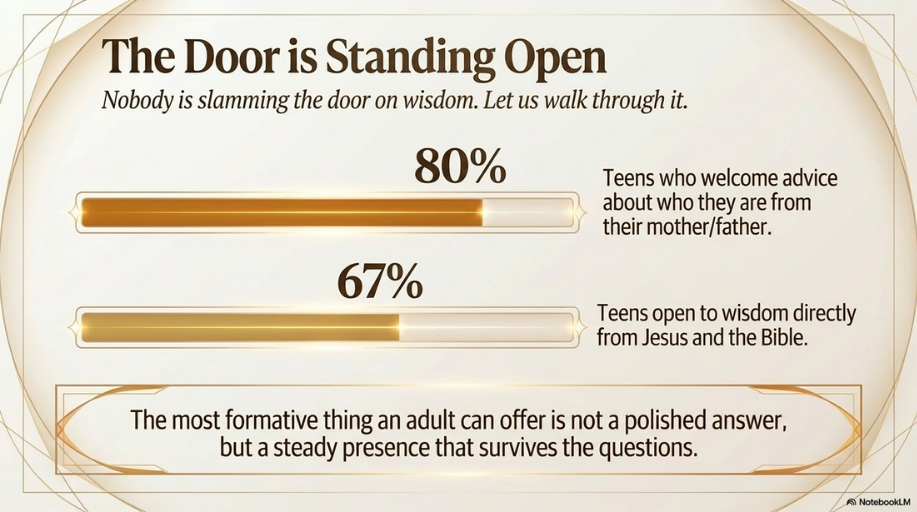
The Barna researchers found a door standing wide open. Eight in ten teens said they would welcome advice about who they are from their mother. More than two-thirds said they are open to wisdom from Jesus and the Bible. Somehow we have been told otherwise, but nobody is slamming that door. The most formative thing any adult can offer a young person is not a polished answer. It is a steady, trusted presence and a faith large enough to survive the big questions.
Scripture
“At that time, Jesus answered, “I thank you, Father, Lord of heaven and earth, that you hid these things from the wise and understanding, and revealed them to infants.”” (Matthew 11:25, WEB)
From Sunday’s Sermon
| “Your questions are not an obstacle to revelation. They are the posture that revelation is looking for.” |
Reflection Questions
- Why do you think God reveals deep things to the humble and hides them from the self-assured, and how does that reorder what we call spiritual maturity?
- Where have you been playing the wise and intelligent, certain about everything and curious about nothing?
- Who is one younger person you could invite into your actual life this week: your kitchen, your garden, your workbench, your grief, your gratitude?
Prayer
Lord of heaven and earth, we thank you that revelation belongs to the small and the searching. Forgive us for the times our certainty has crowded out curiosity. Make us childlike again. Open our tables and our lives to a younger generation, and make us steady, trusted presences with a faith large enough for their questions and ours. Amen.
The Shared Yoke
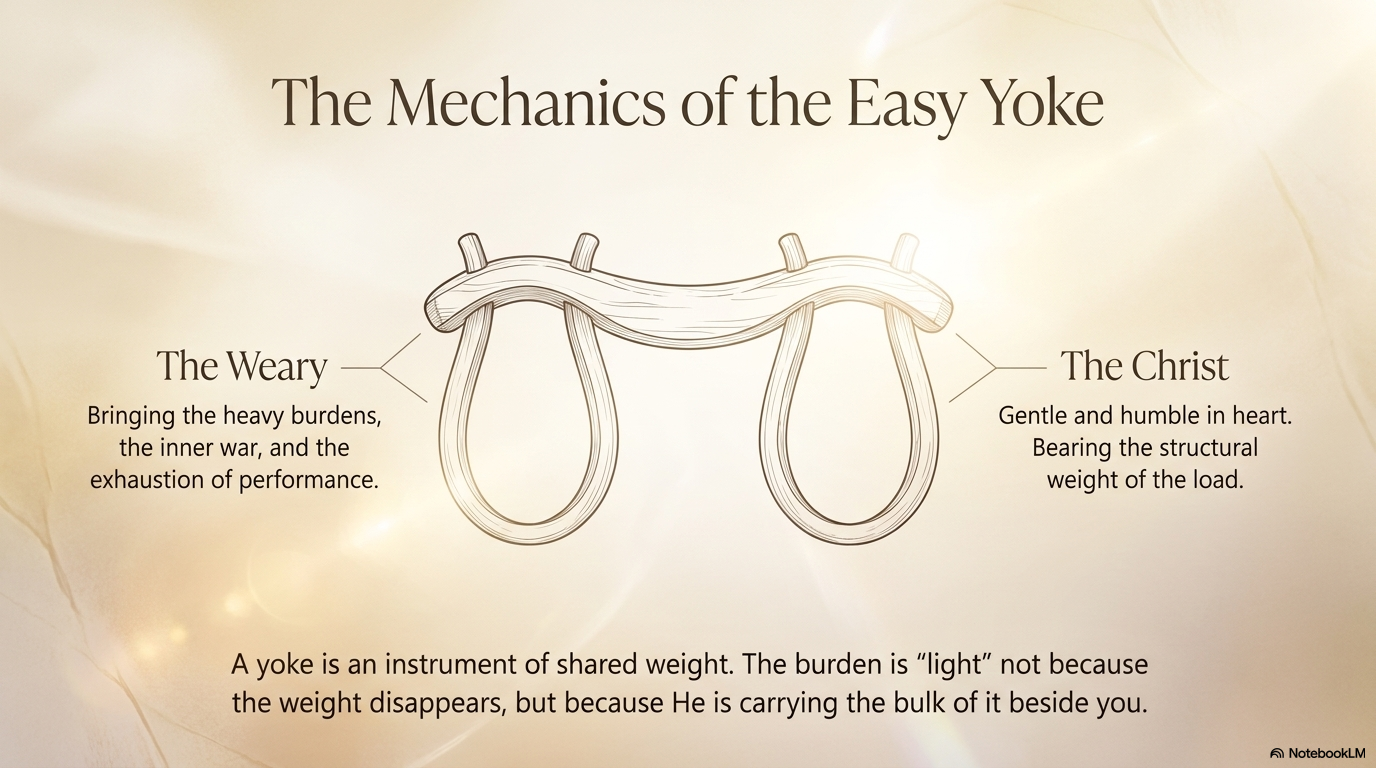
Then comes the invitation, words some of us have carried since childhood: “Come to me, all you that are weary and are carrying heavy burdens, and I will give you rest. Take my yoke upon you and learn from me, for I am gentle and humble in heart, and you will find rest for your souls.”
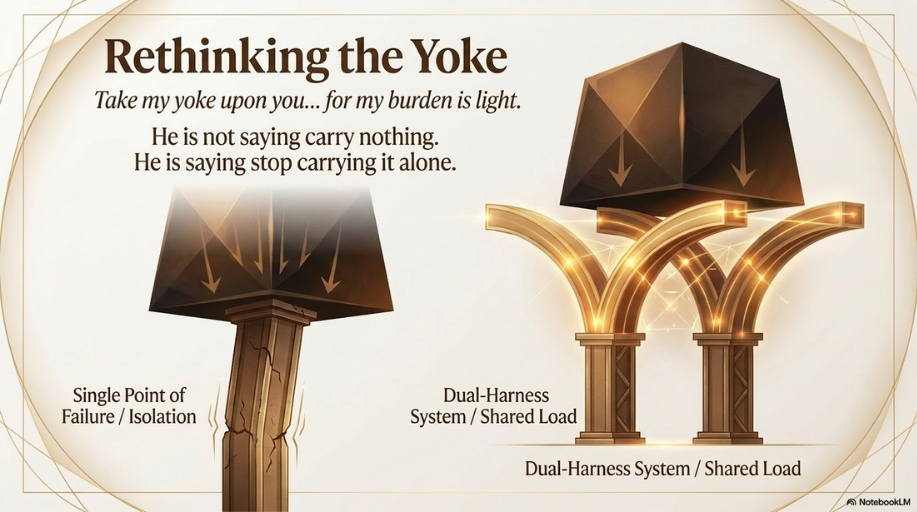
A yoke is a farmer’s tool, and here in the valley we know something about that. A yoke joins two animals so the load is shared and neither pulls alone. So when Jesus says, “Take my yoke,” he is not saying carry nothing. He is saying: stop carrying it alone. Get in the harness with me. Learn my pace. I am gentle. I will not drive you the way the marketplace drives you.
Notice who the invitation is for: all who are weary. Not all who have their worldview sorted out. Not all who have resolved their doubts. Not all who are grieving the right way. The only qualification is exhaustion, which means every person in this room qualifies. The rescue Paul cried out for and the rest Jesus offered are the same gift, and it is not an answer key. It is a relationship. It is a shared yoke.
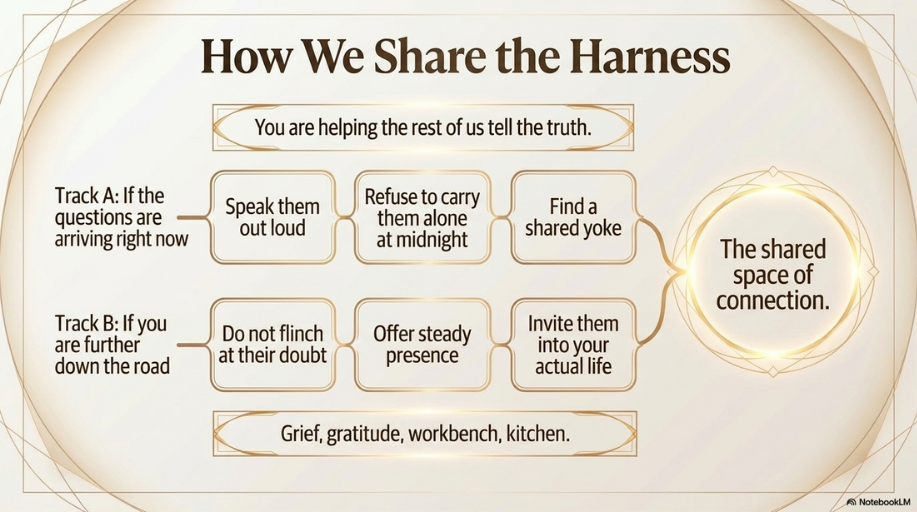
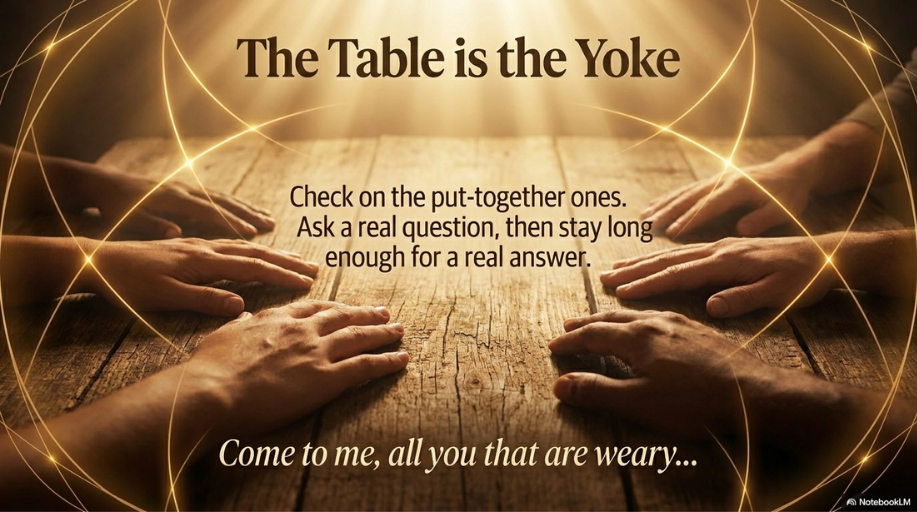
So bring your questions here. Say them out loud to someone you trust rather than carrying them alone at midnight with only a screen for company. Check on the put-together ones: the honor student, the reliable volunteer, the friend who never causes trouble, because the ones who look the most settled may be carrying the most weight. Ask real questions, and then stay long enough to hear a real answer. You were never meant to pull this cart alone.
Scripture
“Come to me, all you who labor and are heavily burdened, and I will give you rest. Take my yoke upon you and learn from me, for I am gentle and humble in heart; and you will find rest for your souls. For my yoke is easy, and my burden is light.” (Matthew 11:28-30, WEB)
From Sunday’s Sermon
| “You were never meant to pull this cart alone.” |
Reflection Questions
- What does it mean that the rescue God offers is a relationship and a shared yoke rather than a technique or an answer key?
- What burden have you been pulling alone, and what would it look like to get in the harness with Jesus this week?
- Which put-together person in your life will you check on this week, asking a real question and staying long enough for a real answer?
Prayer
Gentle Savior, we come to you weary and carrying heavy burdens. We qualify. Take from us the weight we were never meant to pull alone, and teach us your pace. Yoke us to yourself and to one another, so that no one in this church family carries their questions in the dark. Thanks be to God through Jesus Christ our Lord. Amen.
Small Group Discussion Guide
The Inner Struggle of a Generation
Texts: Romans 7:15-25a; Matthew 11:16-19, 25-30 Pleasant Valley Church of the Brethren
Summary
A recent Barna Group study asked 1,500 teenagers what they feel pressure to figure out right now. Three out of four feel pressured to know how they will make a living and whether the future will hold. Seven in ten carry the question of who they really are. Two-thirds wonder whether anyone genuinely cares about them, and more than half are asking whether God is real and whether God loves them. Pastor Harry’s central claim is that these are not teenage questions; they are human questions, and the adults in the room are still asking them too. We have just gotten better at hiding it.
Paul models the alternative to hiding. In Romans 7 one of the giants of the faith says on the record, “I do not understand my own actions.” Honesty about the struggle is not the opposite of faith; it is where real faith actually lives. In Matthew 11, Jesus names the marketplace we all live in (a chorus of voices telling us to dance, to mourn, and judging us either way), then prays that the deep things of God are revealed to infants, to the small and the searching, not to the certain. His invitation is addressed to the weary, and the only qualification is exhaustion. The rescue is not a technique or an answer key. It is a relationship: a shared yoke, so that no one pulls the cart alone.
Opening Prayer
To be read aloud together or led by one person:
God of every generation, thank you for gathering us around your Word. We come with questions we rarely say out loud: about the future, about who we are, about whether you are real and whether you love us. Tonight, help us tell the truth to you and to one another. Make this room a place where honesty is welcomed, where doubt is taken seriously, and where your rest is offered to the weary. Through Jesus Christ our Lord, amen.
Ice Breaker
When you were a teenager, what was one question or worry that felt enormous to you at the time? Looking back, did it fade, or is some version of it still with you?
Key Verses
All quotations from the World English Bible (WEB).
Romans 7:15 “For I don’t know what I am doing. For I don’t practice what I desire to do; but what I hate, that I do.”
Romans 7:24-25a “What a wretched man I am! Who will deliver me out of the body of this death? I thank God through Jesus Christ, our Lord!”
Matthew 11:16-17 “But to what shall I compare this generation? It is like children sitting in the marketplaces, who call to their companions and say, ‘We played the flute for you, and you didn’t dance. We mourned for you, and you didn’t lament.'”
Matthew 11:25 “At that time, Jesus answered, ‘I thank you, Father, Lord of heaven and earth, that you hid these things from the wise and understanding, and revealed them to infants.'”
Matthew 11:28-30 “Come to me, all you who labor and are heavily burdened, and I will give you rest. Take my yoke upon you and learn from me, for I am gentle and humble in heart; and you will find rest for your souls. For my yoke is easy, and my burden is light.”
Group Discussion Questions
- Pastor Harry opened with a confession that after sixty-two years of walking with Jesus, he still does not fully understand his own actions. Why do you think he began there, and how did it change the way you heard the rest of the sermon?
- The Barna study found that teens feel pressure to figure out their livelihood, the future, their identity, whether anyone cares about them, and whether God is real and loves them. Which of those questions surprised you least? Which one do you suspect adults are still quietly asking?
- Paul wrote “I do not understand my own actions” in a letter he knew would be read aloud in worship. What does it tell us about God, and about Scripture, that this confession was preserved rather than edited out?
- The sermon claimed that “honesty about the struggle is not the opposite of faith. Honesty about the struggle is where real faith actually lives.” Do you agree? Where have you seen honest struggle produce durable faith, in your life or someone else’s?
- Barna found that almost half of teens say they have a clear sense of who they are, yet seventy percent feel pressure to answer who they really are: people who have learned to look settled while privately searching. Why do we perform being put together, especially at church?
- Jesus compares his generation to children in the marketplace: nothing satisfies, and every choice gets judged. Where do you feel the marketplace loudest in your own life right now, and how is it different for the youngest people in your family?
- Jesus thanks the Father for hiding the deep things from “the wise and understanding” and revealing them to infants. What is the difference between mature faith and the kind of certainty that Jesus warns against here?
- The invitation of Matthew 11 is addressed to the weary, and Pastor Harry noted that “the only qualification is exhaustion.” What does it mean, practically, that the rescue is a relationship and a shared yoke rather than an answer key?
Life Applications
1. Give one honest answer. At least once this week, when someone asks “How are you doing?”, skip the polished answer and tell the truth, the way Pastor Harry has chosen to about his grief. Check-in prompt: Next week, share who you were honest with and what happened after you told the truth.
2. Check on a put-together person. Identify one person who always looks settled (the honor student, the reliable volunteer, the friend who never causes trouble). Ask them a real question and stay long enough to hear a real answer. Check-in prompt: Next week, tell the group what you learned about someone you thought you already knew.
3. Open your actual life to someone younger. Invite a young person into your kitchen, garden, workbench, grief, or gratitude: presence over lecture. If a doubt gets voiced, do not flinch and do not rush to fix it. Say, “I have wrestled with this too.” Check-in prompt: Next week, share whom you invited and what question, if any, came up.
4. Audit the loudspeaker. Pick one screen habit that has been charging you your peace (a feed, an app, a comparison loop) and reduce it for seven days. Replace one scroll session with the Matthew 11 invitation, read slowly. Check-in prompt: Next week, report what you cut back and what you noticed about your weariness.
Key Sermon Takeaways
- The pressures Barna found in teenagers (livelihood, the future, identity, being cared for, God’s reality and love) are not teenage questions. They are human questions that every generation carries.
- The people who appear most put together may be carrying the heaviest loads. Nearly half of teens claim a clear identity while seventy percent feel pressure to figure out who they are.
- Honesty about the struggle is not the opposite of faith. Paul’s “I do not understand my own actions” shows that real faith lives in truthful confession, not in performance.
- A faith sheltered from hard questions is fragile. Durable faith grows where doubt is welcomed and questions are taken seriously.
- We all live in the marketplace of Matthew 11, but those with screens in their pockets live closest to the loudspeaker. The marketplace hands out thousands of answers and charges us our peace for every one.
- The deep things of God are revealed to infants: to the small, the young, and the searching. Questions are not an obstacle to revelation; they are the posture revelation is looking for.
- Jesus’ invitation is addressed to the weary, and the only qualification is exhaustion. The rescue is not a technique. It is a relationship, a shared yoke: you were never meant to pull this cart alone.
- The most formative thing an adult can offer a young person is not a polished answer but a steady, trusted presence and a faith large enough to survive the big questions.
Closing Prayer
To be read aloud together or led by one person:
Gentle Savior, we come to you weary and carrying heavy burdens, and you tell us that we qualify. Thank you that Paul could confess his divided heart and still belong to you, and that we can carry our questions and belong here too. Quiet the marketplace in our minds. Yoke us to yourself and to one another, so that no student, no parent, no retiree in this church family pulls the cart alone. Make us steady, trusted presences for the generation coming behind us, with a faith large enough for their questions and for ours. Thanks be to God through Jesus Christ our Lord. Amen.