Day One: He Would Not Send Them Away
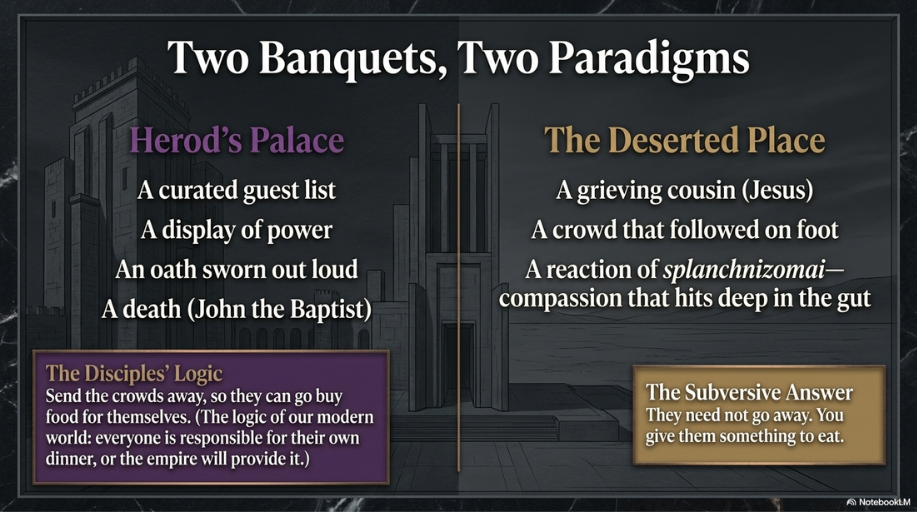
Jesus has just learned that John, his cousin, the one who baptized him, has been killed at a birthday party. He gets in a boat and goes to a deserted place to grieve. The crowds walk around the lake and are waiting on the shore when he lands. Matthew does not say Jesus was irritated. He says Jesus had compassion. The Greek word is splanchnizomai. It means it hit him in the gut, deep as the grief he was already carrying. Later, when the disciples propose the reasonable thing (send the crowds away so they can buy their own food), Jesus answers with eight words that overturn the whole arrangement: they do not need to go away, you give them something to eat. Notice that the compassion comes first and the command comes second. Before there is a miracle, there is a decision not to dismiss anybody.
SCRIPTURE
“When he went ashore, he saw a great crowd; and he had compassion for them and cured their sick.” (Matthew 14:14)
FROM THE SERMON
Matthew says he had compassion for them. Not irritation. The Greek word is splanchnizomai (pronounced splangkh-nid-zom-ahee). It means it hit him in the gut. Deep like the grief.
REFLECTION
What does it tell us about God that Jesus’ first response to an interrupting crowd was compassion rather than distance? Where in your own life have you quietly decided that someone else is somebody else’s responsibility? Who is standing on your shore this week, and what would it cost you to stay?
PRAYER
God of compassion, you saw the crowd on the shore and you did not turn away, even while you were grieving. Teach us that same gut-level mercy. When we are tired, when we are hurting, when the need in front of us is inconvenient, give us the courage to stay. Amen.
Day Two: Whose Table Is This?
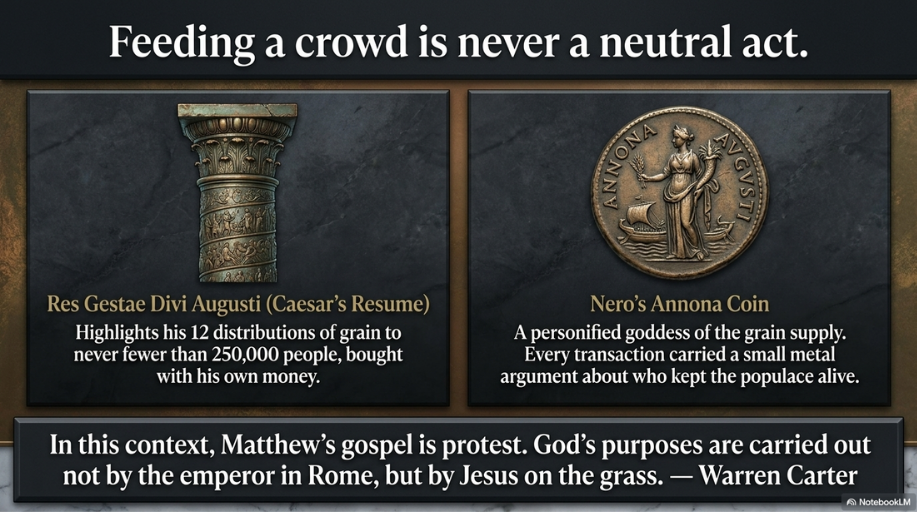
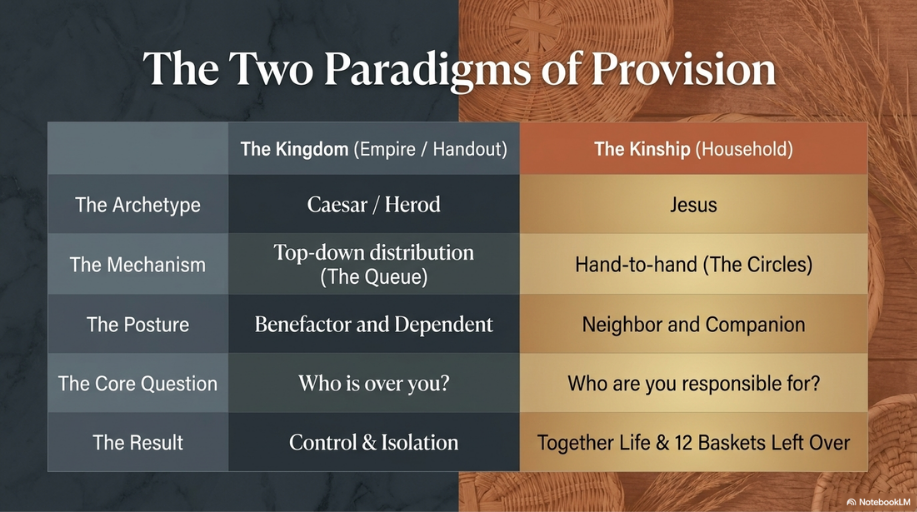
Matthew 14 holds two banquets, and we almost never read them together. The first is Herod’s: a palace, a birthday, an oath sworn out loud in front of witnesses, and a man’s head carried in on a serving platter. Matthew wants you to remember the dinner plate. Behind Herod stands a larger table still. Caesar Augustus had his own resume carved onto bronze pillars, and in the middle of a list of wars won and temples built he stops to tell you about the food: twelve distributions of grain, cash handouts reaching never fewer than two hundred and fifty thousand people. Rome fed you, and Rome made sure you knew it. Then Jesus sets a third table on the grass. No guest list. No ledger. No throne. Small circles of people close enough to see each other’s faces, and twelve baskets left over.
SCRIPTURE
“The kings of the Gentiles lord it over them; and those in authority over them are called benefactors. But not so with you.” (Luke 22:25-26)
FROM THE SERMON
Herod’s table has a guest list, a display of power, and a death. Caesar’s table has a ledger, a benefactor, and a quiet bill of dependence. This table has small groups of gathered people, dispersed, Jesus as Lord, and twelve full baskets for the future of the church.
REFLECTION
Why does it matter theologically that Jesus feeds people without creating dependence on himself as a patron? Which table has quietly shaped how you think about who is owed what, and who is worth feeding? Where is your community still setting Caesar’s table when it could be setting Jesus’?
PRAYER
Lord Jesus, there are many tables competing for our loyalty, and most of them keep a ledger. Free us from the ones that feed us and then hand us a bill. Seat us at your table instead, where the only requirement is hunger and the only currency is grace. Amen.
Day Three: What Was Already in Their Hands
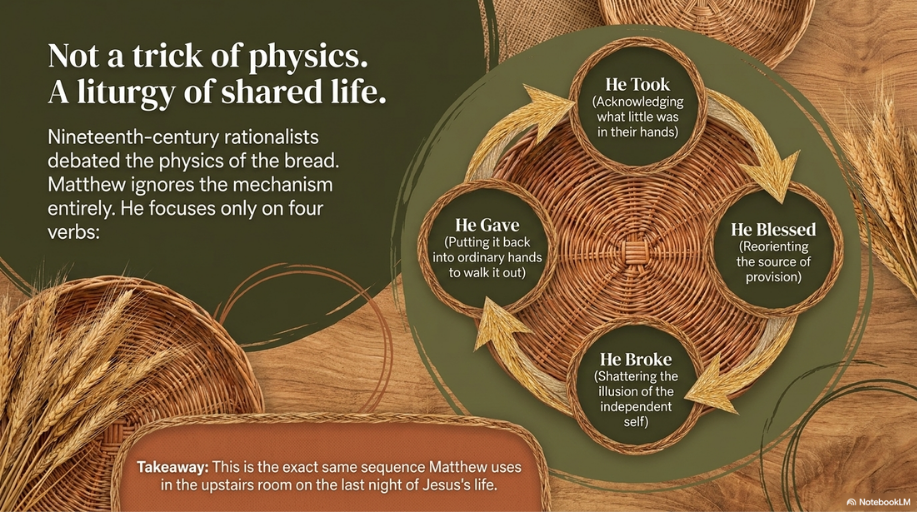
We want to know what kind of miracle this was. Did bread appear out of nothing, or did a crowd quietly open the lunches they had been sitting on all along? Matthew never says. Not one word about the mechanism. He tells us only what was in their hands, five loaves and two fish, and what Jesus did with it: he took, he blessed, he broke, he gave. Those are the same four verbs Matthew will use again in an upstairs room on the last night of Jesus’ life. The point was never the physics. The point is that Jesus never asked for what they did not have. He asked for what they were already holding, which was almost nothing, and it turned out to be enough. Whatever you carry into this day is the raw material.
SCRIPTURE
“They said to him, ‘We have nothing here but five loaves and two fish.’ And he said, ‘Bring them here to me.’” (Matthew 14:17-18)
FROM THE SERMON
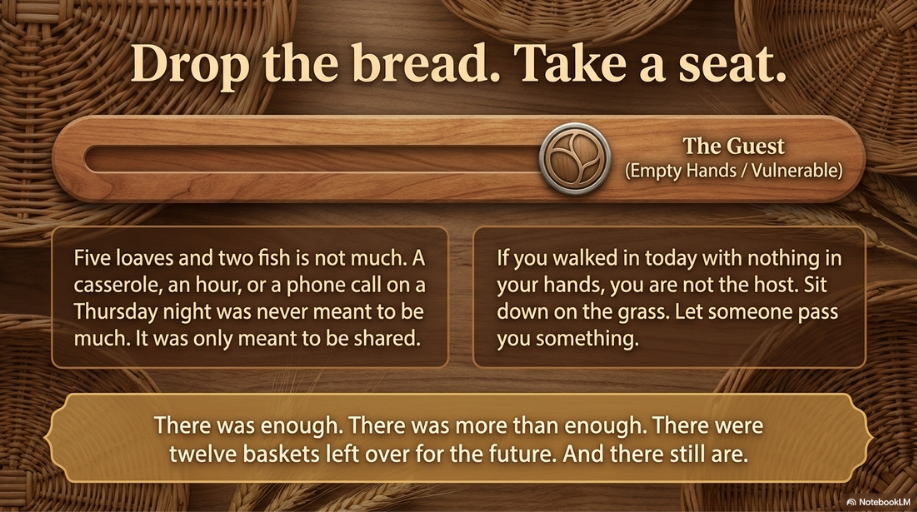
So, bring what you have. Five loaves is not much. Two fish is not much. A casserole, an hour, a phone call, a chair at your table on a Thursday night when somebody is eating alone again. It was never meant to be much. It was meant to be shared.
REFLECTION
What does it mean that Jesus blesses and breaks before he gives, and that the same four verbs return at the Last Supper? What small thing are you holding back because you are convinced it is too small to matter? Name one loaf or one fish you could put in Jesus’ hands this week for someone outside your circle.
PRAYER
Jesus, you took what little they had and you did not apologize for its size. Take ours too: our short hours, our thin patience, our five loaves of ordinary ability. Bless it, break it, and give it away through us. Amen.
Day Four: A Kingdom Asks. A Kinship Asks.
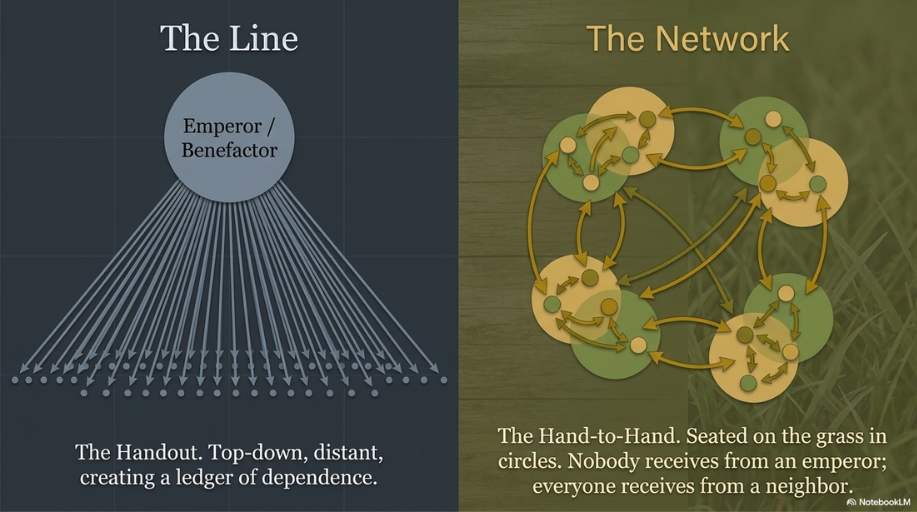
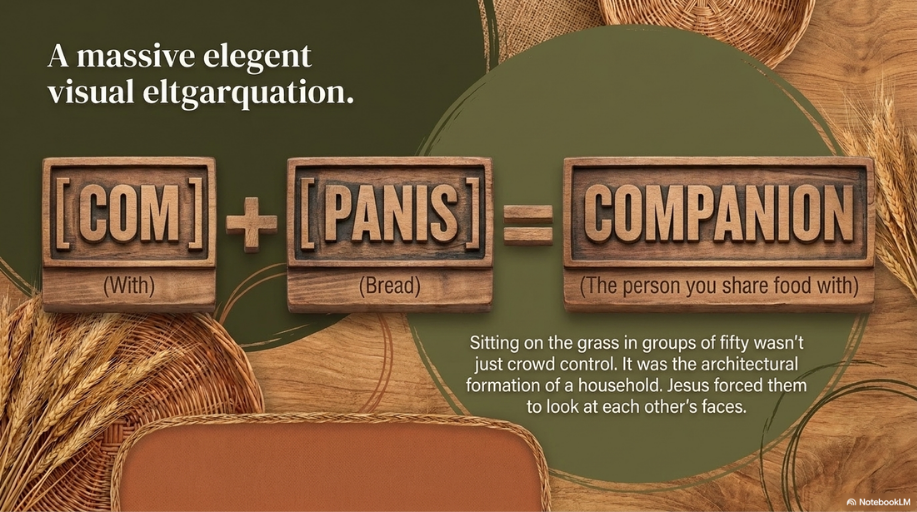
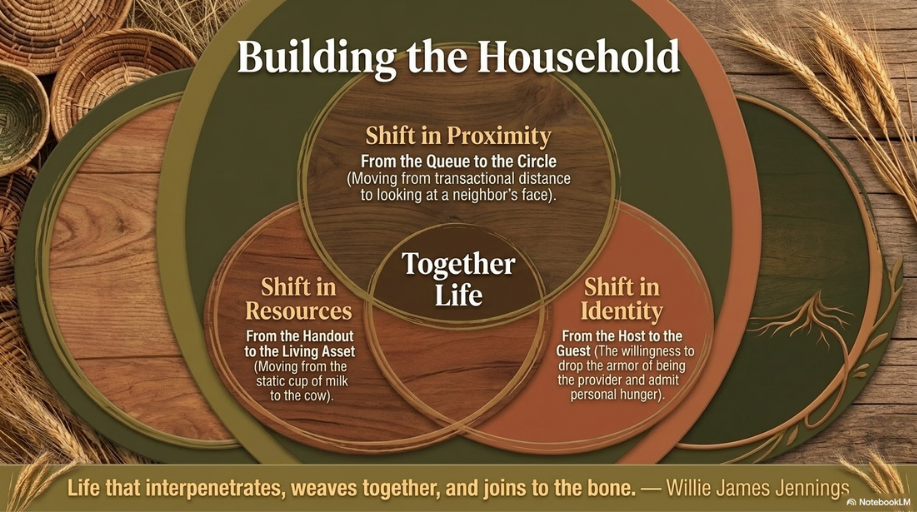
Look at how Jesus does it. He tells the people to sit down on the grass, and Mark tells us they sat in groups of hundreds and fifties. Not a bread line. Not a queue at a distribution point. Circles small enough to see a face, small enough to pass something yourself. Our word companion comes from exactly there: com panis, the person you share bread with. Bruce Malina noted that in Jesus’ world only two institutions stood on their own, politics and kinship, so when Jesus spoke of the kin-dom of God nobody heard an abstraction. They heard a claim about which of the two they now belonged to. Jesus puts the bread into the disciples’ hands and makes them walk it out. Nobody receives from a distance or an emperor. Everybody receives from a neighbor.
SCRIPTURE
“So we, who are many, are one body in Christ, and individually we are members one of another.” (Romans 12:5)
FROM THE SERMON
A kingdom asks: who is over you? A kinship asks: who are you responsible for?
REFLECTION
If the church is a kinship rather than a kingdom, what changes about how we make decisions and share resources? Willie James Jennings calls us to a life that “joins to the bone.” Who are you joined to at that depth, and who are you merely near? Whom is God asking you to be responsible for, and what is the first concrete step?
PRAYER
Holy Spirit, you are still making strangers into a household. Move us past proximity and politeness into the kind of belonging that costs us something. Put the bread in our hands and make us carry it to the person sitting next to us. Amen.
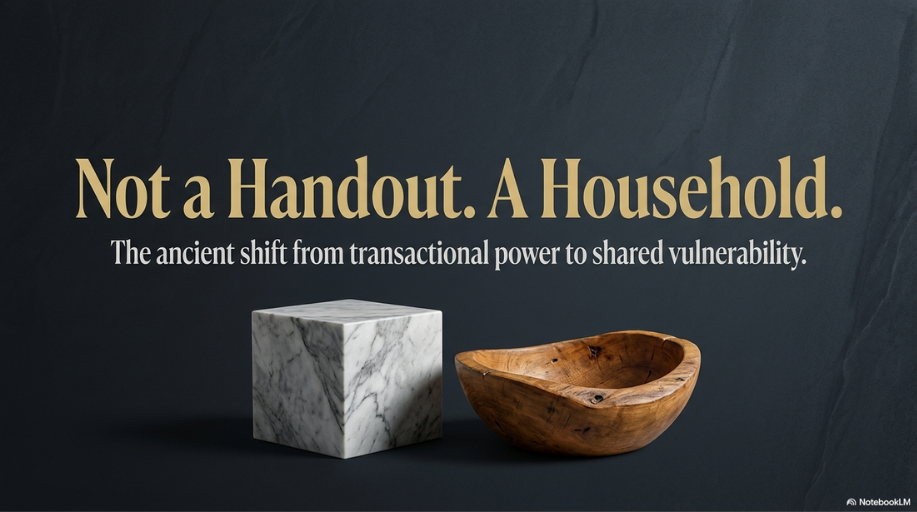
Day Five: Not a Handout. A Household.
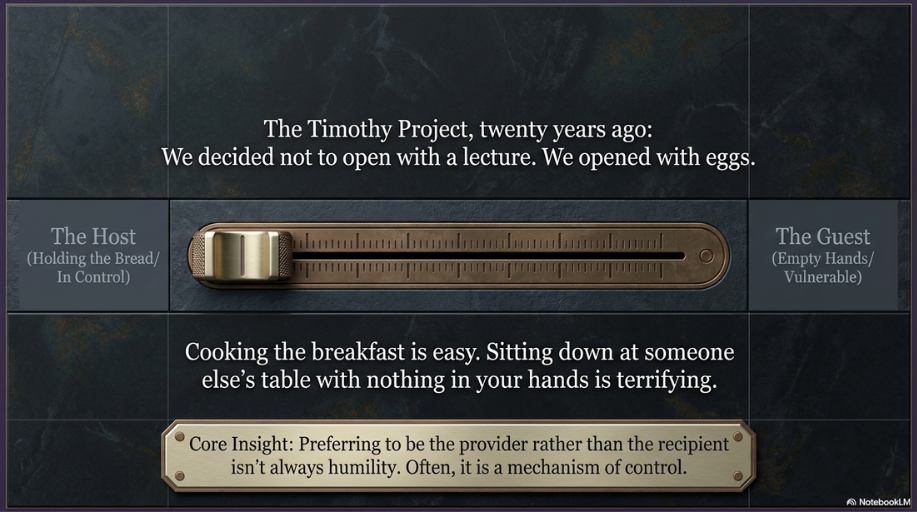
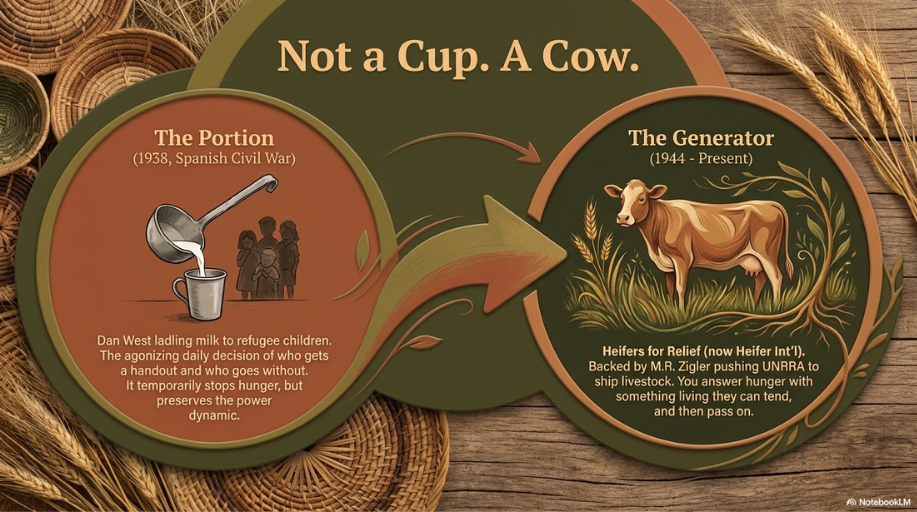
In 1938 a Church of the Brethren relief worker named Dan West stood in Spain ladling cups of milk to refugee children, deciding every day who got a cup and who did not. Somewhere in that line he thought: these children do not need a cup, they need a cow. The first heifers shipped in 1944, and Heifer International was born on a simple conviction: you do not answer a family’s hunger with a portion, you answer it with something living they can tend and then pass on. That is the difference between a handout and a household. But there is one more turn, and it is the hardest one. Preferring to be the host is not always humility. Sometimes it is control. As long as you are the one carrying the bread, you never have to admit that you are hungry too. Today you may not be the host. You may be the guest.
SCRIPTURE
“All who believed were together and had all things in common. Day by day they broke bread at home and ate their food with glad and generous hearts.” (Acts 2:44, 46)
FROM THE SERMON
And if you walked in with nothing at all in your hands, hear the better news. You are not the host today. You are the guest. Sit down on the grass and let somebody pass you something.
REFLECTION
Why does the gospel insist that receiving is as holy as giving? What would you have to let go of in order to accept something you genuinely need from another person this week? Who around you has been handed cups when what they need is a cow, and what would it take for your household to help them tend it?
PRAYER
Gracious God, we would rather provide than need, and you know it. Loosen our grip. Teach us to sit down on the grass with empty hands and receive. Then send us out with full baskets into a world that is still hungry. Amen.
Not a Handout. A Household.
Small Group Discussion Guide | Matthew 14:13-21
Pleasant Valley Church of the Brethren | Pastor Harry Jarrett
Summary
Matthew 14 sets two banquets side by side. Herod throws a birthday party in a palace that ends with John the Baptist’s head carried in on a serving platter. Then Jesus, grieving his cousin, withdraws by boat to a deserted place and finds a crowd waiting for him on the shore. He has compassion on them. When evening comes, the disciples offer the reasonable solution: send the crowds away so they can buy food for themselves. Jesus answers with eight words that overturn the arrangement: they do not need to go away, you give them something to eat.
In the Roman world, feeding a crowd was never neutral. It was the signature move of an empire, and Caesar advertised his grain distributions on bronze pillars and on coins. Jesus feeds people a different way. He seats them in small circles on the grass, takes what is already in their hands (five loaves and two fish), blesses it, breaks it, and puts it back into the disciples’ hands to carry out. Nobody receives from a distance or from an emperor. Everybody receives from a neighbor. This session explores the difference between a handout and a household, and the harder question underneath it: whether we are willing to be the guest and not only the host.
Opening Prayer
God who sees the crowd and will not send it away, gather us now. We come with what little we have and with more hunger than we usually admit. Open the Scriptures to us, open us to each other, and teach us to share what is in our hands. In the name of Jesus, who took, blessed, broke, and gave. Amen.
Ice Breaker
Think of a meal someone else made for you that you still remember. Who set the table, and what made it stick with you? If you would rather answer the flip side: how comfortable are you being served by someone else, on a scale of one to ten, and why?
Key Verses
- Matthew 14:14 “When he went ashore, he saw a great crowd; and he had compassion for them and cured their sick.”
- Matthew 14:16 “Jesus said to them, ‘They need not go away; you give them something to eat.’”
- Matthew 14:19 “Taking the five loaves and the two fish, he looked up to heaven, and blessed and broke the loaves, and gave them to the disciples, and the disciples gave them to the crowds.”
- Matthew 14:20 “And all ate and were filled; and they took up what was left over of the broken pieces, twelve baskets full.”
- Romans 12:5 “So we, who are many, are one body in Christ, and individually we are members one of another.”
Group Discussion Questions
- Matthew places Herod’s banquet and Jesus’ feeding back to back in the same chapter. What is he trying to show us by putting a palace party that ends in death next to a hillside meal that ends in twelve full baskets?
- Jesus had just lost John and was actively seeking solitude when the crowd showed up. What does it mean that his response was compassion (splanchnizomai, a gut-level word) rather than resentment? What does that reveal about God?
- The disciples’ plan (send them away to buy their own food) was practical and not unkind. Why do you think Jesus rejected it? What is lost when people are sent off to buy what they need?
- Caesar Augustus advertised his grain distributions on bronze pillars, and Rome put the grain supply on its coins. How does knowing that change the way you read this story? What are the modern equivalents of those coins?
- Matthew never tells us the mechanism of the miracle, only that Jesus took, blessed, broke, and gave. Why do you think he leaves it out? Does that omission bother you or free you?
- The sermon put it this way: a kingdom asks who is over you, a kinship asks who you are responsible for. Where does our church function more like a kingdom, and where does it function more like a kinship?
- Willie James Jennings writes that our great challenge is to enact “actual together life, life that interpenetrates, weaves together, and joins to the bone.” What is the difference between a church that is merely friendly and a church that is joined to the bone?
- Dan West looked at a milk line and said these children do not need a cup, they need a cow. Where in our community are we handing out cups when we could be helping people tend something living?
Life Applications
- Set one table. Choose one meal this week to share with someone who would otherwise eat alone. It does not need to be elaborate. A sandwich at a kitchen table counts. Check in: at your next gathering, say who you ate with and one thing you learned about them.
- Bring your five loaves. Identify one thing you are actually holding (an hour, a skill, a spare chair, a working vehicle, a casserole dish) and give it away this week without being asked. Check in: name the loaf you offered and what happened when you handed it over.
- Be the guest once. Let someone do something for you that you would normally insist on doing yourself. Accept the ride, the meal, the help, the prayer. Check in: report how it felt to receive, and be honest if it was uncomfortable.
- Move from cup to cow. Pick one person or family your group knows and ask what would actually help long term rather than just this week. Take one concrete step toward that. Check in: report back on what you learned by asking instead of assuming.
Key Sermon Takeaways
- Compassion came before the command. Jesus saw the crowd and refused to dismiss it before he ever fed it.
- Feeding a crowd was an imperial act in Matthew’s world, and Jesus deliberately does it without a throne, a ledger, or a guest list.
- Jesus never asked for what the disciples did not have. He asked for what was already in their hands.
- The bread traveled hand to hand through small circles so that nobody received from a distance and everybody received from a neighbor.
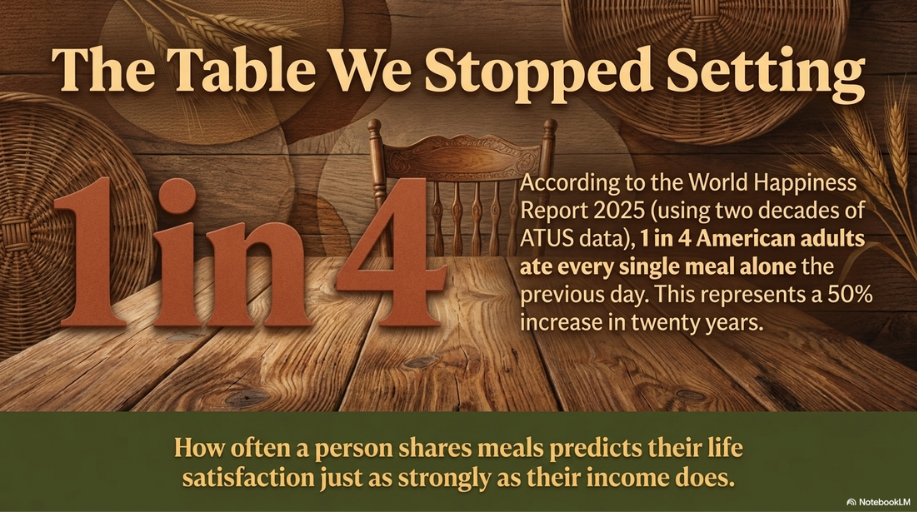
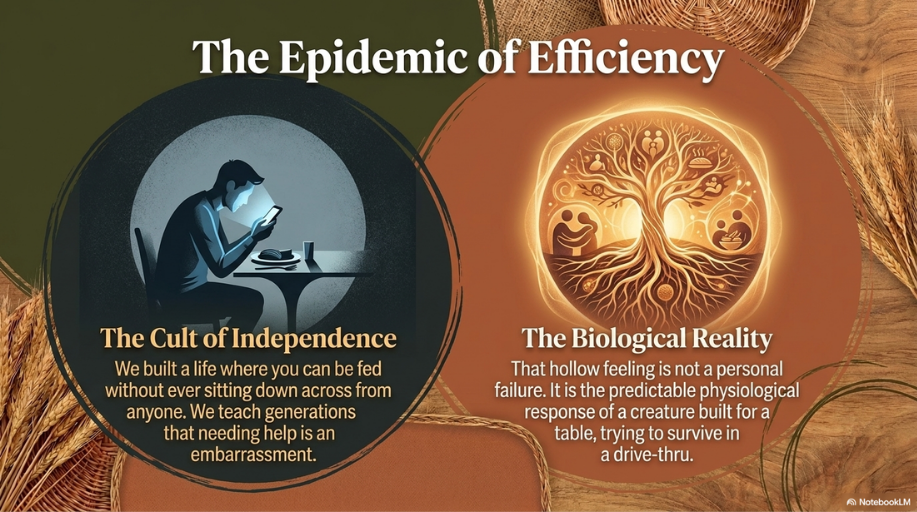
- Sharing meals now predicts life satisfaction about as strongly as income does, and roughly one in four American adults ate every meal alone yesterday. Our loneliness is largely a design choice we can redesign.
- Preferring to be the host can be control rather than humility. The gospel makes us guests before it makes us providers.
- A handout meets today. A household keeps setting the table. There were twelve baskets left over, and there still are.
Closing Prayer
Lord Jesus, you put the bread into ordinary hands and made them carry it to each other. Do that again with us. Make us people who bring what we have, who receive without shame, and who refuse to send anyone away hungry. Go with us in the compassion of the Father, the broken bread of the Son, and the gathering power of the Spirit, who is still making strangers into a household. Amen.