
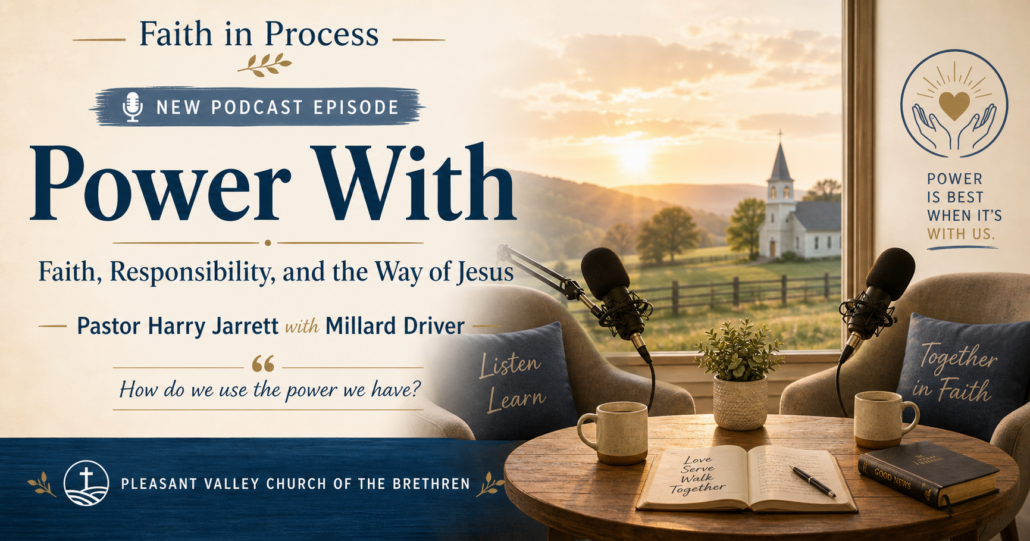
Reflecting on Power with instead of Power Over
I have been thinking about power this week, after my conversation with Millard. He told me yesterday that we didn’t get to everything he wanted to discuss last time, so I imagine we’ll be back to this topic soon. Most of us don’t imagine ourselves as powerful. We know powerful people. We know people with titles, influence, money, authority, or control. We know people whose decisions shape institutions and whose words seem to carry more weight than ours. But most of us, at least most of the time, do not walk around thinking, “I have power.”
In this week’s episode of Faith in Process, I sat down with Millard Driver for one of those wonderfully wandering conversations that somehow begins in one place and ends up touching almost everything. We talked about power, responsibility, faith, parenting, government, teaching, addiction recovery, forgiveness, abuse, Spider Man, Cocaine Bear, and the image of God revealed in Jesus. It was exactly the kind of conversation that led me to start this podcast in the first place.
When I was interviewing to become pastor at Pleasant Valley Church of the Brethren, Millard and Frieda invited me to their home. We sat on the porch, looked out over the sheep, and Millard pulled out a sheet of paper filled with questions and topics he wanted to discuss. That was my introduction to Millard. I quickly learned that lunch with him would rarely be small talk. He would bring questions. He would recommend books. He would tell me what podcast I needed to hear. Then we would talk for a long time.
At some point, I realized that what we were doing over lunch was very much like the podcasts I enjoyed listening to. It was honest conversation between people trying to make sense of faith, life, theology, and the world around us. Faith in Process grew out of those conversations. So it felt right that Millard would be a regular on the podcast. This time he helped us think together about something as big, complicated, and unavoidable as power.
Millard began by talking about the Celtic Christian idea of a “soul friend.” He said everyone ought to have at least one. A soul friend is someone with whom you can have the real conversation. Not the polite version. Not the shallow version. The real one. The kind of conversation where you can say what you think, ask what you fear, disagree honestly, and still remain friends. I think that kind of friendship is itself a form of power, not power over another person, but power with another person. It is the shared power of trust.
That became one of the major distinctions in our conversation: power over and power with.
Power over is the kind of power most of us notice first. It is authority. It is control. It is the ability to make something happen because we have the position, the role, the law, the leverage, or the force to make it happen. Sometimes that kind of power is necessary. We talked about speed limits, for example. A community gives the state authority to set rules for the common good. If someone drives recklessly, there are consequences. That is power over, and in that case it can be used to protect life.
But power over can so easily become dangerous. It becomes dangerous when it serves the one who has the power at the expense of the one who does not. It becomes dangerous when it is coercive, manipulative, self-serving, or abusive. It becomes dangerous when it forgets the humanity of the person on the other side. It becomes dangerous when the question is no longer, “What serves the good of the other?” but “How can I get what I want?”
That is where the conversation became theological for me. Millard said his interest in power has to do with his image of God. That line has stayed with me. Our understanding of power is always connected to our understanding of God. If we imagine God primarily as the one who controls, dominates, punishes, and coerces, then we may be tempted to believe that divine power looks like force. But if we look at Jesus, we see something different.
In Jesus, power looks like healing. Power looks like washing feet. Power looks like telling the truth without destroying the person who needs to hear it. Power looks like forgiving from the cross. Power looks like refusing to answer violence with violence. Power looks like love that persuades rather than coerces. Power looks like an invitation, not domination.
That does not mean Jesus is weak. It means Jesus reveals a different kind of strength.
This matters because we are created in the image of God. If God’s power is revealed most clearly in Jesus, then our use of power is meant to be shaped by Jesus, too. We all carry power because we all carry the image of God. The question is not whether we have power. The question is how we will use the power we have.
That may be the most important sentence I took from the conversation: we all have power.
Some of us have power because of our job. Some have power because of age, gender, race, education, income, family position, personality, experience, or reputation. Some have power because they can speak easily in a room. Some have power because others trust them. Some have power because they have survived something and can now help another person survive it too. Some have power because they know how systems work. Some have power because they have learned how to listen.
And some people who feel powerless still have more agency than they realize.
That does not mean everyone has equal power. They do not. It does not mean systems of abuse, injustice, racism, sexism, poverty, or coercion are imaginary. They are not. It does not mean we should tell harmed people, “You have power, so just fix it.” That would be cruel. But it does mean that one of the most loving things we can sometimes do is come alongside someone and say, “You are not nothing. You are not alone. You are not without value. You are not without voice. You have power, and we will help you find a safe way to use it.”
During the conversation, someone brought up a hypothetical situation involving a professor abusing power over a student. That shifted the tone of the room. It should have. There are some uses of power that are not merely unfortunate or complicated. They are wrong. When a person uses their position to manipulate someone with less power for their own benefit, that is abuse. It is coercive. It is self-serving. It is a violation of trust.
In that moment, I found myself thinking less about abstract definitions and more about community. What does a faithful community do when someone is being manipulated, threatened, silenced, or harmed? We do not simply offer ideas. We create safety. We tell the truth. We protect the vulnerable. We help people know what resources exist. We stand with them so they are not alone. We use whatever power we have to interrupt the misuse of power.
That, I think, is one of the clearest callings of the church.
The church should be a community where power is named honestly. Pastors have power. Teachers have power. Parents have power. Longtime members have power. People with money have power. People with strong opinions have power. People who know the history of the congregation have power. People who control keys, calendars, kitchens, microphones, committees, and conversations have power. None of that is automatically bad. But all of it carries responsibility.
Unrecognized power is often the most dangerous kind. When we do not know we have power, we may use it carelessly. We may intimidate without meaning to. We may silence without noticing. We may assume our preferences are neutral. We may confuse our comfort with faithfulness. We may hurt people and then be shocked when they tell us they were hurt.
That is why awareness matters. It is why humility matters. It is why confession matters. It is why listening matters.
One of the lighter moments in the episode came when I compared irresponsible power to Cocaine Bear. I will admit that is not a metaphor I expected to use in Sunday school. But it worked, at least for me. The image is absurd, but memorable: a bear under the influence, crashing through the world, causing harm without any real awareness of what it is doing. That may be an extreme picture, but it raises a serious question. What happens when people with power are out of touch with themselves, their motives, their fears, their wounds, and their impact on others?
They may not intend harm. But they can still do harm.
That is where Richard Rohr’s Everything Belongs entered the conversation. I had been listening to Rohr talk about contemplation and the true self. The contemplative life helps us stop trying to control everything. It helps us become less reactive, less manipulative, less driven by fear. It helps us see ourselves truthfully, which may be one of the first steps toward using power faithfully.
If I do not know what is happening inside me, I will likely use power poorly. If I am afraid, I may try to control. If I am insecure, I may try to dominate. If I am ashamed, I may try to shame someone else. If I am anxious, I may confuse urgency with wisdom. If I am wounded, I may wound. The spiritual life does not remove power from us. It teaches us how to hold power without letting it deform us.
That is why Jesus matters so much here.
Jesus does not simply teach us what to believe. Jesus shows us how to be human. He shows us how to live with power without turning it into domination. He shows us how to speak with authority without using that authority to crush people. He shows us how to confront evil without becoming evil. He shows us how to forgive without pretending harm does not matter. He shows us how to resist empire without becoming another version of empire.
The cross is the clearest picture of that kind of power. Rome used the cross as an instrument of terror. It was power over in its most brutal form. It was the empire saying, “This is what happens to people who challenge us.” And yet Jesus, from the cross, speaks forgiveness. He refuses to let Rome define the meaning of the moment. He does not answer violence with violence. He reveals a power that empire cannot understand and cannot finally defeat.
That is not weakness. That is the power of God.
So I am left with a question that feels both simple and searching: how do I use the power I have?
How do I use power as a pastor? How do I use power as a husband, father, friend, employer, landowner, writer, and person with a microphone? How do I use power when I am leading a meeting, preaching a sermon, writing an article, asking a question, making a decision, or telling a story? How do I use power when I am tired, anxious, disappointed, or afraid? How do I use power when I think I am right?
That last question may be the most dangerous one. Most of us do not misuse power because we wake up hoping to be villains. We misuse power because we believe we are right, or because we are scared, or because we think the ends justify the means, or because we have never stopped to consider what it feels like to be on the other side of us.
Faith invites us to stop and consider.
Not so we can deny our power, but so we can consecrate it. Not so we can pretend power is always bad, but so we can offer it to the way of Jesus. Not so we can become passive, but so we can become responsible. Not so we can avoid influence, but so our influence becomes loving, truthful, creative, and life-giving.
Power over asks, “How can I get the final word?”
Power with asks, “How can we seek the good together?”
Power over asks, “How can I make you do what I want?”
Power with asks, “How can I use what I have to help life flourish?”
Power over protects itself.
Power with makes room.
Power over coerces.
Power with invites.
Power over can build fear.
Power with can build trust.
I do not think I will ever be done processing this. Maybe that is why it belongs on Faith in Process. The goal is not to settle every question in thirty-six minutes. The goal is to become more honest, more aware, and more faithful as we ask the questions together.
We all have power.
The question is whether we will use it like Jesus.


